Looking for Dutch usage guides in the context of the Bridging the Unbridgeable project has not been easy or productive. Asking around didn’t produce any titles, nor did I come across any in bookshops which I visited regularly across the country. Until recently, when I visited Rotterdam’s iconic bookshop Donner. There, I came across Friederike de Raat’s Een boek vol taalfouten (“a book of language errors”), subtitled “Moeilijke taalkwesties nu eindelijk goed uitgelegd!”, which might be translated somewhat freely as “the definitive guide to tough usage problems”.
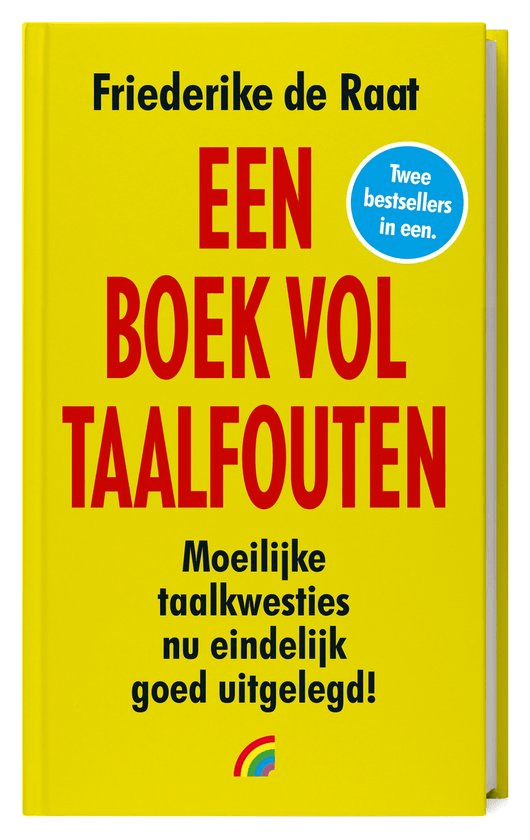
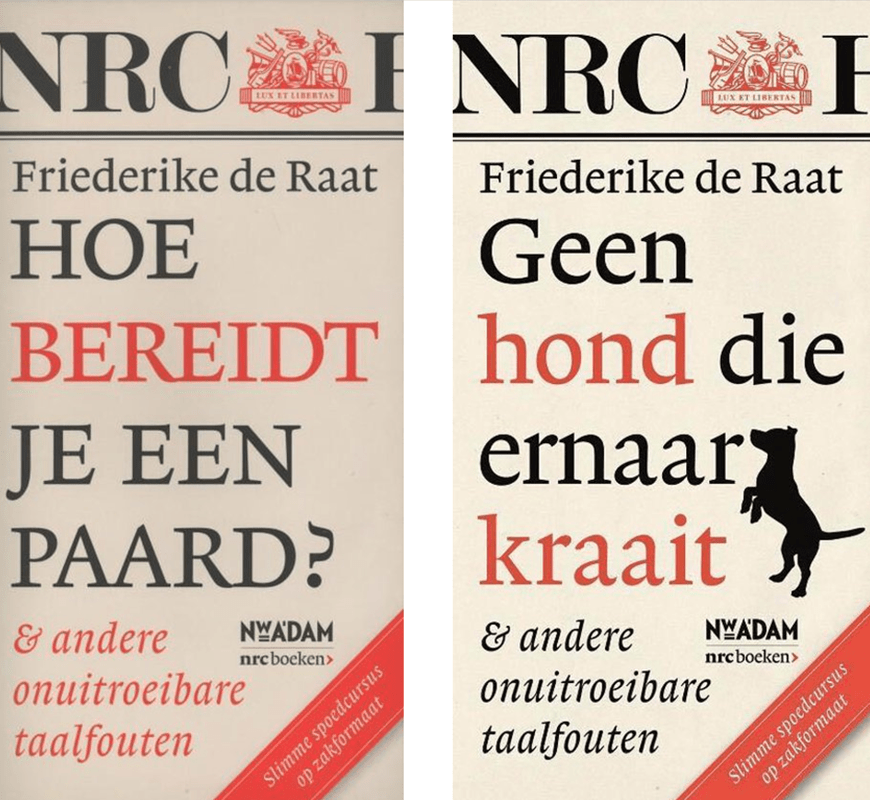
Having bought it and having meanwhile read it from cover to cover – yes, I really did! – I decided to contact the author to see if she might be interviewed for the Language Law and Order podcast, upon which her first reaction was that she hadn’t written the book. Huh? Her name is on the title page! Further prodding produced the explanation that the book was a publisher’s project, combining two earlier publications by her, Hoe bereidt je een paard and Geen hond die ernaar kraait. (Apologies for not translating these untranslatable tongue-in-cheek titles …) Two publications issued by quality daily newspaper NRC Handelsblad, and still available (the pair) at four times the price of the combined publication I happened to come across.
A very good buy in other words (also because it is highly readable and provides excellent usage advice). But more so because it proved to answer a number of questions I have had for a long time (and which I dealt with in a comparative paper on English, Dutch and German usage guides at last year’s prescriptivism conference in Aix-en-Provence). I have been trying for years to find out about linguistic letters-to-the-editor in Dutch newspapers, and never managed to get through. Not only me as a scholar failing to get through, but particularly such letters, which do get sent (as in the English tradition) but don’t tend to make it into the papers (unlike the English tradition). Well, to be fair, my focus has been on NRC Handelsblad only, which I read and check every day, and when they do get through I publish them on this blog (here is just one example, but there are not even a handful of them).
So to my surprise, Een boek vol taalfouten proves to be a discussion – and perceptive analysis – of usage issues the author, Friederike de Raat, used to come across in her days as editor of the newspaper, that is as an editor, but also in letters of complaint the paper received from the general public (she regularly refers to them in her book). To me, this is great news, not only as an acknowledgement of the fact that the phenomenon of the linguistic letter-to-the-editor does exist in this country, even though such letters rarely get published, but that someone took the trouble to collect them and write about them in two accessible books that are still available.
The copy I bought and read combines these two, and even if the author herself wasn’t involved in its publication, I would definitely recommend it to anyone wanting a good analysis of common usage issues. and is in need of very sensible usage advice as well. There are fifty of them, which are all still topical. They’re all carefully analysed and based on actual usage, and described in a highy appreciated lighthearted tone. Very readable in other words.
What finally also struck me, again in the light of the paper I gave on the topic last year, is that there is a reference to Charivarius, an iconic usage guide writer whose Is dat goed Nederlands? first got published in 1940 (with a facsimile edition with highly informative introduction issued by Wim Daniëls appearing in 1998), but is all but forgotten today, Not so, it turned out. So thank you for that, Friederike, as well!
Acknowledgement: the image are from bol.com (though I would suggest to order copies from your local bookshop instead).
Bonusvraagje voor de Nederlanse lezers van dit blog: hadden jullie wel eens van dit boek gehoord? (Ik blijf het proberen!)


 Bridging the Unbridgeable