Perhaps my favourite St Nicholas present this year (ok, I also got the latest Asterix and Obelix comic, as well as the first ever Jane Austen graphic novel and lovely house socks, so hard to choose actually) was Richard Osman’s latest Thursday Murder Club novel! I’m a huge fan, so I read The Impossible Fortune straight away, not planning to use a pencil as I went through it. But sure enough, I found two usage issues, lay for lie in a crucial text message (I have to lay low for a while, p. 330, a repetition of the same message earlier in the book) and a whom for who when Joyce picks up the phone (whom is calling, please?, p. 357). As well as a comment on grammar, on the use of a flat adverb:
“Doesn’t he talk nice?” says Davey.
Ibrahim agrees. With the sentiment, if not the grammar (p. 370).
(Don’t want to explain who the characters are, though every fan will of course recognise Ibrahim. But the usage issue fits the speaker, that much I can say.) The whom for who example I found a bit over the top to be honest, and checking the sentence in Google n-gram produced virtually no instances in British English for the last couple of years (more for AmE though, and increasing …). But the who/whom issue is one Richard made use of before, as I discussed earlier on in this blog.
Perhaps though you don’t agree with me! And because I’m curious, please let me know by filling out this mini-poll.
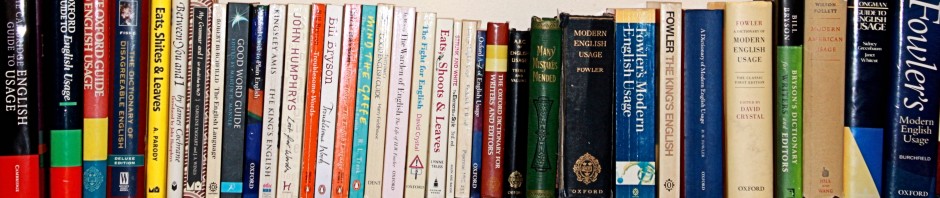
Thank you, Joan Beal, for responding to my call for pictures of works on language in bookshops! Bascially, the question is to see whether usage guides are displayed at all, as somethimes they are, and often enough not. This picture was taken at the small FNAC shop at the Gare Montparnasse. “Not much there,” Joan commented, “but still more than I’d expect at a station shop.”
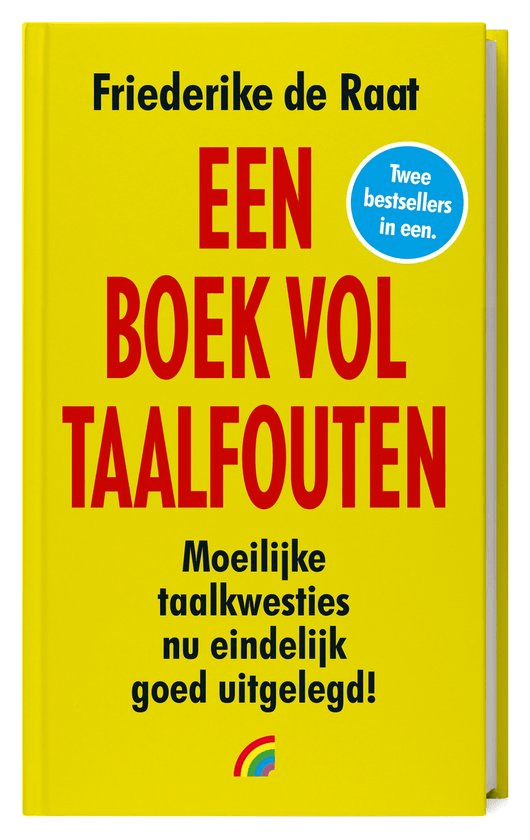
Looking for Dutch usage guides in the context of the Bridging the Unbridgeable project has not been easy or productive. Asking around didn’t produce any titles, nor did I come across any in bookshops which I visited regularly across the country. Until recently, when I visited Rotterdam’s iconic bookshop Donner. There, I came across Friederike de Raat’s Een boek vol taalfouten (“a book of language errors”), subtitled “Moeilijke taalkwesties nu eindelijk goed uitgelegd!”, which might be translated somewhat freely as “the definitive guide to tough usage problems”.
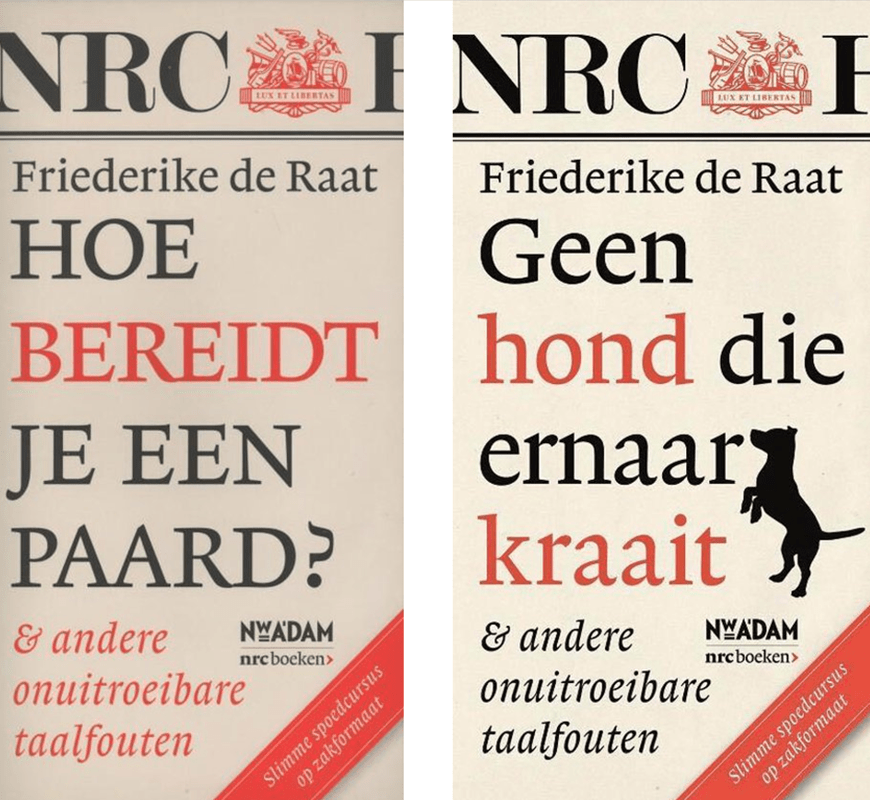
Having bought it and having meanwhile read it from cover to cover – yes, I really did! – I decided to contact the author to see if she might be interviewed for the Language Law and Order podcast, upon which her first reaction was that she hadn’t written the book. Huh? Her name is on the title page! Further prodding produced the explanation that the book was a publisher’s project, combining two earlier publications by her, Hoe bereidt je een paard and Geen hond die ernaar kraait. (Apologies for not translating these untranslatable tongue-in-cheek titles …) Two publications issued by quality daily newspaper NRC Handelsblad, and still available (the pair) at four times the price of the combined publication I happened to come across.
A very good buy in other words (also because it is highly readable and provides excellent usage advice). But more so because it proved to answer a number of questions I have had for a long time (and which I dealt with in a comparative paper on English, Dutch and German usage guides at last year’s prescriptivism conference in Aix-en-Provence). I have been trying for years to find out about linguistic letters-to-the-editor in Dutch newspapers, and never managed to get through. Not only me as a scholar failing to get through, but particularly such letters, which do get sent (as in the English tradition) but don’t tend to make it into the papers (unlike the English tradition). Well, to be fair, my focus has been on NRC Handelsblad only, which I read and check every day, and when they do get through I publish them on this blog (here is just one example, but there are not even a handful of them).
So to my surprise, Een boek vol taalfouten proves to be a discussion – and perceptive analysis – of usage issues the author, Friederike de Raat, used to come across in her days as editor of the newspaper, that is as an editor, but also in letters of complaint the paper received from the general public (she regularly refers to them in her book). To me, this is great news, not only as an acknowledgement of the fact that the phenomenon of the linguistic letter-to-the-editor does exist in this country, even though such letters rarely get published, but that someone took the trouble to collect them and write about them in two accessible books that are still available.
The copy I bought and read combines these two, and even if the author herself wasn’t involved in its publication, I would definitely recommend it to anyone wanting a good analysis of common usage issues. and is in need of very sensible usage advice as well. There are fifty of them, which are all still topical. They’re all carefully analysed and based on actual usage, and described in a highy appreciated lighthearted tone. Very readable in other words.
What finally also struck me, again in the light of the paper I gave on the topic last year, is that there is a reference to Charivarius, an iconic usage guide writer whose Is dat goed Nederlands? first got published in 1940 (with a facsimile edition with highly informative introduction issued by Wim Daniëls appearing in 1998), but is all but forgotten today, Not so, it turned out. So thank you for that, Friederike, as well!
Acknowledgement: the image are from bol.com (though I would suggest to order copies from your local bookshop instead).
Bonusvraagje voor de Nederlanse lezers van dit blog: hadden jullie wel eens van dit boek gehoord? (Ik blijf het proberen!)
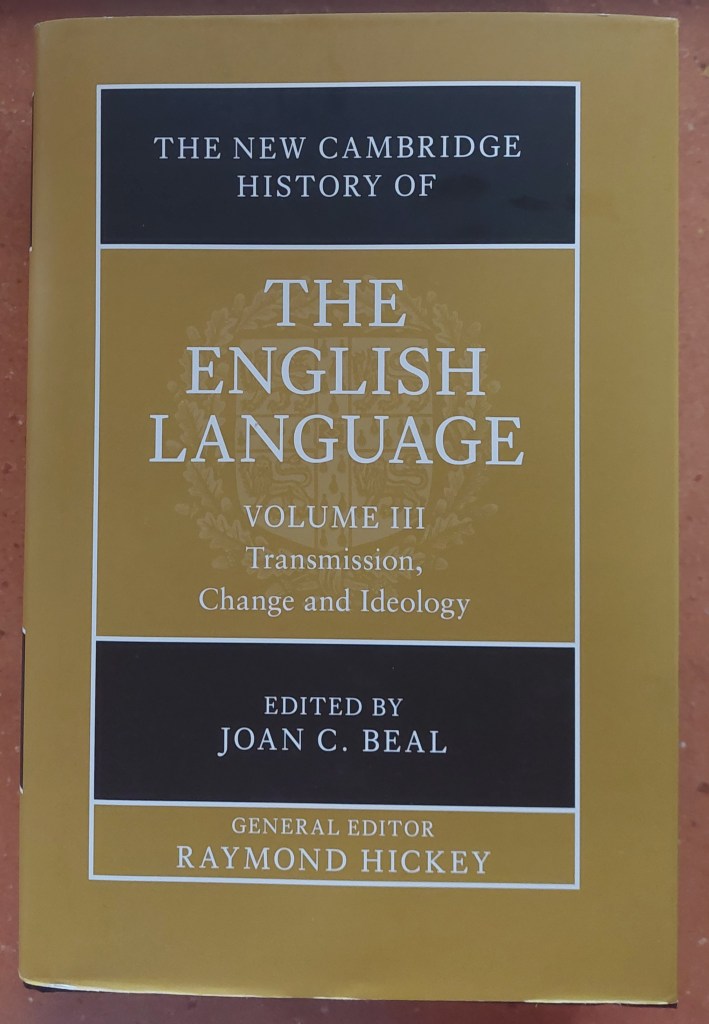
Congratulations, Joan Beal (editor) and Raymond Hickey (general editor)! A major new publication, up to date and with a large array of topics by established scholars on the history of the English language. This is Volume III, which consists of three parts, includes 27 chapters (not counting the two introductions) by 33 authors (including a chapter on prescriptivism by Don Chapman), and it weighs nearly a kilo and a half! In other words: a must-buy and definitely a must-read!
Next year is a Fowler year. The Fowler year, when we will be commemorating the 100th anniversary of his Modern English Usage. We’re definitely looking forward to it! Anticipating 2026 in this light, Bryan Garner, author of OUP’s well-known Garner’s Modern English Usage, devoted his November 2025 column in the online National Review to a reconsideration of Fowler. Thank you, Bryan, for allowing us to share your column on Fowler with our readers!
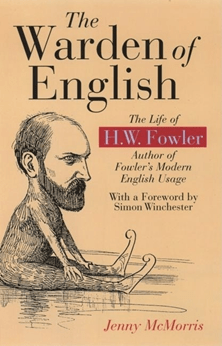
Next year, 2026, will be a Fowler year, just like this year is a Jane Austen year. In Henry Fowler‘s case, 100 years after the publication of his phenomenal Modern English Usage. So I’m looking for Fowler narratives, stories about the man and the book that wouldn’t normally go into a biography, of which I would definitely recommend the late Jenny McMorris’s Warden of English.
Of real interest would be Ben Yagoda’s article “The Autocrat of English Usage“, which appeared in The New Yorker a couple of weeks ago (you have to be a subscriber to be able to read it, which I am not so cannot unfortunately – but see comment below, with thanks to Matjaž Zgonc!).
There may well be more like this around, so do let me know! Also, let me have your Fowler narratives please – I’ll be terribly interested to read them.
Please note: for articles behind paywalls, this tool is recommended: https://www.smry.ai/ It is not really AI and it won’t simply generate summaries. It just removes the effects of the paywall most of the time.
For a presentation next week, I’d like to have some preliminary data about my research question in the heading of this post. Do you use Fowler’s Modern English Usage? So here come some specific questions:
If you use Fower, what do you use the book for? To consult it on doubtful issues of usage? To win annoying arguments at dinner about who is right and who isn’t about a particular usage question? (This is what one of my earlier informants once told me …) For research? For other reasons? If so, please specify.
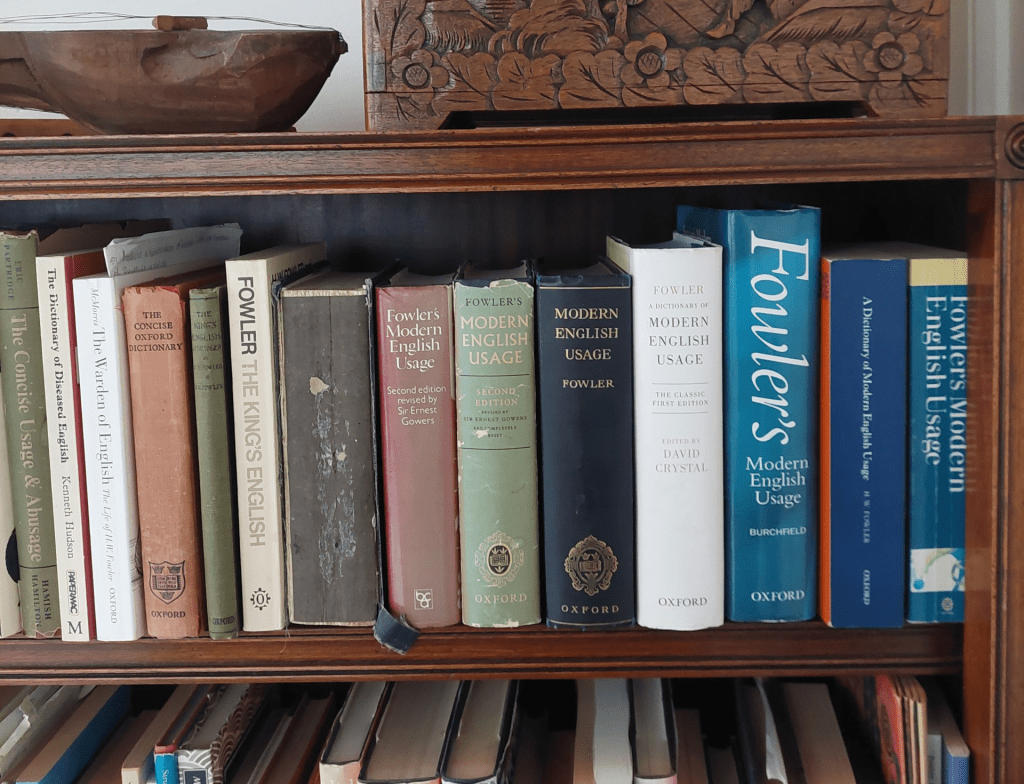
If you do use Fowler, which edition do you consult? I myself own various editions of Modern English Usage, mostly from second-hand bookshops, where I couldn’t resist picking up a copy that went for only a pound or a euro. And even though we recently moved house (and had to cut down on shelf space) I decided to keep them all.
Would you be willing to discuss Fowler with me privately to help me get an insight into why people use Fowler, what you use the book for, and how useful you thought the advice was?
It is particularly your stories I’m interested in! They would be extremely valuable to me for my research. So please respond!
Last night on the 8 o’clock news: a new gadget was introduced that warned users if a stalker would come too close. A woman was interviewed anonymously about the advantages of wearing such a gadget, saying how happy she was with the police monitoring it all in the background. “Gelukkig dat hun het allemaal screenen,” she said. For some unclear reason, the text was subtitled, and for another unclear reason, the speaker’s non-standard use of hun as the subject pronoun, a shibboleth in Dutch, had been edited out:
“Gelukkig dat zij het allemaal screenen,” the subtitle read.
My request for information and images of how bookshops in other cities than the ones I frequent promote prescriptivism, and in particular usage guides, has met with a response! Thank you, Matjaž Zgonc, for your pictures of the linguistics section from Slovenia’s major bookstore knjigarna konzorcij, in Ljubljana. Matjaž is a regular contributor to this blog, and I’m really grateful for his input to my new LLinB project. I hope it will set an example!
So here are his pictures and a brief description of what he found:
‘The section is divided into subsections corresponding to languages as well as a “linguistics” section, which is actually linguistics of Slovenian. The other section titled “learning of Slovenian” učenje slovenščine contains materials for L2 learning. In fact, all the sections, including the one for English, contain exclusively learning materials for L2 (or LX) learners, mostly coursebooks and exercise books that would, or indeed are, used in the state education system. The “linguistics” section contains materials for “improving” Slovenian as L1, namely exercise books containing orthography and grammar exercises. All of them are retellings of the official, state (academia) licensed normative texts. Some of them are pedagogical and some andragogical. There are also two scientific treatises available. In any case, no usage guide in sight.
I labeled the photos of interest for the project with languages that the exercise books there contain. I must stress that this is not only a major bookstore, it is also typical in that most other smaller bookstores will contain a very similar repertoire of books on linguistics, only smaller.
To me, this seems to be one of the more striking differences between presctiptivism landscapes in Slovenia and the UK, for example – namely that private prescriptive enterprise does not engage in producing unique works where the author’s or some other version of Slovenian would be promoted – it is rather the licenced, sponsored version of the standard that is contained in those works, together with loads of exercises.’
It occurred to me that what I’m doing with this project is similar to what Yorick van Norden did for his book The Platenkast van Paul McCartney (“Paul McCartney’s record collection”) which came out earlier this year. Except that my project is a linguistic one. But we both have in common that reading the spines of records (in his case) or books (in my case) is not always easy.
So here we go again. Yesterday I happened to be in Delft, which houses The Netherlands’ best-known technical university and of course the home of Vermeer.
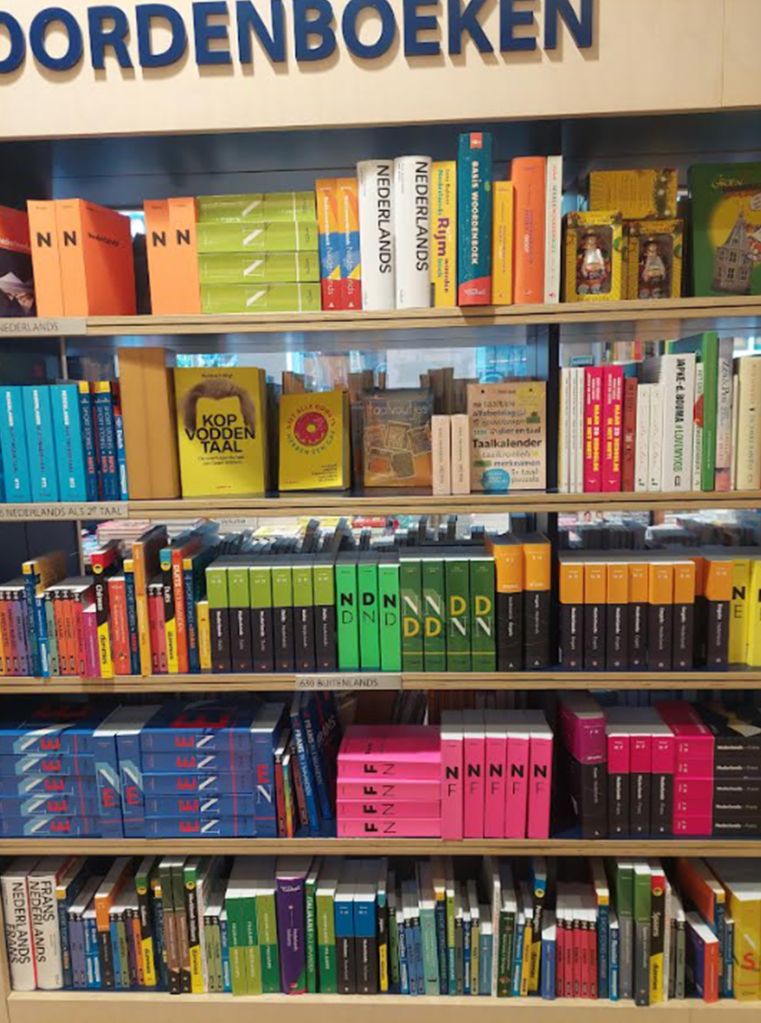
Very surprised at what I found in Paagman, situated near the Grote Kerk in the city centre, and a bookshop I was only familiar with in The Hague. A huge language section, which even included images of Haagse Harry (statuettes and Christmas decorations no less) that would be more suitably displayed in a bookshop in The Hague (and most likely are).
An impressive array of dictionaries in multiple languages, as well as a large selection of guides for learning foreign languages, including Greek (very hard to find when I embarked on the language two years ago) and Croatian (in Dutch as well as English).
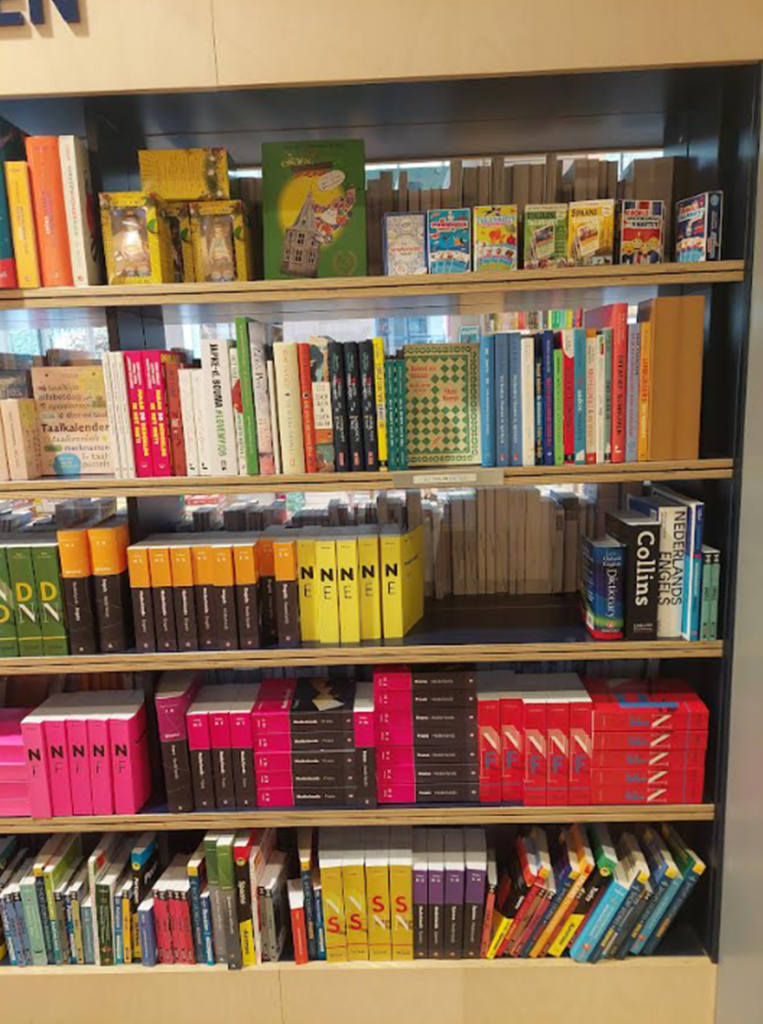
The second picture shows a whole shelve of – again – taalboekjes, on various topics, as well as writing guides. No usage guides here, unfortunately, neither for Dutch nor for English.




 Bridging the Unbridgeable