Drownded: read drowned

Perhaps the most interesting irregular verb form I found in my analyse of the usage guides in HUGE (for a paper I’m giving next week on the topic) is drownded. The only usage guide in the HUGE database that mentions it is Garner’s Dictionary of Modern American Usage (1998), which labels it as dialectal. The word has a separate entry, and here is Garner’s example, in which the offending form is corrected into proper English:

“True, [the flooding] helped duck and geese populations, but it also drownded [read drowned] millions of other living creatures who weren’t favored targets.” “Hunters Are Not Really a Tool of Nature,” Buffalo News, 14 Feb. 1993, at 8.

I checked the Corpus of Contemporary American English as well as the Corpus of Historical American English, and found 17 instances in COCA (all of them either classified or classifiable as fiction or spoken usage). COHA produced 169 instances, though with peaks in the 1880s and 1920s and only single instances for the 1990s and the 2000s. (Which raises the question of whether COCA is included in COHA – probably not given the respective sizes of the two corpora.) If usage is rare today, why did Garner include it? If usage is indeed dialectal, as he suggests, it need not be a usage problem, so why?

How about British English then? The British National Corpus includes five instances, three from dialect produced in fiction, one from real speech and one from children’s writing. Is drownded a form that children produce when overgeneralising irregular verbs? If so, they will very likely get corrected by adults around them. Drownded may be dialectal in British English and characteristic of children’s language, but it is not a usage problem.

Amazingly, I just came across another instance of drownded, in John Banville‘s latest novel, The Blue Guitar (2015), which I happened to be reading:

As we went along he [an “Old MacDonald” type of farmer] told me with relish of a suicide committed in this place years ago. “Drownded himself, he did, after his girl jilted him.”

The novel is written in the form of interior monologue, either in the protagonist’s head or on paper, as a diary. The old farmer isn’t given more than one or two lines of speech, but evidently, making him say drownded was enough as a linguistic characterisation of this marginal character. In this light it is striking that we find whom all over the place in the novel – always used correctly, but to my mind the form a bit of a stylistic incongruity, and I stumbled over it every time. I’m interested in literary authors’ awareness of issues of prescriptivism. Would the novel’s copy-editor have had a hand in this or is this Banville himself?

Finally, I couldn’t resist googling the word, and here are some of the things I found:

  • simple past tense and past participle of drownd (Wiktionary): so a new verb is born, to drownd!
  • Same thing as drowned, hick style. (Urban Dictionary): hick is defined as “A derogatory slang term for lower class whites raised in rural areas, usually within trailer parks or hog farms. Generally used more for Midwesterners than Southerners” (also Urban Dictionary). Dialectal, in other words, socially as well as geographically.
  • Is drownded a word? (English Language & Usage, a self-moderated blog): interesting discussion, which draws on the OED and produces a Google N-gram image showing the “heyday” of drownded as coming between 1850 and 1950 (compared to drownd, past tense, I suppose).

What do readers of our blog think? Is drownded a word, should it be treated as a usage problem in British English, too? Do we hear it more today, as the person raising the question on English Language & Usage says? Was Garner right in including (and proscribing) the form?

Posted in usage features | Tagged , , | 12 Comments

Happy birthday, Janet Whitcut!

Though none of us in the Bridging the Unbridgeable project has ever met Janet Whitcut, her work is nevertheless very important to us. Janet is the author, together with Sidney Greenbaum, of The Longman Guide to English Usage (1988). Jointly, they revised Sir Ernest Gowers’s Complete Plain Words, which was published by His Majesty’s Stationary Office in 1986; a third edition came out the year after that (Penguin). The Longman Guide is one of the 77 usage guides in our HUGE database of usage guides and usage problems, and Janet is one of the 290 people listed in the database.

A few years ago, one of my MA students, Chloe White, decided to write her final paper for the course Testing Prescriptivism on the Longman Guide to English Usage. She tried to find out who Janet Whitcut is (or was); unfortunately though, Janet, unlike Sidney Greenbaum, has no entry in the Oxford Dictionary of Biography, nor could Chloe find any information about her on the Internet.

So we launched a search for Janet on our project blog, and this brought us into contact with a former colleague and friend of hers, Robert Ilson, as well as with a number of her friends, who told me that she will be turning 90 this month, on 19 January! A major birthday in other words, and to celebrate this, we asked some of her old friends and colleagues and even one new one to write something about her.

This is what Andrew Delahunty wrote:

I was certainly aware of her as one of the freelance lexicographers regularly used by Longman when I worked there in the late 80s/early 90s, and I’m a fan of the Longman Guide to English Usage, which she co-wrote with Sidney Greenbaum. There is one point I’d like to make here: the year after the Oxford Guide to English Usage was published, OUP brought out an abridged version called the Little Oxford Guide to English Usage (1994), and it was Janet who did the abridging. I always think cutting down a text, something I have done many times over the years, is an underappreciated skill, and in my view Janet’s judicious and elegant editing down of the OGEU text may actually have produced a better book that its parent.

Here is Robert Ilson, praising her work as follows:

Janet Whitcut cares about language, knows about language, and writes well.  That combination of attributes is rarer than it ought to be.  Many people who dish out diatribes against words, senses, and constructions they dislike are surprisingly uninterested in how language works and develops over time: they prefer condemning to understanding.  Janet’s views are supported by evidence and analogy.  Moreover, the proof of the pudding is in its presentation. Janet practises what she preaches by presenting her views in a style of incomparable elegance and clarity, which itself reinforces her claim to speak on matters of English usage with authority.

We also found Adrian Stenton, who wrote:

Dear Janet, I hope this finds you well and enjoying a magnificent birthday! Ingrid asked me to put together a little note, and so I immediately thought of the many fruitful hours we spent at Longman, discussing the finer points of lexicography and grammar. In particular, I think you can take credit for changing the somewhat arcane, if accurate, LDOCE-1 [D1;V4b] for ‘put up to’ to the rather more transparent ‘put sb up to sth’, and come up with a procedure for categorising phrasal verbs in the first place! Happy days, and much missed!

Finally, we asked Rebecca Gowers, the great-granddaughter of Sir Ernest, to write something about her experiences of revising Plain Words, which came out in 2014. Jane, of course, had been her predecessor in this. Here is what she wrote:

Though I have never met Janet Whitcut, that is not quite how it feels, because we have a rarified bond, and form a club of two. Put another way, can there be anyone else alive who has worried about Plain Words as much as, separately, we have?

Janet Whitcut was one of a pair of editors to work on the third edition of Ernest Gowers’s style guide in 1986, and I did my best to create the fourth in 2014. When rolling my sleeves up for this job, I naturally looked to see how she and Sidney Greenbaum had gone about the same task the last time round.

One aspect of the original book that desperately needed updating for the twenty-first century was, I thought, the use of the all-embracing masculine pronoun, about which my great-grandfather had expressed qualms as far back as the 1960s: in the third edition this problem had been addressed erratically, but it had by no means gone unnoticed. I found it impossible not to imagine that it had been a doughty Janet Whitcut who had sprinkled or she across the various sections of the book that had fallen under her care.

The third edition of Plain Words revised the second, as one might expect; but for the fourth I was charged with directly revising the first, in part to restore the original book’s predominantly discursive feel. Fair enough, I hope, but there is no question that in going about things this way I was forced, here and there, to reinvent the wheel. As I marshalled my thoughts, I was to discover odd places where one of the 1986 editors had amended an original Gowers sentence exactly as I myself was contemplating doing. It was a funny form of friendship, enacted in silence and looped across decades, but when I stumbled over one of these points of coincidence, I would think, “Ah ha!”, and mentally thank my fellow toiler for a moment of solidarity in what we must all have found a daunting as well as an exhilarating task.

So, to end this short piece, Janet, on behalf of all the members of the Bridging the Unbridgeable project as well: HAPPY BIRTHDAY to you!

(And, readers of this blog, if you wish to join us in our good wishes to Janet, feel free to do so by leaving a comment. Her friends will pass them on to her when they see her.)


Posted in news, usage guide | Tagged | 3 Comments

Irregular verbs in English usage guides

For a paper I’m giving in January at the Leiden conference The Effects of Prescriptivism in Language History, I decided to look at strong verbs, or rather at the larger category of irregular verbs. Two questions for our readers: how many strong or irregular verbs are there in the English language? Perhaps there is not an answer to this, even though it is a closed class. But what about this one: which of these would be discussed most frequently in English usage guides and why?

One small clue (since I’ve finished my analysis): it is none of the verbs in the Snakes & Ladders image.

Posted in Uncategorized | 7 Comments

Season’s Greetings

We wish all our readers a Merry Christmas and a Happy New Year – hoping to receive as many comments from you as ever!

To end with a “fun fact”: did you know that most Christmas cards feature animals? And so does ours!

The Bridging the Unbridgeable Team

kerstkaart 2015

Posted in Uncategorized | 2 Comments

Online sources on English usage advice

Within our project, we have been looking at the history of printed usage guides and commenting on their growing number.

Online sources on usage, however, have also been gaining prominence.

With the number of websites offering usage advice, we’d like to know how users make decisions regarding what advice to follow.

By filling in our survey you will help us get an insight into the choices users make regarding online sources on English usage. Do you still consult printed books on grammar? Do you have your go-to online sources and do you consider some to be more reliable than others?

This anonymous survey should not take more than 5 minutes of your time and you’ll be informed about the results!

Proofreading laptop

Posted in Uncategorized | Leave a comment

Key player media?

Since I am particularly interested in the media’s role in the later stages of the standardisation process of English, I would like to invite you to participate in a brief survey which also serves as a starting point for a bigger investigation of this subject matter.

The aim of this survey is to identify current attitudes towards the language use of the media. While the majority of questions deals with traditional print media in Great Britain, especially national daily newspapers, a few general questions involve also broadcast media (TV and radio) and digital media (Twitter, blogs, etc.).  The survey, which will take roughly 10 minutes, is available here and your participation is, of course, anonymous and highly appreciated.

Posted in polls and surveys | Tagged , , , , | 1 Comment

Sexy usage advice

Comma Sutra proved my husband’s favourite St Nicholas present this year. Good for me, because I was the one who bought it for him. The reason I did is that it neatly combines our respective research interests – mine in usage guides, and his in the Kamasutra, of which he produced the first Dutch translation from Sanskrit in 2008.

Other than through the title there is no Indian connection. The book was published in the US, and its author is Laurie Rozakis, who is described on Wikipedia as “a writer of the Complete Idiots books and an expert on writing, grammar, usage, test preparation, and coaching writers”. Another usage guide writer, in other words. The book was published in 2005, and we might well have included it in our HUGE database if we had known about it before.

Is it funny, and hence effective? It would be interesting to find out! Let us know: copies are very cheaply available: I’ve seen it advertised at one dollar cent only. Extremely good value for money, I would say.

Posted in usage guide | Tagged , | 2 Comments

He said, she said or he admitted, she boasted?

What is wrong with the word said? Personally, I do have nothing against this very useful verb. But as it turns out, some teachers in the US are actively encouraging their students to not make use of it.

sc-9780545083034_lGabriel Roth describes this trend in his Lexicon Valley blog post “Teachers! Please Do Not Make Your Students Use Synonyms for Said,” I Blurted and states examples of teachers including said on lists of banned words or providing pupils with lists of alternatives to use instead. One of the leading proponents of this trend is Leilen Shelton, middle school teacher and author of the book Banishing Boring Words which displays a school boy thinking of words to use instead of said on its cover.  According to Roth, the problem lies in the application of this banning-said approach. While finding useful synonyms and enriching the pupils’ vocabulary are sensible objectives, Roth cautions against possible drawbacks:
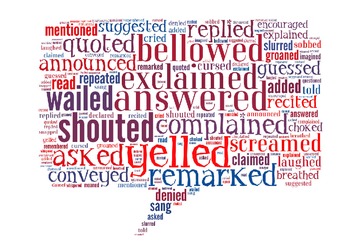
First we’ll teach students to vary their vocabulary, and then to modulate their tone appropriately. The problem is that, on the evidence of all those slush piles, step two never takes place, and Shelton’s students go out into the world commanding and boasting and suggesting in the belief that they’re making their writing “more sophisticated” rather than less.

It does not come as a big surprise that the trend of substituting said also has been noticed in Great Britain. Toby Chasseaud reported on the Mind your language blog of The Guardian on newspapers replacing said with admit resulting in an expansion of meaning of admit in order to avoid repeating said or sounding too plain. He illustrated this by including numerous examples taken from various UK newspapers which shows not only its widespread use, but also its admitting downright ridiculousness. Chasseaud’s annoyance with replacing said is obvious as he said:

“A poll by LighterLife found nearly a quarter of UK women admit to secretly eating.”

Admitting to eating? Whatever next? Man admits to breathing? Woman admits to drinking water? I must admit I’ve had enough already, and most readers probably have too.

What do you think about avoiding said? Is it simply a matter of style?  Let us know what you think in the comments below!

original-758275-1


Posted in usage features | Tagged , , | 7 Comments

Washington Post accepts singular they or Newspaper style guides as language authorities

Today one of the top trending tweets on the topic of English usage was “Washington Post will allow singular they”.  The same Post memo stating that they is now okay included the style guide updates regarding the spelling of email, website, mic and Walmart (instead of e-mail, Web site, mike and Wal-Mart). The comments of Twitter users were quite positive and many welcomed the update as a sensible gender-neutral variant. This news followed last week’s story of the New York Times introducing the gender-neutral honorific Mx.

By the time newspaper style guides include updates, this is usually (and understandably) at a point when the respective linguistic feature is already in wide use.  There are also differences regarding the speed of their acceptance across publications (The New York Times is still quite skeptical about the usage of split infinitives).more than AP

The  updates and changes in newspaper style guides are popular news topics and they travel far.  At the 2014 American Copy Editors Society conference, the AP Stylebook editors announced that “over” is fine when referring to quantity, and that it doesn’t need to be replaced by “more than”. The change caused strong reactions.

When the AP Stylebook announced in 2012 the update on the usage of an “old chestnut”, hopefully, some similar reactions followed (Seems the AP has been tasked with dumbing down the language. Hopefully, we’ll ignore its — oh, let’s just say their — illiterate nonsense.), although most of the commenters rightfully pointed out that the usage has already been accepted by most speakers and in most contexts for a while – the change was overdue.

hopefully

What I find interesting in these reports is the relevance that the commenters give to the changes in newspaper style guides. Most of these books are envisioned as in-house guides and their purpose is ensuring the uniformity of style of a particular publication. The authors of style guides and journalists like to point out this fact and restrict themselves from being viewed as linguistic authorities by the public, but rather only as skilled, professional language users. It seems that this does not stop the public from viewing language professionals such as journalists as authorities on matters of usage.

If you know of any other news stories such as these, please share them (or any other feedback) in the comment section below!

Posted in usage features | Tagged , | Leave a comment

What are your thoughts on the Microsoft grammar and style checker?

In the past two years, we’ve been publishing a series of interactive features in the journal English Today as a way to engage more readers in issues of interest to our research project. (Past features can also be found on the English Today page on our blog.) The eighth interactive feature, published in the latest issue of English Today, relates to a blog post I wrote about the influence of the Microsoft grammar and style checker on the attitudes to grammar and correctness of people who use the program.

What I find most interesting in this respect is what those of you who use Microsoft Word think of the grammar and style checker. Do you customise your settings, or do you rely on the default options? Do you accept the program’s suggestions, or do you get annoyed by them? To find out more about these and related questions, I have launched a short survey; I’d be really grateful if you could take a couple of minutes to fill out the survey and let me have your thoughts in this issue.

ENGToday

Posted in polls and surveys | Tagged , , , , | Leave a comment