Are Americanisms taking over the British Language?

Below follows Jan van den Berg’s first blogpost:

“American influence is busily eroding a valuable and once firm distinction in British speech and writing” (Amis 1997: 11). This is a quotation from Kingsley Amis’s usage guide The King’s English (1997). As we can tell from these words, Amis is concerned that the British English language is under attack by American influences and he does not seem too happy about it. Secondly, Amis states that certain Americanisms are driving out their British equivalents in British English . These concerns are shared by the Fowler brothers, who in their usage guide from 1906, which carries the same title as the one by Amis, also express their concern: “There is a real danger of our literature’s being Americanized, and that not merely in details of vocabulary – which are all that we are here directly concerned with –  but in its general tone” (Fowler & Fowler 1906: Americanisms).

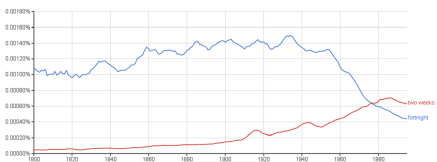
But is it truly the case that certain Americanisms are replacing, or are in the process of doing so,  their British equivalents in the British English language? A quick look at two different examples  given by Amis in his The King’s English (1997) produced an inconclusive picture. For example, when using Google Ngram viewer (set to English generally) we are able to see that the British noun fortnight (in red) is indeed in the process of being replaced by the American equivalent two weeks (the blue line).

Ngram two weeks fortnight general

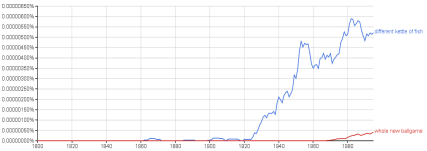
Another example mentioned by Amis  is that the British expression a different kettle of fish is experiencing serious competition from its American equivalent a whole new ballgame. However, Google Ngram tells us otherwise (blue for a different kettle of fish, red for a whole new ballgame):

Ngram kettle of fish


When we take a look at this second example from Google Ngram, we find that the expression a different kettle of fish is hardly being threatened by its American counterpart. Consequently, it remains to be seen whether the American influence on the British language is really as great as is being presupposed by our usage guide writer around 1995 (the year of Amis’s death).

So what do you think? Do you as a reader of this blog post and native speaker of British English feel that ‘American influence is busily eroding the British English language’ as Amis claims? Please let me know by sharing your opinion in the poll below. If your answer is ‘yes’ than I am also very much interested in your thoughts on this.


Posted in usage features, usage guide | Tagged , , , | 7 Comments

Pedants and Perpetrators: or, language, power and the dangers of simplificitation

source: idler.co.uk

source: idler.co.uk

Yesterday, the website of The Guardian posted an article on the members of the Idler Academy’s Bad Grammar Awards‘ shortlist. The bad grammar perpetrated by those on the shortlist contained a number of the ‘old chestnuts’ such as the use of less for fewer, the use of an apostrophe in a plural, you’re for your, and it’s for its. So far, so usual. What caught my attention, however, was the following quote at the bottom of the article. It also features on the Academy’s website from one of the judges, and host of the Awards, Jeremy Paxman. It’s a short quotation, but there’s plenty to be said about it.

Jeremy Paxman, The Idler

Jermey Paxman  source: idler.co.uk

People who care about grammar are regularly characterised as pedants. I say that those who don’t care about it shouldn’t be surprised if we pay no attention to anything they say — if indeed they’re aware of what they’re trying to say.

Let me start with the second sentence. First, I think that people are virtually always aware of what they are trying to say. Whether they also say what they are trying to say is another matter.

Getting people to pay attention to what you say is less a matter of grammatical correctness and more a matter of power. Language is power, though in a different way depending whether you approach it from a purely linguistic perspective, or from a social one.

Linguistically, I think that in this case it works the other way around. Let’s assume for a moment that Mr. Paxman counts himself among the pedants (which I don’t think he does, but more about that later) and that’s what we refers to. What amuses me is that the people who don’t care about grammar, the masses, have been happily using the English language in their own way, without major incidents or misunderstandings for many, many years, without paying attention to the pedants. Why? Because language usage is democratic; it is shaped by the masses.

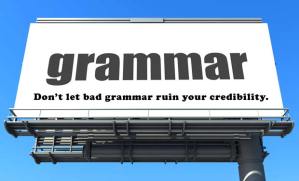
source: skilledup.com

source: skilledup.com

From a social perspective, however, it is true that some people, or groups, will not have their voices heard, suggesting that they will be disenfranchised because of it. However, this is not because because they use ‘bad grammar’, but because they are disenfranchised already. Not caring about grammar can only disenfranchise you if you have no power to begin with. If you have power, you can speak and write however you want.

Now to the first sentence, and particularly to the word pedant. First, the quote seems to suggest a kind of name-calling by others; this is not what’s happening here. The Bad Grammar Awards (“Starring Jeremy Paxman”), to be held on May 1st, are advertised on the Academy’s website with the following text (my emphasis).

Come to the Idler Academy Bad Grammar Award 2014, a thrilling X-Factor for pedants.

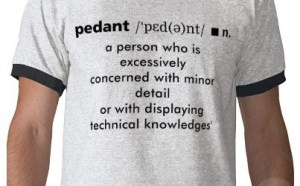
source: makemerhyme.wordpress.com

source: makemerhyme.wordpress.com

Second, the quote seems to suggest that people who care about grammar are pedants. I don’t think they are, and I don’t think that Mr. Paxman thinks that either. It is very well possible to care about grammar, without being a pedant. But to equate people who care about grammar with pedants creates a problem when we read about ‘those who don’t care about it’. The problem is that what is perpetuated here is a simplistic and false dichotomy in which since those who care are pedants, those who don’t care are the perpetrators of flagrant ungrammaticalities. This is not a helpful way to think about it.

Whereas I think that most people care about language, though mostly subconsciously, many people do not care about grammar, but are mostly indifferent to it. Yes, pedants do exist, but what they care most about is not grammar, but social order, of which they (subconsciously) see grammar as an index. What troubles me is that the perpetuation of such a simplistic dichotomy stands in the way of nuanced discussions about grammar and usage.

Labeling people […] obscures the complexity of their views and makes it harder for people to hear what others have to say: Once we see someone as bearing a label we don’t like, we stop listening. —Deborah Tannen in “The Argument Culture” (1998)

Although Tannen referred to belligerent and divisive attitudes in the media and education, it is no great leap from these to discussions about language, which abound in the press.

You can care about grammar without being a pedant, and you can care about language without caring about grammar. Let’s just be clear with our language (no pedantry intended).

Posted in news | Tagged , , , , , , | 1 Comment

Pietersen and Prescriptivism (ctd.)

In an earlier blogpost, Ash Navrady commented on how the star cricketer Kevin Pietersen was sacked by the English Cricket Board (ECB). Here follows another blogpost, in which Ash again focusses on an issue of prescriptivism, in this case the use of literally, a topical issue it appears!

In my previous blog post, I pursued the idea of prescriptivism in professional sport focussing upon the ECB’s ‘explanation’ for sacking Kevin Pietersen as an illustrative example of Type 2 Prescriptivism discussed in Milroy and Milroy’s Language and Power. Remarkably, subsequent developments in the KP saga have also featured elements of language prescriptivism. In an interview with England’s wicketkeeper Matt Prior, who was dropped from the team during the aforementioned Ashes series due to poor form, Prior was asked whether the changing room would be better off with KP’s absence, to which he controversially replied: “Yes it will.” From a prescriptivist’s perspective, this was not the only inflammatory comment made by Prior during the interview. Concerning his own admission from the team for the Fourth Test in Melbourne, Prior admitted that it “quite literally wrenched my heart out”.

(The friendship between Prior (left) and Pietersen (right) appears to no longer extend to off the field of play.)

Prior’s use of literally here as an emphasiser did not go unnoticed.  On Twitter, Melbourne-based writer Russell Jackson (@rustyjacko) commented: “Flagrant misuse of “literally” by Matt Prior: being dropped “literally wrenched my heart out.” Oh dear.” A response to this tweet came from BBC cricket writer/broadcaster Elizabeth Hammon (@legsidelizzy) who retorted: “jamie Redknapp syndrome” (referring to the ex-professional footballer Jamie Redknapp, who is now a commentator for Sky Sports).

tweet

Subsequently, I looked for literally on Factiva, which is an online database comprising tens of thousands of international newspapers and journals full-text articles.  During my search, I came across an article by John-Paul Ford Rojas (2012) from the Telegraph Online which bemoans the use of literally. Ford Rojas argues that the misuse of literally stems from sports broadcasters and commentators and has spread to the domains of politics, illustrated by Nick Clegg’s infamous quip “You see people literally in a different galaxy who are paying extraordinarily low rates of tax”. Ford Rojas complains:

Wayne Rooney was often described as “literally on fire” or “literally playing out of his skin” by sports commentators while a BBC newsreader had said in another sporting context: “You are up against Norwegians who are literally born on skis.”

Another example saw football pundit and former player Alan Shearer apparently embarking on a Lilliputian flight of fancy when he said: “After the first goal went in you could literally see the Derby players shrinking.

Does all this mean that the misuse of literally was initially corrupted by ineloquent sports pundits?

Searching further on Factiva, I found an article by Polly Curtis (2012) from The Guardian, who consulted Radio 4’s debate on the use of literally which was also initiated by Clegg’s statement.  Ironically, listeners tweeted in their suggestions for other culprits of the misuse of literally. Tweeter @dangerhere suggested: “In his youth, Michael Owen was literally a greyhound.” (Sorry, Jamie.)

Evening Post

However, Curtis does go on to inform us that the use of literally has been “used to ‘intensify statements’ as early as the 17th century and misused from the 19th century”. This evidence was presented in 2005 by an editor of the Oxford English Dictionary called  Jesse Sheidlower,  who stated:

As is often the case, though, such abuses have a long and esteemed history in English. The ground was not especially sticky in “Little Women” when Louisa May Alcott wrote: ‘The land literally flowed with milk and honey.’ Tom Sawyer was not turning somersaults on piles of money when Mark Twain described him as ‘literally rolling in wealth’. Jay Gatsby was not shining when Fitzgerald wrote that he ‘literally glowed’. Such examples are easily come by, even in the works of the authors we are often told to emulate.

Thus, while sports commentators, especially Jamie Redknapp, appear to fan the flames of a ‘misuse’ of literally, the usage of the word has literally been around for centuries.

Returning to cricket, how did Kevin Pietersen, a previous victim of the ECB’s Orwellian newspeak, respond to a former teammate’s happiness at his axing, who would dare to use literally in a figurative manner? Quite simply, he tweeted (@KP24):

Kevin Pietersen's tweet

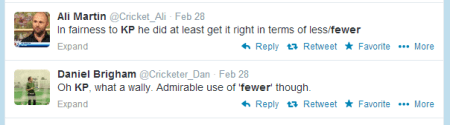
Pietersen’s retort to Prior suggests that he should spend less time doing interviews and more time practising with his county team of Sussex. More importantly, Pietersen’s correct use of fewer rather than less (“Fewer Q&A’s”) again did not go unnoticed.

Ali Martin, cricket writer for The Sun (@Cricket_Ali) and Daniel Brigham (@Cricketer_Dan), Features Editor at The Wisden Crickiter both congratulated KP’s use of language in his reply, though his hashtag #josbuttle, referring to Prior’s up-and-coming wicket keeping rival Jos Buttler, may not have been so ‘appropriate’. 
on Pietersen's use of fewer

Overall, it’s been tough starts to 2014 for KP, controversially sacked from the England Cricket Team, plus having a former team mate acknowledge that the team would be happier with his exclusion too. However, with his excellent grasp between the distinction between fewer and less combined with his an abundance of newly found free time, maybe a new career in writing usage guides beckons for KP, but I wouldn’t bet on Matt Prior getting a free copy.

Posted in MA Leiden, usage features | Tagged , , | Leave a comment

The turbulent times of hopefully

Below follows Anna Yuryeva’s first blog post. She’d be pleased with your comments.

Two years ago, in April 2012, the Associated Press (AP) Stylebook published a tweet, which was followed by a virtual tsunami of criticism from grammar enthusiasts: “Hopefully, you will appreciate this style update, announced at #aces2012. We now support the modern usage of hopefully: it’s hoped, we hope.” What has been happening for decades among speakers of English around the world – that is, using the word hopefully to modify a whole sentence, contrary to the traditional meaning “in a hopeful manner” (that is, modifying only a verb) –  is now accepted in official writing as well.

Source: someecards.com

The historic announcement not only received a lot of attention from fellow tweeple, it also sparked outrage in the Washington Post, the New York Times, and among a number of grammar devotees on the Internet. Despite the fact that clause-modifying hopefully has been around since the second half of the twentieth century according to the Oxford English Dictionary, the language gatekeepers appeared to greatly disapprove of this news: “When enough people fail to learn the rule, the mistake becomes the rule. This is change but not progress,” says one commenter in response to a blog post dedicated to this announcement. “Really wish you hadn’t done this. But I understand why. It’s like media as a plural word—you can’t fight the tide forever,” adds another. These claims also draw attention to the idea that accepting such usages will (potentially) make our written communication more confusing – one concerned writer, sharing his opinion on the Editorial Board blog of Minnesota Daily, believes it is highly unlikely that anybody would paraphrase the AP tweet as “We hope, you will appreciate …”. Omit the comma and the sentence will read: “In a hopeful manner, you will appreciate this style update.” Yet, these people ground their arguments on beliefs that may not be shared by other speakers.

While the negative reactions may all seem at least somewhat reasonable, they do, in fact, call attention to a truly chicken-and-egg situation in language: what change is a natural step in language change, and what is just laziness to obey certain rules? In the case of hopefully, it looks like the AP Styleguide is only trying to “keep it real”, as Clyde Haberman of the New York Times puts it. AP’s deputy standards editor David Minthorn explained the style update as follows: “[…] it just seemed like a logical thing to change. We’re realists over at the AP. You just can’t fight it.” Hopefully, then, may serve as an epitome of this kind of battlefield language professionals come across on a regular basis; the question is, though, whether vernacular usages, spread by means of Internet platforms like blogs and other social media, will eventually make the prescriptivists reach a peace treaty.

What we would be interested in is how the readers of this blog would respond to the AP tweet. We hope (hopefully?) you will let us know.

Posted in MA Leiden, usage features | Tagged , | Leave a comment

What makes a usage guide? 

During the construction of the HUGE database, I have been thinking about the genre of usage guides a lot for the simple, practical purpose of determining which titles would be put in the database, and which would not. Edmund Weiner asked himself 25 years ago…

What are we to make of that neglected genre, the Usage Guide?

source: mixedbagart.tumblr.com/ photo by: chadmize (instagram.com/chadmize)

source: mixedbagart.tumblr.com
photo by: chadmize (instagram.com/chadmize)

As a genre, the usage guide is somewhat of a mixed bag. Weiner notes that although a usage guide covers all parts of the language, it doesn’t describe all of it. A usage guide gives the meaning of words, but it is not a dictionary (altough it can be set up like one). A usage guide discusses grammatical structures, but it is not a grammar. According to Tieken-Boon van Ostade, the usage guide “aims to point out and correct linguistic errors” instead of “focusing on actual grammar”, while offering “some entertainment in the process”. Weiner says that it covers all parts of the language, and while this is generally true, it doesn’t cover every part equally.

To help define the usage guides as a genre, I have made came up with a number of other genres that cover parts of the language which are also addressed in usage guides: dictionaries, style guides, handbooks on writing, spelling & punctuation guides, descriptive grammars, language acquisition textbooks, and popular works on language. What kind of work do you think of when you think about a usage guide? Share your thoughts by taking the poll!

Posted in polls and surveys, usage guide | Tagged , , , | Leave a comment

The Correct and Improving Major Byron F. Caws

This is Richard Bond’s second blog post.

The Story So Far

At Dr. Johnson’s House in London there is a plaque that reads “Castigavit et emendavit” (“he corrected and improved) suggesting that these are H. W. Fowler’s words in recognition of Major Byron F. Caws’ contribution to the Concise Oxford Dictionary. Major Cawss’ grandson, Richard Byron Caws, erected the plaque in 1997.

What was Fowler’s major reason for making this inscription to Major Caws?

Dr. Johnson’s House Trust suggested the possibility that Major Caws might have been related in some way to Sir James Murray, the primary editor of the first edition of the Oxford English Dictionary. They advised that the City of London Corporation, a possible option for further information, maintains the statue with the plaque, but they suggested I contact the OED. I did so and am waiting for the reply.

I continued by consulting Jenny McMorris’ biography of H.W. Fowler. As there was no reference to Major Caws in the index, I read through the sections where the Fowlers may possibly have met a major, that is their time spent in service during the First World War, and also sections on when H.W. Fowler was writing the COD. There is no mention of Major Caws but there are possible clues.

McMorris mentions a kindly CO who helped the Fowlers in a non-language related capacity during the war, but no name is given. I wonder whether a Major would have filled a CO position during the First World War, but taken in conjunction with the meaning of the inscription, it is unlikely that this CO was Major Caws. Later on in the book, a retired army surgeon is mentioned who provided some assistance to Fowler and also a military correspondent in Jamaica. Again, no names.

A memoir of H.W. Fowler by George Gordon Coulton might possibly have some information, but I haven’t found a copy yet. (Drop us a line if you find anything!)

Ingrid Tieken suggested that Major Caws might have been cited with a quotation in the OED online, so I OEDed Major Byron F. Caws and all permutations of his name but did not find any results. I also found Richard Byron Caws’s family tree online but no links to the Major nor toSir James Murray so far. Investigations continue and any insights are welcome!

Introducing Major Byron F Caws

Recent research has turned up a post on the alt.usage.english website that seems to tie everything together. User ‘Mike’ says that he found Major Caws name mentioned in earlier drafts of the COD. I located a first edition online, but did not see any reference there to Major Caws.

In response to Mike’s post one user “Bartie” wrote: “Byron Frank Caws born Seaview Isle of Wight 1863 died Jamacia (sic) 19 April 1943“. Mike Barnes added more information he had found:

The [Jamaica Garrison] church is built just outside the entrance to the
main guardroom of Lathbury Barracks and immediately opposite to the
Obelisk erected in memory of those officers, men and families who
perished in the great calamity of 1907. It was built by S.R. Eustace
Fielding Esq., and the work was supervised by Lieutenant Colonel R.
Carey Commander Royal Engineers and Major B.F. Caws, R.E. while QMS V.
Sponsor was the military foreman of works. Incidentally, the late Miss
Phyllis Caws, daughter of Major Caws, maintained a constant link with
the church up to the time of her death on 4 January 1968. She was for
many years Sunday school teacher. Miss Caws’ funeral service was held in
the church with which she was connected for over fifty years.

Article in the Jamaica Times 
[Kingston, August 25, 1934]. Unwanted Guests Should Be Spat On. Mr. Marcus Garvey at Meeting of U.N.I.A. Convention Again Attacks
”Ginger”^1

[…]

1. Ginger was a pseudonym used by an Englishman named Major Caws, author
of a column called “Pepper Pot” in the Jamaica Times in the 1930s (Ken
Post, Arise Ye Starvelings: The Jamaican Labour Rebellion of 1938 and
its Aftermath [The Hague, Boston, London: Martinus Nijhoff, 1978], p.
197, n. 51).

— 
Mike Barnes

Caws as a young manOne writer indicated that they are the great-grandchild of Major Caws and invites to contact them for further information, so I wrote and received a lovely email in response with the following two photos of Major Caws.

At least we know what he looked like!

So now we are trying to find any of his contributions to the Jamaica Times “Pepper Pot” column in the 1930’s as ‘Ginger’, or any correspondence he may have had with H.W. Fowler.


Do you have anything to share with us to help us continue the story of Major Caws?


Caws in uniform

References:

McMorris , Jenny (2001). The Warden Of English. Oxford University Press

Coulton, G. G. (1935). H.W. Fowler. Clarendon Press.

Posted in biography, MA Leiden | Tagged , , , | 4 Comments

Maar is het fout? (But is it wrong?)

Here is Annemarie Walop‘s second blog post.

While browsing on the internet a few weeks ago, I found a very interesting article on the website of Dutch quality newspaper De Volkskrant about the Dutch coordinating conjunction maar (“but”). The article is called ‘Beter: de maar-ziekte’ and it deals with the fact that maar  is used increasingly often at the beginning of sentences, and that it suggests a contrast with the previous sentence.

Het [woord maar] wordt vaak ten onrechte gebruikt, wanneer de gebruiker een tegenstelling suggereert die er helemaal niet is. (It [the word maar] is often wrongly used, when the writer suggests a contrast that is not really there.)

The author of the article, Jean-Pierre Geelen, provides multiple examples of the wrong use of maar, and indeed, it can be found in virtually any book or article.

Jean-Pierre Geelen

Is the use of maar at the beginning of a sentence really een ziekte (“a disease”), as Geelen claims? Wikipedia seems to think so. It gives the following definition of a coordinating conjunction:

Een nevenschikkend voegwoord verbindt twee zinnen of deelzinnen die even belangrijk zijn… Een nevenschikkend voegwoord staat altijd tussen de deelzinnen in, nooit aan het begin. (A coordinating conjunction links two sentences or clauses of equal importance together… A coordinating conjunction is always placed in between the clauses, never at the beginning [of a sentence].)

Interestingly, Wikipedia gives no references to sources to back their claim. In the absence of a Dutch usage guide tradition, people would have to revert to Dutch books on grammar in order to find out whether it is acceptable to use a coordinating conjunction at the beginning of a sentence. Finding information on a usage item like this one is very time-consuming, especially if you take into consideration that the answer might not be in the grammar at all. Alternatively, you can try to find the item on the website of Genootschap Onze Taal (Dutch language society), which in this case states that en (“and”) and maar can be used at the beginning of a sentence, but the website does not include information on other coordinating conjunctions (for instance, it does not mention want (“for”/”because”).

What about English coordinating conjunctions, such as but, and, and for? Wikipedia states that “many students are taught that certain conjunctions … should not begin sentences. But authorities such as the Chicago Manual of Style state that this teaching has ‘no historical or grammatical foundation’”. (Notice the but starting the previous sentence!)

Wikipedia

The Chicago Manual of Style (2010) claims that “[i]n fact, a substantial percentage (often as many as 10 percent) of the sentences in first-rate writing begin with conjunctions. It has been so for centuries, and even the most conservative grammarians have followed this practice”. Even though the CMS claims that there is no usage dispute surrounding the use of a conjunction at the beginning of a sentence, some people still get quite worked up about it, as is apparent from the following quotation from Charles Allen Lloyd, author of We Who Speak English: and Our Ignorance of Our Mother Tongue (1938):

Next to the groundless notion that it is incorrect to end an English sentence with a preposition, perhaps the most wide-spread of the many false beliefs about the use of our language is the equally groundless notion that it is incorrect to begin one with “but” or “and”. As in the case of the superstition about the prepositional ending, no textbook supports it, but apparently about half of our teachers of English go out of their way to handicap their pupils by inculcating it. One cannot help wondering whether those who teach such a monstrous doctrine ever read any English themselves (1938: 257-8)

One of the most popular and best-known English usage guides, Fowler’s Modern English Usage (1996), says about and that “[t]here is a persistent belief that it is improper to begin a sentence with And, but this prohibition has been cheerfully ignored by standard authors from Anglo-Saxon times onwards’, and about but that ‘[t]he widespread public belief that But should not be used at the beginning of a sentence seems to be unshakeable. Yet it has no foundation” (1996: 52, 121). However, MEU writes that for “cannot normally be placed at the beginning of a sentence” (1996: 305).

In English, it seems as if there should not be any confusion: the coordinating conjunction is used at the beginning of a sentence by many people in many contexts, and prescriptivists do not find a problem with its usage as such. In The Netherlands we lack a usage guide tradition, so grammars are used as authorities on language use. Coordinating conjunctions are widely used by the public at the beginning of a sentence, but some people appear to have a problem with it. Perhaps it is time for a Dutch usage guide to be written, which has to include the disputed usage of coordinating conjunctions at the beginning of a sentence, among other things.

Posted in MA Leiden, usage features | Tagged , , , , | 4 Comments

NWO Humanities blog

NWO, the Netherlands Organisation for Scientific Research and the funding agency of our project, recently started a Humanities blog. They asked us to write a couple of blog posts for them, and the first one appeard online yesterday. Though the post itself is in Dutch, you might wish to read it and leave a comment. If you do, you will be the very first!

Posted in news | Tagged | Leave a comment

Yagoda’s Language Madness

March Madness describes a very American phenomenon: the NCAA college basketball tournament. In this tournament college teams compete against each other and by winning move on to the next round. This process is often visualised in so-called brackets, which apparently has started a mocking trend. You might have asked yourself by now, why I am talking about sports on a language blog. Here is why.

Ben Yagoda

Ben Yagoda, a linguist from the US, transferred the concept of March Madness into linguistics. If you are puzzled by this, give me a chance to explain. On his blog he introduced daily polls including two pet peeves such as for example Wordiness and cliches in the first round of his Language Madness series. Yagoda’s aim was to determine the biggest “sin against language” – the wording should be taken with a pinch of salt of course. Intrigued by this idea, I started to do some research on his Language Madness and discovered his contribution to the book The Enlightened Bracketologist: The Final Four of Everything published in 2007. In this book he produced a bracket sheet for the “sins against language”. The results of the first round “matches”, which can be seen below, were the basis for this Language Madness polls.

First round results

In an article on The Chronicle of Higher Education, Yagoda comments on his 2007 results:

“Looking back over the winners, I’m OK with all of them, with one exception. Today, I would choose “commas or periods outside quotation marks” (otherwise known as “logical punctuation”), definitely to advance to the second round and possibly a lot farther. My students are wedded to this, and it drives me cuckoo.”

In the end, Yagoda left the choice to the readers of his blog. I recommend reading his entries and tracing back the debate. If you are somewhat impatient and want to go straight to the results, you can find the final bracket here. I’d be curious to see what the readers of this blog think about this results. Do you agree or disagree?

Posted in polls and surveys, usage features | Tagged , , , , | 1 Comment

Overused exclamation marks!!!

In the latest issue of Intelligent Life magazine published by the Economist Group, six writers including Julian Barnes, Claire Messud, and Ali Smith discuss their favourite punctuation marks. We have addressed the topic of punctuation in a number of our posts in the past. The Oxford comma, the possessive apostrophe, and misused dashes all evoke a great amount of criticism. Julian Barnes reminds us in the aforementioned article of another misused and abused punctuation mark, the exclamation mark. Barnes writes:

‘Some of My Best Friends litter their e-mails with “!!!!!!!!”, like lines of poplars by French canals. I’ve even been caught using a few of them in a row myself. And is there anything more depressing than the hand-drawn version, in which the outline of a cigar sits perkily atop a small circle’.

intelligent

Many usage guides and authors advise against the excessive use of the exclamation mark. The American novelist and screenwriter Elmore Leonard stated in his 10 rules of good writing:

Keep your exclamation points under control. You are allowed no more than two or three per 100,000 words of prose.

Some linguists, however, attribute the overwhelming use of exclamation marks to the changing nature of written language, which is (largely due to computer mediated communication) becoming more conversational.

We might be witnessing language change that is affecting punctuation. Instead  of signalling strong feelings or a forceful way of speaking, the exclamation marks are now mere indicators of excitement or positive disposition (Sure, let’s have coffee!, See you later :)!). From the number of articles lately addressing this issue, it seems that the language pedants are not calmly observing the change.

exclamation omb

See the results of the Intelligent Life’s survey on favourite punctuation marks here.

Posted in usage features | Tagged , , , , , , | Leave a comment