Punishing Princes Street

Edinburgh’s Princes Street is a true shopper’s delight. Its countless shops and stores make the hearts of shopaholics beat faster and credit cards moan even louder. Yet, it is not all sunshine and roses down Princes Street. Grammar – or to be more accurate – punctuation sticklers are unhappy about a simple “squiggle”: the missing apostrophe in Princes Street.

Apostrophe Vigilante

The Apostrophe Vigilante is on the beat to pinpoint missing or incorrect apostrophes and encourages the general public to report any evidence of crimes committed against proper punctuation. According to this article in the Independent, measures have been taken to demand correct punctuation by re-establishing the street’s old name: Princes’ Street.

Princess Street

Named after King George III’s two eldest sons, Prince George and Prince Frederick, Princes Street lost its apostrophe sometime in the 1830s much to the displeasure of those observing correct punctuation. This new punctuation watchdog is a fine example of how social media is increasingly used to advocate accurate punctuation and correct grammar. So in case you witness any crimes committed against punctuation while strolling down your favourite shopping street, you have the right to either send in a snap-shot to the Apostrophe Vigilante or to remain silent and keep on enjoying the latest trends and gadgets.

Note: Any crimes committed against punctuation in this post are done so unknowingly and the author is more than grateful to learn and eradicate mistakes.

Posted in usage features | Tagged , , , , | 1 Comment

Favourite language blogs

Our blogroll on this site shows the language blogs that we like. But we would also like to know which ones are your favourites?

Posted in polls and surveys | Tagged , | Leave a comment

Secretary of Dutch Taalunie no fan of Dunglish

Geert Joris (Radio 1, Belgium)

Anticipating on his talk at the LUCL public event “Wie is de baas over de taal” (Who makes the rules in a language?) next Saturday, Geert Joris wrote in NRC-Handelsblad on Thursday that he dislikes Dunglish. He claims to be much more in favour of  proper Dutch and proper English co-existing as indepent languages in Dutch speaking territories.

LUCL public event 2013

My own talk at the same event, “Van wie is het Engels”? (Who owns English”), will deal with precisely that as well, though from an English perspective. So I will be looking forward to the forum discussion afterwards.

Meanwhile, I’d be interested to hear what you think about Dunglish. Fill in this poll, and let us have your views here, so that I’ll be able to report on them next week.

Posted in news | Tagged , , , , | 6 Comments

Prescriptivism and the curriculum in UK schools

Charlotte Brewer, Hertford College, Oxford

Is prescriptivism being reintroduced into the English educational system? This is a topic that hit the news a year ago, and is keeping teachers and politicians still very much occupied – and concerned – today. So much so that Charlotte Brewer (University of Oxford) has offered to drop her original topic for the Leiden conference Prescription and Tradition in Language  next week to address the issue from the perspective of historical linguistics. Needless to say, we are all very pleased by this and are looking forward to this highly topical paper very much. And if you are interested in the topic as well: registration for the conference doesn’t close until Thursday.

So if you want to take part in the discussion, come to the conference next week. In addition, you may want to add your comments here, or in David Crystal’s blog.


Posted in news | Tagged , , , | 1 Comment

David Crystal and the history of English spelling, or how the Internet is killing off silent letters

The Hay Festival of Literature and Arts, which is held annually in Wales, was a prolific spell it outplace this year for discussions about language use. Professor David Crystal gave a wonderfully engaging talk at the event, presenting his latest book Spell it Out: The Singular Story of English Spelling (the podcast is available here).

The Daily Mail reported on the event in an article with a catchy title Receipt without “p”, rhubarb without the “h”: How the Internet is killing off silent letters. Crystal explains the history of English spelling in his talk, a history of waves of variation and novelty, and of various people who kept “messing it up”. The French changed the simply-spelled Anglo-Saxon word CWEN into QUEEN, the Flemish typesetters are responsible for the “H” in GHOST, and the educated users of Latin for the “B” in DEBT (lat. DEBITUM). Crystal goes on to explain how English spelling is continuing to evolve today through the use of the Internet. The silent letters, such as the “H” in RHUBARB, are disappearing online in a medium which allows for writing and publishing without the filtering, editing process.

David Crystal was not the only one at the Hay festival to tackle the issues of spelling, language and pedantry. Simon Horobin, English professor at the Magdalen College, Oxford, addressed the language pedants in his talk, suggesting that there is nothing sacrilegious about “thru”, “lite”, and even the lack of spelling differences among “they’re”,“their”, and “there”, the Telegraph reports.

What caught my attention were the reactions from the readers, who seem to have less tolerant attitudes towards usage than the linguists. The best rated comments on the David Crystal article all express concern about “language wreckage” and the lack of education, whereas the results of the poll on the importance of grammar in the Telegraph below speak for themselves.

Does grammar matter

Posted in usage features | Tagged , , , , , , , | Leave a comment

Marilyn French and the split infinitive

Marilyn French (wikipedia)

I found another one! And once again in a novel by Marilyn French (1929-2009), this time My Summer with George (1996). The novel is situated in 1991 (p. 236), and it is about the dream of an affair in late middle age with a man called George, who declares himself a hater of women, poor-self-deluded Hermione!

During a conversation that appears to be getting nowhere, George …

told me about a quarrel at the newspaper among a group of editors, about a split infinitive. He wondered how I felt about split infinitives; he seemed seriously interested. So I, too, treated it seriously, explaining that being of the old school, of course I disapprove of split infinitives; they invariably hit my ear as crude and déclassé. I offered my old-fashioned opinion for what it was worth, and he launched into a series of grammatical questions that plagued the editorial desk at Newsday. As he paid the check, I remarked that it was impressive that the editors would argue about such high-flown subjects. I thought grammar was no longer of interest to anyone except a few linguists talking to each other by E-mail, I said (p. 205).

Penguin edition

And so on. “Crude and déclassé”, in the early 1990s, fit for a topic in this empty conversation, followed by the comment that grammar was not believed to be of any interest except to the occasional linguist. This reads like a critical comment on the absence grammar as a subject in the school curriculum at the time. George raised the topic because he had sat next to a former “grammar teacher” on the plane to New York, who got “all agitated about the grammar in a column in the Louisville Herald – my paper! I was insulted!” (p. 206).

Posted in usage features | Tagged , | Leave a comment

Wanted: Usage Guide Writers (f)

Our current strategy for deciding which usage guides to enter into our database of English usage guides and usage problems has been to identify different categories of usage guides and focus our efforts on acquiring the guides that fit into these categories.

unidentified writer

unidentified writer

One of the categories we came up with was usage guides written by women. This category resulted from ideological as well as practical considerations. The ideological argument was that since women are underrepresented in terms of number as writers of usage guides, it wouldn’t be amiss to pay special attention to them. This led to a more practical consideration: because of the smaller number it shouldn’t be too difficult to identify and acquire all usage guides written by women.

So far we have identified 54 usage guides written by women, of which we have acquired 9 so far. Now, original editions of usage guides  published in the latter half of the 20th century are not that hard to come by, but earlier ones aren’t easy to find. This is where you come in. At present, we’re hoping to find the following titles:

Use and Abuse of English 1896 Rosaline Masson (Edinburgh: James Thin) — or the 1924 fourth edition

Desk-book of Errors in English 1909 Josephine Turck Baker (Evanston, IL: Correct English Publishing Co.) — or the 1920 revised edition

You don’t have to worry about copyright, the books are used for research purposes only. If you own or can get hold of one of the guides we’re looking for, we would like you to scan them and share the file(s) with us via Google Drive or some other method of file sharing. All our benefactors will be listed on this blog. However, if you wish to donate but remain anonymous, please include a note to that effect.

Posted in technology, usage guide | Tagged , , , , | Leave a comment

Beaumont’s Better English Campaign

In The English Journal of November 1927, George Norvell reported that the teachers of Beaumont Senior High School were so tired of their students’ nonchalant disregard for rules of correct English which they had learned “dozens and perhaps hundreds of times”, that they proposed the Better English Campaign.

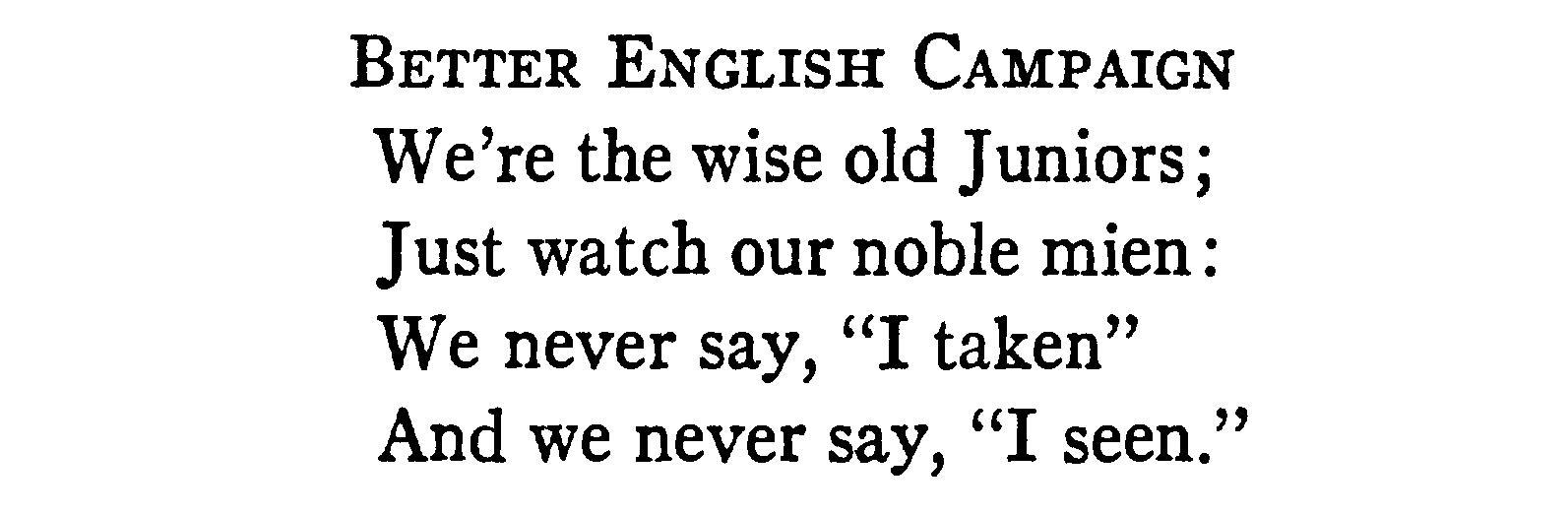
A poster contest and an essay contest were organized, as well as a best stunt contest. Lively competition was provoked by especially the latter. The Juniors first took their chance, and they tagged the town with little pink cards that read:

picture.better.eng.tag

The Seniors, on the other hand, tried to win the best stunt contest by publishing a school newspaper that was headed with the words: SENIORS PLAN TO SLAY SLANG. In addition, they provided every student and teacher in the school with a card. Whenever a pupil detected a language error made by somebody else, that pupil was allowed to collect the other person’s card. According to Norvell, students were particularly diligent in monitoring the speech of teachers. Each time teachers were corrected and had to surrender their cards, students loudly celebrated their triumph.

The best stunt, eventually, was a play written and performed by the Seniors, called: “A Tragedy of Errors”. In the play, a student called Jack got into trouble as a result of his extraordinarily bad speech. Of course, as soon as Jack learned to pay attention to his English, his problems were also solved in some way or other.winner.contest

At the end of the Better English Campaign, the points earned via the contests were added up. The Juniors had been most ambitious and thus they were awarded the silver cup. Up until the next Better English Campaign a year later, the cup reflected these students’ honor.

Just like the topic of my previous post The Alphabet of Errors, Beaumont’s Better English Campaign similarly shows that some teachers of English actively encouraged their students’ use of proper English in the 1920s.

I wonder what other kinds of projects and plans that aimed at correcting students’ English were carried out in the first half of 1900?  Would teachers of English today also like the idea of letting their students participate in a yearly Better English Campaign?

Norvell, George W. (Nov. 1927) “Beaumont’s Better English Campaign.” The English Journal, 16.9: 682-687.

Posted in usage features | Tagged , , , , , , , , , | Leave a comment

Apostrophe humour

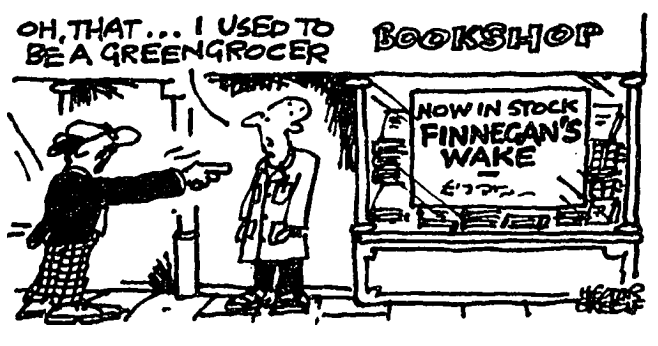
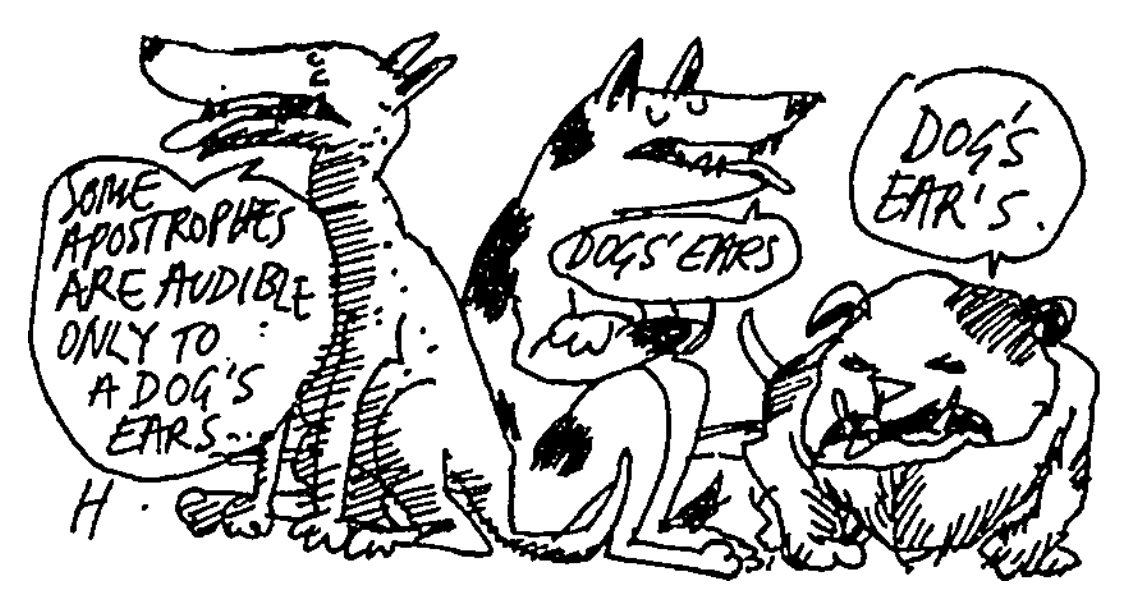
In a recent analysis of letters to the editor written on the topic of the errant apostrophe, I have come across many humorous examples of both letters and featured comics. The two comics below are taken from the Guardian. The first (The Guardian Oct. 9, 1992, p. 22) depicts the misspelled novel title which, the pedants say, causes James Joyce to turn in his grave.joyceThe second comic (The Guardian Apr. 15, 1994, p. 21) alludes to those who claim to be able to hear a misplaced apostrophe.

dog's ear'sMy favourite letter on the apostrophe yet raises an interesting point regarding the spelling of Father’s Day, which is coming up in only a couple of weeks!

australian


Posted in cartoons | Tagged , , | 2 Comments

A blogpoll on ain’t

As a follow up to Chloe’s post below on ain’t, I’d be interested in having your feedback in a blog poll as well. So please let us know what you think! (Click on the title to access the blog poll.)

More Galleries | Tagged | 2 Comments