Whom on the way out?


cartoon

In Chad Harbach’s novel The Art of Fielding (2011), one brief interaction between two characters is the scene of a linguistic inside joke. Pella Affenlight is arguing with her father, the President of Westish College as well as a professor of Literature. The passage is as follows:

“Don’t look so glum,” she said. “Now you can have guests over.”
Affenlight chuckled, or tried to. “Yeah, right,” he said. “Like whom?”
It was the classic criminal error, that like whom—the longing to get caught, to take credit for the crime. Pella steeled herself. (429)

Related to the above is a discovery I made the other day. I was leafing through my little sister’s workbook for English class; she is currently in her fourth year of high school and learning English as a second language. My eye fell on an assignment which required two simple sentences to be combined into one, “keeping the preposition after the verb in the relative clause”. One of the sentences was My mother died last week. I looked after her for many years. My sister had rewritten these as My mother who I looked after for many years died last week. Almost thoughtlessly, I scribbled down My mother whom… and asked my sister to discuss this with her teacher. Later that week, she reported back to me: “Mr. Stevens says that what you wrote in my book is right, but we don’t necessarily have to do it that way. What I did is also okay.”

This teacher, then, takes a – perhaps unusually – tolerant approach to what is actually considered to be a usage problem: who ‘incorrectly’ used as whom. He evidently chooses not to correct students when they write My mother who I looked after. And indeed, why should he? It’s obvious that who and I don’t share a referent in this clause. Besides, is there anyone who even uses whom in informal writing or actual speech (excepting fictional professors of Literature) anymore? Was I being old-fashioned by suggesting whom?

It made me wonder if the linguistic situation might be changing. If teachers of Second Language English are loosening the prescriptivist rules to better fit real-life language use, ‘whom’ might already be on the way out. Several decades from now, readers of The Art of Fielding might furrow their brows at that once-classical error, ‘like whom’. They’ll wonder, what’s a whom?

Posted in usage features | Tagged | Leave a comment

“The Alphabet of Errors”

Last week, I was fervently combing the earliest volumes of The English Journal, hoping to track down some articles about usage guides and problems for the database. After a while, just when I had figured that Volume 10, Issue 8 would probably contain nothing of the project’s interest, I ran into a fascinating little news article, called: “The Alphabet of Errors”.  Not really knowing what to expect, I set my eyes on the first of what seemed to be a set of short poems:

Asinging-alphabet
A is for and,
Overused till ‘tis faint,
The letters stands, also,
You must see, for ain’t.

Encouraged by the metre, I read on: B.., C ..

D
D stands for don’t
And that scalawag done;
She and he shun the first,
Have takes the last one

More little poems followed, one for each letter of the alphabet. It became clear that these verses deal with specific usage problems. Some prescribe the pronunciation of a word, whilst others (like the one below) point out grammatical mistakes that someone thought should be avoided:

W
W is for was you
A shocking mistake.
If you’d study grammar,
More care you would take.

After I had read all the little poems, I noticed the short piece of text introducing them. Apparently, “most of the verses were composed by Senior pupils” from a girl’s high school in Boston, Massachusetts. Elizabeth Richardson, the person who sent the poems to The English Journal back in 1921, remarks that during “Speech Week”, girls wore the letters and “recited their rhymes in turn” on an assembly platform.

I wonder whether projects like “Speech Week” still exist nowadays? Are you familiar with other works that use poetry or songs to prescribe usage?

Reference:
Richardson, Elizabeth M. (Oct. 1921) “The Alphabet of Errors.” The English Journal, 10.8: 472-473

Posted in usage features | Tagged , , , , | 1 Comment

Grammar: Days and Tests

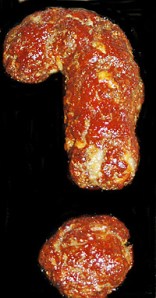
This interrogative meatloaf might actually be an alien. Punctuation is exciting!

This interrogative meatloaf might actually be an alien. Punctuation is exciting!

Earlier this month, March fourth to be precise, National Grammar Day was celebrated in the U.S. I like to think was the impetus for many dinners of punctuation-meatloaf (or walnut loaf for the veggie punctuation partiers among us). The day provides a neat excuse to chat about grammar which – I think many readers of this blog will agree – is always welcome. I am going to take advantage (albeit belatedly) of this excuse here and focus the issue of grammar testing.

An article posted on National Grammar Day by Grammarly’s Brad Hoover reminded me of this topic. Specifically, it was his reference to an article posted last summer by Kyle Wiens, CEO of iFixit. Wiens discusses in this article why he does not hire anyone (for any function) unless they pass a basic grammar test. The general message of Wiens’ article is uncontroversial: attention to detail is an important quality. However, his method for measuring this quality is very controversial. The 3,794 comments which currently accompany Wiens’ article will back me up on this assertion.

First published in 1991 and newly available online - click image for more information.

First published in 1991 and newly available online – click image for more information.

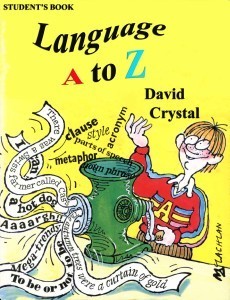
Grammar testing seems to be in fashion in some English-speaking communities and countries. David Crystal wrote recently on his blog that he suspects the renewed interest in several of his books – specifically Language A to Z, Words on Words, and Language Play – is related to the mandatory grammar tests for eleven-year-old students. This policy was introduced in 2012 by British MP and Secretary of State for Education Michael Gove.

British MP Michael Gove

MP Michael Gove

I’m not sure whether tests like the one proposed by Gove will be helpful for children in the long run. Here’s an article from yesterday’s The Independent which suggests they will not be. However, for better or worse, such grammar tests comprise one of the many hoops English speakers must be equipped to jump through if they want to do certain things in their lives – such as find work at a particular organizations such as iFixit.

Personally, I love grammar terminology and think it is a useful thing for kids to learn so they can chat about language more easily – as well make and enjoy grammar jokes if they so choose. But there are many things which are equally important to learn. What and how best to teach and learn things remains a complex and open question.

Grammar jokes stay great.

Grammar jokes stay great.

From the perspective of this project, it would be interesting to consider the correlation between the sales of English usage guides and particular policies on grammar testing over time and in different national and cultural contexts. I wonder about the extent to which such policies are reactions to increased popular interest in grammar education. Or are they more often simply actions by lone grammatically-oriented politicians? The power to exercise personal pet peeves may be intoxicating.

Exclamation man supports National Grammar Day!

Exclamation man supports National Grammar Day!

Please feel free to share information or opinions on this topic or others. And (belated) hooray for National Grammar Day: march forth grammar lovers!

Posted in cartoons, events, news | Tagged , , , , , , , | 2 Comments

Preserving students’ self-esteem?

From: The Book Depository .com

In his book Spoilt rotten: the toxic cult of sentmentality (2011), Theodore Dalrymple writes: “a friend of mine who teaches history at Oxford is specifically enjoined by the guidelines provided for markers [of papers, exams] by the authorities not to mark students down for their poor grammar, spelling and composition. If he were to so mark them, as once he would have done, good degrees would be awarded far less often than they are awarded. But at least the self-esteem of the students is preserved”  (p. 66).

I’d like to know how much truth there is in this observation. A friend of his? The guidelines? The authorities? Fewer good degrees if students’  language was corrected? From the University of Oxford? All this smacks of hearsay to me.

Or is it all true? Has any university teacher ever received such instructions from the university they work for in order to ensure higher pass rates? And do students need or even want to have their self-esteem preserved in this way? Unless I get to see the evidence, I find it all a bit hard to believe. And I’d also like to know if I’m the only one who is skeptical.

Posted in Uncategorized | Tagged , , , | 1 Comment

MA course on prescriptivism at Leiden

Next academic year, Ingrid Tieken-Boon van Ostade is offering an MA course on prescriptivism at the University of Leiden. The course, which will be called “Testing Prescriptivism”, is part of the MA track English Language and Linguistics, but is open to other students as well.

Testing Prescriptivism:

Prescription is the final stage in the standardisation process for a language like English or French, and it is followed by what is usually – pejoritatively – referred to as prescriptivism. The prescription stage has produced what are known as usage guides, works like Fowler’s Modern English Usage (1926) which offer advice on the correct usage of forms like taller than I/me, different to/from/than, lie/lay and hundreds of others.

star trek on tumblr

A staple item of usage guides, and one that has become iconic of the concept of prescriptivism, is the split infinitive, as in to boldly go where no man has gone before, but despite nearly two hundred years of adverse comment, the construction is more alive than ever. So are usage guides fighting a losing battle? And is this why they are produced in ever increasing numbers, in Britain as well as the US?

In this course we will study the phenomenon of the usage guide from a historical as well as a sociolinguistic perspective, and we will do so withing the context of the research project Bridging the Unbridgeable. Drawing on the HUGE database that has been developed for the purpose of doing research on the topic, and making use of linguistic corpora like the British National Corpus and the Corpus of Contemporary American English (as well as the Corpus of Historical American English) we will study the effect of nearly 250 years of prescriptivism on the English language.

The primary focus of the course is on English. But since prescriptivism is an issue in other language as much as in English – Dutch, French, Russian … – students with a background in other languages will be particularly welcome too, as this will enable us to take a comparative approach to this highly topical subject.

For further information, see Masters in Leiden, click on Literature and Linguistics, and then on Linguistics.

Posted in MA Leiden, news | Tagged , , , | Leave a comment

Guest lecture by Anya Luscombe: 10 April 2013

This gallery contains 1 photo.

On 10 April, Dr. Anya Luscombe from University College Roosevelt (Middelburg, The Netherlands), will give a guest lecture at the University of Leiden Centre for Linguistics. The lecture will be from: 1.15 to 3 pm, and will take place in … Continue reading

More Galleries | Tagged , , , , | 2 Comments

HUGE database

HUGE_logo-neat_colour1The creation of a database of English usage guides and usage problems: the Hyper Usage Guide of English, or HUGE-database, is one of the sub-projects within Bridging the Unbridgeable. It is the first database to combine more than two hundred years of usage advice into a single reference library.

1770_Baker_Reflections on the English Language T195603Strictly EnglishThe HUGE-database contains usage guides from the entire history of the genre, starting in 1770 with the publication of the first ever usage guide, Robert Baker’s Reflections on the English Language in 1770, up to the present day with one of the most recently published usage guides, Simon Heffer’s Strictly English.

a-dictionary-modern-american-usage-bryan-a-garner-hardcover-cover-artstrunk-and-whiteThe databse will also include such evergreens and best-sellers as Henry Fowler’s Dictionary of Modern English Usage (perhaps the most famous usage guide of them all) Bryan Garner’s Modern American Usage, Strunk & White’s Elements of Style and Eats, Shoots and Leaves by Lynne Truss.

We are still in the process of compiling the database, so it keeps growing all the time. We are currently working on an extension, which includes bibliographic information of secondary sources that deal with specific usage guides or usage problems. For now, the database can only be used in the project Bridging the Unbridgeable, but pending current copyright negotiations, we would like to eventually make the database more widely available.

Users can expect to find detailed advice on many usage problems in the English language, and will be able to compare usage advice across guides, across time and two varieties of English.

Posted in news, technology | Tagged , , , , , , , , , , | 6 Comments

Avoid saying ‘ketchup’

500 mistakesLooking through usage guides makes me notice prescriptions that haven´t quite ‘taken’. Especially older usage guides can be an amusing source of these. These prescriptions, in addition to prescribing current usage, often also give a prediction for future usage.

A while ago, I was going through Walton Burgess’s Five Hundred Mistakes of Daily Occurrence in Speaking, Pronouncing, and Writing the English Language, Corrected (1856) and I noted some of these predictive prescriptions. To start with, these are some words that are now pronounced in the ‘wrong’ way:

2010_04_08-KetchupCatsup

No. 23. “I prefer the yolk of an egg to the white:” the more common word is yelk, with the l sounded; but if yolk be used, it should be pronounced like yoke.

No. 309. “Let me help you to some catsup:” avoid saying ketchup.

No. 312. “We poled the raft up the creek:” pronounce as if written krik.

No. 391. “Gibbon wrote the Rise and Fall of the Roman Empire:” pronounce Rise, the noun, so as to rhyme with price; Rise, the verb, rhymes with prize.

The words afraid and by we now commonly use with the ‘wrong’ meaning, according to Burgess:

ridgefield20cannonball1No. 387. “I am afraid it will rain:” say, I fear. Afraid expresses terror; fear may mean only anxiety.

No. 457. “ He was killed by a cannon-ball,” should be, He was killed with a cannon-ball. He was killed by the cannoneer.

And these are some other incorrect usages, now in daily use as correct:

No. 14. “It is an error; you are mistaken:” say, you mistake. Mistaken means misapprehended; “you  mistake” means “you misapprehend.”

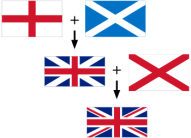
Flags_of_the_Union_Jack.svgNo. 100. “Victoria is Queen of the United Kingdom:” say, United Kingdoms. Who ever speaks of the United State of America?

No. 203. “Give me both of those books:” leave out of.

No. 490. Do not use to, the sign of the infinitive mood, for the infinitive itself. “I have not written to him, and I am not likely to” should read, “I am not likely to write to him

These prescriptions are all nice examples of how yesterday’s gaffes can become today’s standards. As we look at more usage guides, we will share more of these predictions that didn’t quite ‘take’.

Posted in usage features, usage guide | Tagged , , , | 3 Comments

The greengrocer’s apostrophe

I came across an interesting generalisation concerning the use of the apostrophe with plurals on the website  of the Apostrophe Protection Society, quoted in Beal (2010):

3. Apostrophes are NEVER ever used to denote plurals! Common examples of such abuse (all seen in real life!) are: 1000’s of bargains here! which should read 1000s of bargains here!

The following comment is added:

We are aware of the way the English language is evolving during use, and do not intend any direct criticism of those who have made the mistakes above. We are just reminding all writers of English text, whether on notices or in documents of any type, of the correct usage of the apostrophe should you wish to put right mistakes you may have inadvertently made.

As a English secondary-school teacher in The Netherlands, I felt intrigued by this, and decided to offer the following comment: firstly, not everybody that doesn’t precisely follow the rules outlined on the website is ‘illiterate’ or ‘stupid’. Secondly, it is not a matter of life and death if somebody gets their apostrophe’s wrong, you yourself had to learn it as well. Thirdly, life isn’t all that black and white. These generalisations seem to have a lack of scholarly nuance.

Continuing on my third point, I will now provide a different  explanation, proving any claim I make, in contrast to some who merely rely on their instinct to create a generalised ‘rule’. I now quote An English Grammar for Students in Higher Education (Koning & van der Voort 1997:165) on correct ways to form a plural:

Plural formed by ’s

[W]ith … numerals the plural may be formed by s, but s is more common: The 1980’s (but usually 1980s).

In addition, Practical English Usage (Swan 1995:465) also points out the following option:

Apostrophes are used in the plurals … of numbers. It was in the early 1960’s  (More usually: … 1960s).

There’s no such thing as a breakdown of society (as Beal comments on) when someone puts an apostrophe s after a numeral. Not intending to offer any direct criticism of those who have carefully compiled the list of language abuse, I would like to claim that it would be too easy to dismiss other variants, since English is and will always be the language of exceptions.

APS

References

Koning, P.L. & Voort, van der, P.J. (1997), An English Grammar for Students in Higher Education. Groningen: Wolters-Noordhof.

Swan, M. (2005), Practical English Usage. Oxford: Oxford University Press.

Joan Beal (2010), “The grocer’s apostrophe: popular prescriptivism in the 21st century”. In English Today 102. 26/2, 57-64.

Posted in usage features | Tagged , | Leave a comment

John E. Metcalfe?

Who was John E. Metcalfe? He appears to have been the author of a usage guide, called The Right Way to Improve your English. The book is cited by Milroy and Milroy (1999), but (apart from a couple of references to Fowler) it is the only such work they focus on. The Milroys drew upon the 1975 edition, which is a revised edition, so there must be an earlier first edition, but I can’t seem to find it.

Milroy and Milroy cite him for his objection to expressions like face up to, stand for, slow down, try out and the like, which they quote him as describing as “hateful”, “horrible” and “disreputable”  (1999:62). In other words, he is cited (among other things) for using the kind emotional metalanguage that we often find in popular books on usage. (The Milroys do not deal with Metcalfe’s use of metalanguage though.)

On p. 57 of their book they write that the book “first appeared as an inexpensive paperback in 1963 and has been reprinted several times”.

But who was John E. Metcalfe? And why was his book so popular that a revised edition was required? These are things we’d very much like to know. And if anyone has a copy to spare, we’d be very interested.

References:

Metcalfe, John E. (1975), The Right Way to Improve your English [rev. ed.]. Kingswood, Surrey: Elliot Right Way Books.

Milroy, James and Lesley Milroy (1999), Authority in Language. Investigating Standard English [3rd ed.]. London and New York: Routledge.

Posted in usage guide | Tagged , | 2 Comments