Give me some data!

Researching language in its social context inevitably includes collecting considerable amounts of data. As I move closer to the fieldwork period of my research project, I have set up a new blog to help me get in touch with (primarily) American English native speaking enthusiasts and collect data for my project.

Langitudes: Attitudes to language usage in American English will serve as a data collection portal, in addition to discussing content related to the sub-project investigating attitudes in American English.

Check out the blog for new content in the days to come, and make sure to fill in the inauguration survey.

Posted in polls and surveys | Leave a comment

God Save the Queen … and this blog, innit?

The time has come to launch the blog of my PhD project called Proper English Usage: A sociolinguistic investigation of usage attitudes in the ‘Golden triangle. The title of this post will probably have given away the target group of my research; it is indeed targeted at British English speakers. Before you skip this post and go on to the next, even though it is mainly about attitudes of British English native speakers, English usage and disputed items are discussed, and every input is highly appreciated. So please go on, browse through the blog, fill in the usage polls and spread the word: A new blog is in town. It has an attitude, so beware!

Proper English Usage

Proper English Usage


Posted in news | Tagged , | Leave a comment

Baker and the apostrophe

Baker’s Reflections (1770) includes, among others, rules on the proper usage of the apostrophe (XXV). According to his remarks, this punctuation mark ought to be avoided when the writer intends to indicate a plural and he also encourages the audience to write words at full length.

greengrocer's apostrophe

He was dealing with the so-called grocer’s apostrophe though his concern with such punctuation mark did not surprise me as it was “one of the greatest bêtes noires of popular prescriptivism”, as Joan Beal described it. Rather, I was surprised by the slip I came across:

(…) “The Words ought to be written at full length, the Pronunciation being the Same when the E is inserted as when it is omitted and it’s Place supplied with an Apostrophe” (sic.) (1770: 26)

Thanks to this, I can figure out why the apostrophe became a matter of concern in the 18th century. Even though he attempted to lay down general and hands-on rules, Baker also committed “abuses” since the usage of the apostrophe was still far from being regular. The proof of the pudding is in the eating! Though, we must also consider the possibility of Bakers’ typesetter as the responsible for such typo… who knows.

References:
Baker, R. (1770). Reflections on the English Language, In the Nature of Vaugelas’s Reflections on the French. London.

Beal, Joan C. (2010) “The grocer’s apostrophe: popular prescriptivism in the 21st century.” English Today. 26 (2): 57-64
Posted in MA Leiden, usage features, usage guide | Leave a comment

Publication history Fowler ctd.

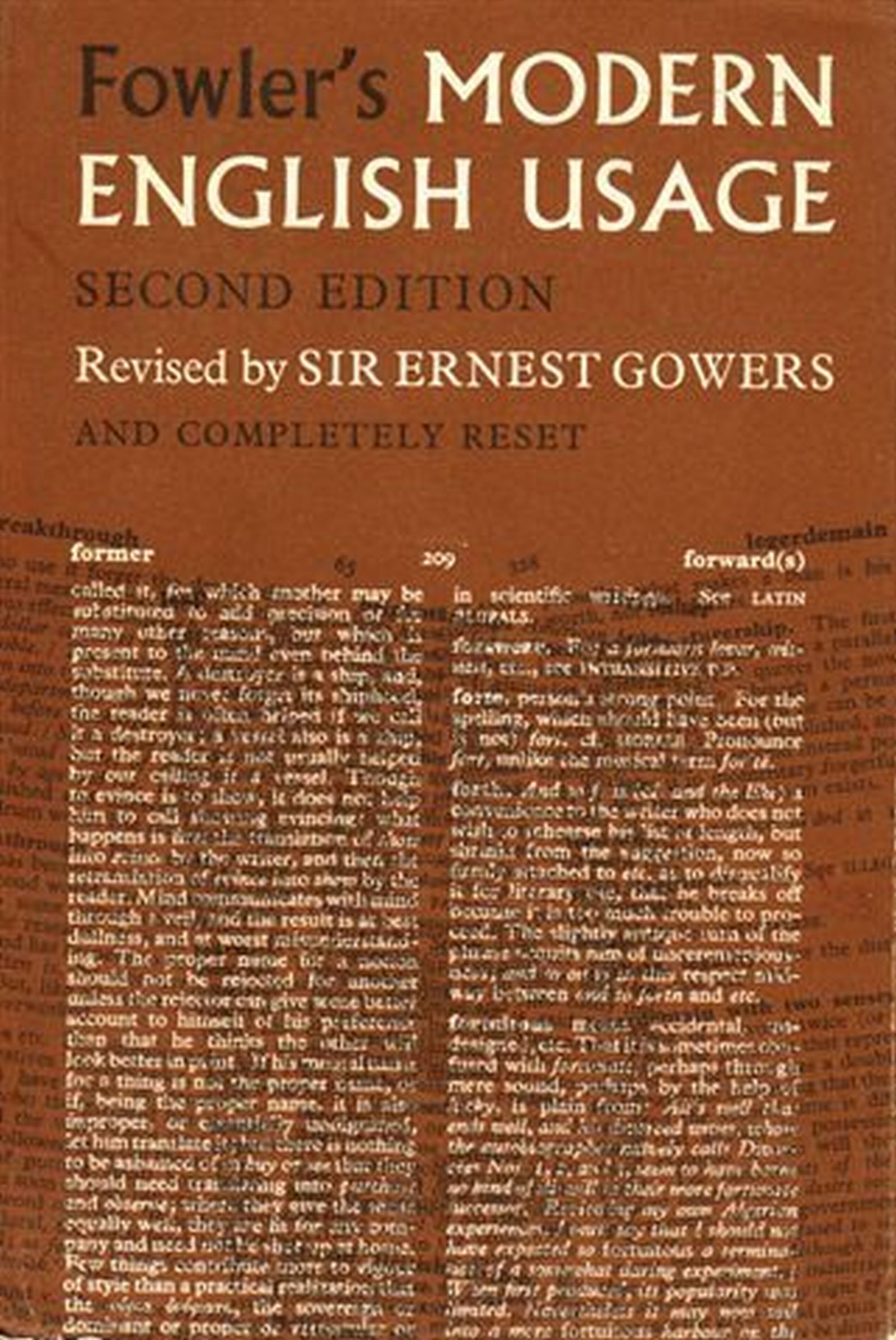
Fowler_(Modern_English_Usage) largeIn an earlier post, I announced my attempts to reconstruct the publication history of Fowler’s Modern English Usage. This weekend, I was able to lay my hands on another copy of Fowler (my 8th!) at the same second-hand shop, and equally cheaply. It is a 1975 reprint of the second edition, revised by Ernest Gowers (1965).

I can now add a great deal more to my original overview:

  • first edition April 1926
    • reprinted June 1926
    • reprinted August 1926
    • reprinted October 1926
  • reprinted
    • 1930 (with corrections)
    • 1933
    • 1934
    • 1937 (with corrections)
  • second edition 1965
    • reprinted with corrections 1965 (twice)
    • 1966
    • 1968 (with corrections)
    • 1970
    • 1972
    • 1974 (with corrections)
    • 1975
    • first issued as OUP paperback 1983
  • third edition 1996
    • revised 1998
    • reissued with title change 2004.

There will be more to follow (and of course additional information will be very welcome).

Posted in Uncategorized | Leave a comment

Pre-conference workshop

Attitude-Holland-AHAttitudes to Prescriptivism is the theme of a workshop that we will hold on Tuesday 11 June 2013as a ramp-up to the conference Prescription and Tradition in Language which will take place here at Leiden University. There is more information about the workshop on the conference page of this blog. Watch out for a call for papers next week and keep coming back for updates on the programme!

Posted in announcement, events, news | Tagged , , , | Leave a comment

My amazement with amaze

Checking one’s facebook page in the morning is probably one of the first things done by any “normal” facebook addict. Well, having said that, I am one of them. So this morning, still sleepily taking a few sips of my coffee, I stumbled across a post which caught my eye immediately. No, it was not a post about kittens and no it was also no post revealing any shocking confessions of one of my fb friends. It was a word that caught me off guard and instantly made me snap wide awake; the word was amaze.

You may ask yourself why I am so intrigued by this word and the answer is simple: its usage. Having been familiar with it being used as a noun as well as a verb, I have recently noticed amaze being used as an adjective. Apparently, one can look amaze in a new dress and buy amaze mugs and Tshirts.

The Urban Dictionary, a dictionary dealing with slang and phrases, defines this new usage as being used by “annoying teenage girls”, as “the better, in fact BEST, way to say something is amazing” or simply referring to amazing. Seeing the usage of amaze expand makes me think about the consequences for the good old amazing. What do you think? Is amaze just a temporary trend or is it here to stay? How acceptable is amaze?

Posted in usage features | Tagged , | 3 Comments

Prescription conference papers

For a list of speakers  at the prescription conference (University of Leiden, 12 – 14 June 2013) as well as for the abstracts of the plenary speakers, see the black bar above. The abstracts of the speakers will follow soon.

Posted in news | Tagged | Leave a comment

Brief account of the evolution of Spanish prescriptivism

Antonio de Nebrija's Spanish GrammarIn the 13th century the process of standardization of the Castilian language started when Alphonse Xth, the Wise (1252-1284), ) acknowledged it as the official language. Likewise, Antonio de Nebrija wrote the 1st Spanish grammar in 1492 wherewith one of the basic rules of the Castilian language was established: spelling must be adjusted to pronunciation.
The period that spanned the 16th and the 17th centuries was the period that encompassed the phase of ‘Selection’, that is to say, the first stage of the process of standardization according to Milroy and Milroy (1991). The Toledan Castilian of the court was selected as the “pure” norm of the language at the expense of the Andalusian dialect so that national and social purisms emerged.

One century later, aimed at fixing the language and sanctioning former changes made by speakers throughout the centuries, the Royal Spanish Academy (Real Academia Española) was founded in 1713.

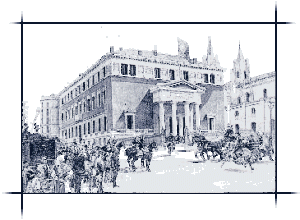
Inauguracion_AcadThis institution had a regulating role that implied the ‘purification’ of the language from other external linguistic influences. Besides, in search of linguistic norms, the first publication of its grammar in 1771 supposed the codification of the rules that embodied the pillar of the identity of Spanish society.
Nowadays, the Academy alongside the twenty-one Latin American academies fosters the language’s cohesion under the motto: “Unidad en la Diversidad” (that is, “Unity in Diversity”) whereby they strive to reach a consensus on a common norm for grammar, spelling and lexis (La función política de las academias de la lengua).

Sources:
LUDWIG, R. (2000), “Desde el contacto hacia el conflicto lingüístico: el purismo en el español. Concepto, desarrollo histórico y significación actual”, Boletín de Filología (Facultad de Filosofía y Humanidades. Universidad de Chile) 38 (1): 167-196.
MILROY, J. and MILROY, L. (1991) Authority in Language. London, Routledge.
La función política de las academias de la lengua. In: elcastellano.org (la página del idioma español).
Ortografía de la lengua española. In: Salvador Gutiérrez Ordóñez. Real Academia Española.
Posted in MA Leiden, Uncategorized | Tagged , | Leave a comment

This blog in the Leiden University Yearbook for 2012

The Bridging the Unbridgeable blog got a mention in the University Yearbook Our World which appeared on the Leiden Dies, on 8 February. Read all about it on page 21.

Leiden University Yearbook 2012

Posted in news | Tagged , | Leave a comment

Focussing? Focusing?

A while ago, I used to get phone calls from colleagues from all over the university with questions like how to write focussing, with single or double s. As a member of the English department I was expected to know these things. The questions have stopped coming, which may be due to the university-wide use of Microsoft Word which tells you whether you made a spelling error. (I switched this option off, because I often work with 18th-century documents, which consequently get marked with red squiggles all over.)

Fowler 3rd ed.But I always vaguely assumed that there were different preferences between British and American English, and wonder whether people who rely on Word’s spelling checker are aware of this. But perhaps I’m wrong. I now get increasingly insecure as students correct me for writing things like: “Next time, try focussing on …”. Looking this usage feature up in Fowler (Burchfield’s 3rd edition, 1996), I read that the “proper” spelling is focusing (is it really?), but that “forms with –ss– are used by many printers and publishers”. So what do I do now? Do different publishers’ style sheets include spelling features like this?

Lets have a vote on this, and fill in the poll. 

Posted in usage features | Tagged , , , , | 12 Comments