Prescriptivism conference: Leiden 2013

As announced earlier in this blog, the next prescriptivism conference will be held in Leiden, on 12, 13 and 14 June 2013. A call for papers will be launched soon.

Meanwhile, we are happy to inform our readers that we have contracted three plenary speakers:

We’ll post further news about the call for papers soon.
Posted in news | Tagged | Leave a comment

Waterstone’s and their apostrophe

A few days ago, Marilyn Hedges, one of our contributors, left a comment to tell us that she had heard on the BBC Radio 4 Today programme that Waterstone’s has decided to drop its apostrophe.

As Marilyn summarised:

The reason given was that the apostrophe creates too many difficulties and too much confusion in today’s internet world, particularly with email (in email addresses, etc.). The Apostrophe Protection Society was not best pleased! Could this be the thin end of the wedge for the apostrophe?

In fact, the apostrophe is widely being dropped already, as we can see on this website for instance, which is kept by Woodlands Junior School in Tonbridge, Kent (UK). It seems that the Apostrophe Protection Society is fighting a lost battle.

Posted in news, usage features | Tagged , | Leave a comment

Reading John Honey’s The Language Trap

This gallery contains 1 photo.

John Honey’s The Language Trap, subtitled “Race, class, and the ‘standard English’ issue in British schools”, is a 38-page pamphlet published in 1983 by the National Council for Educational Standards. It is a controversial document to say the least, even by … Continue reading

More Galleries | Tagged , | 2 Comments

Grammar advice on the go

simulation of iGE on iPhone4

I just found out this week that linguists at University College London have developed an app called interactive Grammar of English (iGE). The app is based on the British Component of the International Corpus of English (ICE-GB) developed by the UCL Survey of English Usage, which started in 1959 by Randolph Quirk, and which already has produced several grammars since its inception. The iGE is the latest of these and offers itself as a ‘comprehensive introductory course in English grammar’.

It’s quite easy to use and has interactive exercises, complete with feedback, to test what you have learned. All in all, at less than five euros it’s a nice addition to students’ resources. I’m not sure I’d go as far as to chime in with its creators’ cheer that “Learning grammar can be fun!” but at least with this app you can do it wherever.

Will this kind of usage-based descriptive grammar bring normativism, usage and descriptivism closer together by virtue of those in need of usage advice having easy access to it?

Posted in news, technology | Tagged , , , , , | Leave a comment

3 PhD positions for the Bridging the Unbridgeable project

In the course of the next few weeks, three PhD positions will be advertised for this research project. So keep an eye out for more information, on this blog as well as on the University of Leiden Centre for Linguistics website. And if you’re interested, leave a comment so that we will be able to get back to you with more information. (The comments themselves won’t be published.)

Posted in news | Tagged , | Leave a comment

Fighting Estuary English with an English Academy

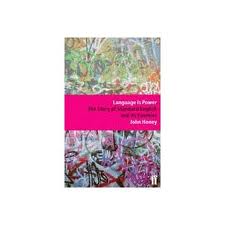
This is a suggestion made by John Honey in Language is Power (1997:166-168). Estuary English Honey describes as being typically characterised by t-glottaling and l-vocalisation (though there are many other characteristics of Estuary English as well). Already in 1989 he had described what he calls “the invasion of RP by these features of ‘typical London speech'”.  A few years later, Honey notes, it was “condemned by the Secretary of State for Education as a form of English to be discouraged by schools”.

Apart from his pejorative attitude to this variety of English, it is interesting to see that Honey calls upon the institution of an Academy as a solution to put a stop to its “invasion” and spread. Such an attempt would be failed to doom, as the parallel case of the French Academy’s attempt to halt the influx of English words and expressions into French (see elsewhere in this blog). And why put a stop to Estuary English to begin with?

In calling for an English Academy Honey aligns himself with his eighteenth-century illustrious predecessors Dryden, Addison, Defoe and Swift. During the eighteenth century, calls for an academy eventually died down, and the issue is only revived sporadically, most notably in Robert Baker’s Reflections on the English Language (1770) and much later in John Simon’s Paradigms Lost: Reflections on Literacy and its Decline (1980). It seems a typical ready-made solution that presents itself to prescriptivists like Baker (who was the author of the first English usage guide ever written) and Simon, and Honey thus neatly fits into this same category of writers.


Posted in Uncategorized | Tagged , , , | Leave a comment

Finding reviews of John Honey’s Language is Power

In an earlier post, we mentioned our quest for reviews of John Honey’s Language is Power, first published in 1997 by Faber and Faber. Several have come up, including a review by Jean Aitchison in the Sunday Times of 14 September 1997 (thanks to Kate Wild for this).

But how to find the review? Leiden Universitty Library only keeps the current month’s copies. Fortunately, the library also subscribes to Factiva, which contains (according to their own website) “the world’s best news and business information with search tools that fit every need in your organization”. It turns out to be a fantastic tool: searching the database for “John Honey” with a data range that covered all over September of the year when the book came out produced Jean Aitchison’s review (published a week earlier than she herself recorded on her website) as well as a review by Donald MacLeod (2 September 1997) and an announcement showing that the book had been “Pick of the week” for The Guardian during that month. It would be interesting to find out how many copies were sold as a result. And of course there will be no end to things that can be searched for in newspapers with the help of this tool.

Posted in Uncategorized | Tagged , | Leave a comment

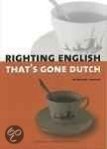
Dunglish: How English should a text be?

This gallery contains 1 photo.

This will be one of the topics discussed at the SENSE panel discussion ‘Varieties of English: How prescriptive should we be?’ on 27 January (see under News for more information). One of the panel members will be Joy Burrough-Boenisch, the author of the … Continue reading

More Galleries | Tagged , , | Leave a comment

Something for the Christmas break

We have just published the sixth usage poll, which we hope you will have time to complete during the upcoming Christmas break. You will find it under the tab Usage polls just under the banner of this blog.

We’re temporarily skipping the fifth usage poll for reasons explained in the poll itself, but we’ll let you have it in the near future. We will be very grateful for your feedback once again, and hope you will continue to read this blog and let us have your contributions throughout the year 2012! Our best wishes for the New Year!

Posted in usage features | Tagged , | Leave a comment

Usage problems in (Dutch) students’ essays

I’m currently reading a pile of students’ essays on the use of WordSmith Tools in the analysis of two eighteenth-century English novels. They make very interesting reading, and no two are alike.

This time, though, in view of the discussions about usage and usage problems on this blog, I decided to keep track of the kind of usage problems I encountered in their writing (which btw tends to be very to fairly good).

So far, I’ve listed the following:

  • to dig even deeper (for “more deeply”)
  • computer programme (for “program”)
  • this research (for “analysis”: is this an Americanism?)
  • amount of similarities, a high amount of French words (for “number”)
  • it are these differences (possibly a typically Dutch error)
  • the reason is because (for “that”).

How common are these features among native-speaking students? Mine are in their second year. What other features of this kind do readers of this blog encounter?

Posted in usage features | 4 Comments