A review from the UK Guardian yesterday: “Linguists say that random chance plays a bigger role than previously thought in the evolution of language – but also that ‘English is weird’”, available here.
I just proofread an article of mine which had been copy-edited, in the process of which all my whichs (and some whos) had been changed into thats! Copy-editors tend to be anonymous, but I bet this person was American. Another which-hunter caught!
To put the final (well, almost final) touches on my study of usage guides and usage problems, I decided to have one more survey, on the acceptability of –lily adverbs. These are words like cowardlily, ghastlily, heavenlily, livelily, lovelily, lowlily, manlily, mannerlily, scholarlily and statelily, which several usage guides claim should be used since all adverbs should be marked by –ly, even if the adjective concerned already ends in –ly.
Microsoft Word, as I saw in the chapter I'(re)writing, only accepts the form livelily. What do readers of this blog think, are these forms acceptable or not? Please let me have your opinions, and fill in the survey — the last one for my book, I promise!
Anne Curzan (Fixing English: Prescriptivism and Language History, Cambridge University Press, 2014) has recently(?) launched an “English Grammar Boot Camp” with The Great Courses. This is “a thorough immersion in all of the key elements of English grammar and usage”, in twenty-four lectures, from “Why Do We Care about Grammar?” to “Trending Language”. This is not a MOOC but a paid-for course, either as DVD or Video Download. Might be interesting!
… a chapter on prescriptivism. True recognition of an important approach and an interesting perspective on the subject. Congratulations Laurel Brinton!
A very positive review has recently appeared of our book Prescription and Tradition in Language, in the Kelvingrove Review, issue 16, called “Rise and Fall” (pp. 15-16). The review is by Colin Reilly from the University of Glasgow, who highlights several important points about the book, and only notes (rightly, in our view!) that more languages could have been dealt with, and that particularly languages from South America are not represented.
… interview with Carmen Ebner about her PhD thesis, which she successfully defended on Tuesday, this time in the Leiden University weekly Mare. The interview is even announced as a feature article on the front page.
Common Errors in English is a website that has been up and running since March 1997, as its maker, Paul Brians, told me. Does that make it the oldest language advice website that has been about? Quite possibly It has also been up for twenty years this year, and has just been given beautiful a new interface.
It was given this new interface (an 18-month job no less!) not because Paul asked for it, or as a twentieth birthday present, but because it was recognised that it was “by far the most popular academic area on the entire university Web system”, as Paul emailed. Washington State University, well done to give recognition to the importance of language advice on the web!
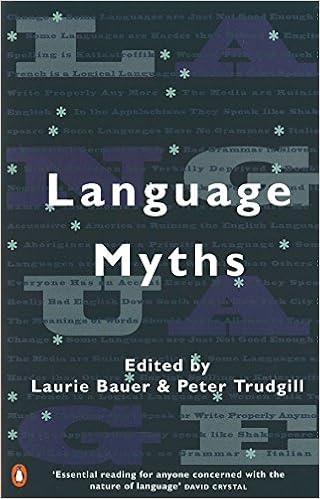
I’m reading (partly re-reading) the book Language Myths, edited by Laurie Bauer and Peter Trudgill, published in 1998. It includes 21 pieces by well-known linguists such as James and Lesley Milroy, Jenny Cheshire, Dennis Preston, John Algeo (apologies to the others for not mentioning them as well), who one after the other set out to debunk long-standing myths such as “French is a logical language” (Anthony Lodge) and “Women talk too much” (Janet Holmes).
The Introduction reads that “linguists have not been good about informing the general public about language” (p. xv), and on the cover we can see a blurb by David Crystal (who did not write any of the pieces in the book) saying that the book is “Essential reading for anyone concerned with the nature of language”.
My question, while reading the book, is whether the book succeeded in “informing the general public” about these myths being without any grain of truth, in other words, whether they succeeded in killing the myths or whether, as is in their nature, the myths simply continue to be what they are. This has been my own experience when I tried to kill the myth that Lowth wrote his grammar as a bishop. I can usually tell if people did or did not read The Bishop’s Grammar (2011) by the way they refer to Lowth in their own subsequent publications.
My impression is that Language Myths is read only by linguists, for why should the general public want to be told that Italian is not beautiful (Howard Giles and Nancy Niedzielski) or that bad grammar is not slovenly (Lesley Milroy) when this is how they it? Why should the general public want to listen to linguists? Recently, I had a discussion with someone about the “new” use of singular they as believed to be advocated by LGTB activists. My telling her that singular they has been around since the age of Chaucer fell on deaf ears. And why should it have done otherwise since it is something she finds she is bothered by? So shouldn’t linguists, instead of “informing the general public about language” engage into a discussion with the general public about why they feel the way they do about these thing? Talking with instead of at them, as the book seems to do?
So I thought: lets have another poll about this question. Please let me know what you think! I’d really like to know. (And please note that by the term linguist I don’t mean somebody who knows many languages!) Feel free to leave comments as well.

 A very positive review has recently appeared of our book Prescription and Tradition in Language, in the
 The Introduction reads that “linguists have not been good about informing the general public about language” (p. xv), and on the cover we can see a blurb by David Crystal (who did not write any of the pieces in the book) saying that the book is “Essential reading for anyone concerned with the nature of language”.


 Bridging the Unbridgeable