Microsoft Word, or: what is wrong with prescriptivism?

I’m reading through Carmen Ebner’s PhD thesis one more time (defense coming up soon!), and it strikes me in my own writings, too, every time – the red squiggles under prescriptivism, as in the header to this post. It makes me terribly insecure: is the second r in place? What is wrong with the word, why don’t they like it, over at Microsoft?

Posted in usage features | Tagged | 2 Comments

How many d’s in Grand(d)ad? No riddle

This post is dedicated to Clive Upton, who was surprised that I spelled Granddad with two d’s in the middle. I’m no native speaker, and just told myself: surely it must be grand + dad. Since then I looked it up in my copy of the Concise Oxford Dictionary, which allows for either: grand(d)ad, but this doesn’t help the linguistically insecure or those of us who just want to know which of the two is the correct spelling. Surely one must be better than the other? So, tell us what YOU think is better or more correct? Or if you think either is fine, in which case it wouldn’t be a usage problem?

Even if most people on this blog voted for granDDad (71.4% at the moment of writing), Penguin seems to prefer granDad. Or seemed to do so in the mid-1980s: I’ve just reread Nice Work by David Lodge (p. 373, where Grandad is spelled with a capital G as well).

Posted in Uncategorized | 5 Comments

TIME Magazine – a style guide?

I’d like to know if TIME Magazine employs a style guide. The answer is of course “yes”, but do they have style guide of their own? And is it publicly available?

In particular, I’d like to be able to see what their views are on the placement of only (he only had/had only one chapter to finish). The reason I’m asking is that my search for this construction in the TIME Magazine Corpus produced fewer instances of had only (the prescribed variant) than only had (the criticised form) for the last decade which I looked at (the 2000s). The decrease suggests that only had is now no longer the prescribed form. Does anyone have any views on what may have happened in terms of TIME’s editorial style? And can anyone help me find access to TIME’s styleguide if such a thing exists?

Posted in usage features | Tagged , | 2 Comments

Congratulations, Paul Brians!

This year, it has been twenty years since Paul Brians first published his website Common Errors in English Usage online. The late 1990s were early days for internet usage advice, so congratulations, Paul! It seemed a good idea to publish a book based on the website as well, and it first came out in 2003, with a third edition published ten years later. Another major achievement – three editions in ten years time. Paul tells me the book has been selling well.

Paul also produces regular podcasts on Common Errors (not so long ago, I was even interviewed on our project for one of them: Episode 8 of the series), but there are two more recent ones about the history of the Common Errors website, Episode 15 and Episode 16. We hope you will enjoy listening to them, and that you will join us in our warmest congratulations of this wonderful anniversary!

Posted in news, usage guide | Tagged | 2 Comments

Angela Burt

I’m trying to get in touch with Angela Burt: perhaps someone can help. She is the author of The A to Z of Correct English (2000), but the publisher, How To Books, no longer seems to exist. The blurb of the book describes her as in the image below, and the book appears to have been quite popular. The new edition dates from 2004.

angela-burt

Posted in usage guide | Tagged | 6 Comments

Yet another survey

For English Today readers, and indeed anybody else who may have missed it last time, here is my trial survey, on number concord in the species noun phrase, which I have posted on Qualtrics. You will find the survey HERE. It’s a short survey, starting with an example from Mittins et al.’s (1970) Attitudes to English Usage, just to set a bench-mark. This is followed by twelve examples, all taken from my corpus, and differing from Mittins et al. in that they are all presented in context, typically including the sentence before and the sentence following. Apart from teasing out your attitudes to number concord, the survey also gives you the opportunity to comment at length. I am hoping to use your responses to refine the survey for the authors of my corpus.

If you would like more details on the survey, please go to  BtU HERE .

Many thanks! Adrian Stenton, PhD candidate at the Leiden University Centre for Linguistics.
Posted in Uncategorized | Leave a comment

The Pedant on the split infinitive

For readers of The Times or anyone who didn’t happen to be present: yes this was us, and thank you, Oliver Kamm for referring to the symposium! The column is a good read, and offers excellent advice: it is alright to split infinitives!

(Thanks, Marilyn, for the reference.)

Posted in news | Tagged , | Leave a comment

A Christmas wish

On behalf of all the members of the Bridging the Unbridgeable project: our very best wishes for Christmas and the New Year, hoping for continuing very useful input from you all!

kerstkaart2016

Posted in Uncategorized | 2 Comments

Call for Papers on standardisation

At last week’s symposium. Linda Pilliere announced a call for papers for the international peer-reviewed electronic journal E-rea that might be of interest to readers of this blog, so I’m passing it on. More information here.

More Galleries | Leave a comment

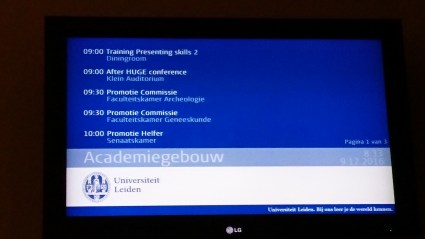
Life after HUGE? Absolutely!

after-huge

Many thanks to all the speakers for their wonderful presentations as well as to the participants for the discussions afterwards. Read more on Twitter: #afterhuge!

Posted in events, news | 1 Comment