The next Prescriptivism conference: 21-23 June 2017

Following the fourth conference on prescriptivism, which was held here at Leiden and co-organised by the Bridging the Unbridgeable project, the next one will be held at Park City, Utah, organised by Don Chapman from Brigham Young University.

The theme for the conference will be “Value(s) of Language Prescriptivism” and papers on any aspect of prescriptivism are invited. So SAVE THE DATE: 21-23 June 2017, and further details will be announced soon.

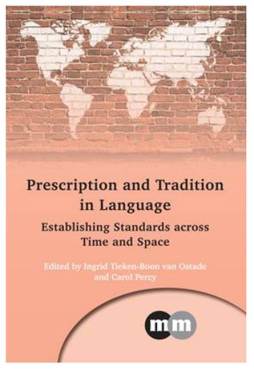
The book of the previous conference will be out by then. Find more information on the Multilingual Matters website.

Prescriptivism book

Posted in announcement, events, news | Tagged | 3 Comments

“Use the active voice” – full stop

Here is one example of the effect which following up on Strunk and White’s linguistic advice may have (see last week’s blog post on this):

He spent a considerable portion of 1802 in Nellore collecting manuscripts, interviewing local Brahmins whom they considered accomplished poets, collecting information on local libraries and their contents, and finally translation work (p. 137).

(Thanks to my husband for the example.) They? Who are they in this context? The subject in the preceding clause is “he”, pronominalising Lakshmaya in the sentence before that. Is this the work of a copy-editor, alerted to a passive (“who were considered accomplished poets”) and applying Strunk and Whites dictum “The active voice is usually more direct and vigorous than the passive” (p. 18 in my copy)? (If so, he or she may have been pleased to be able to change the who into whom at the same time.)

Nearly five years ago I reported on a conference paper by the late Geoffrey Leech on this blog, called “Decline and (?)disappearance: The negative side of recent changes in Standard English”. The passive was one construction under threat according to Leech, which he attributed to the over-zealous application of prescriptive rules in popular (American) usage guides like Strunk and White. So, copy-editors at OUP’s New Delhi branch and elsewhere: keep the passives in, this will keep them alive and “vigorous”, but will stop us from making grammatical blunders in the first place.

Posted in usage features, usage guide | Tagged , , | 2 Comments

Strunk & White in our very own NRC-Handelsblad!

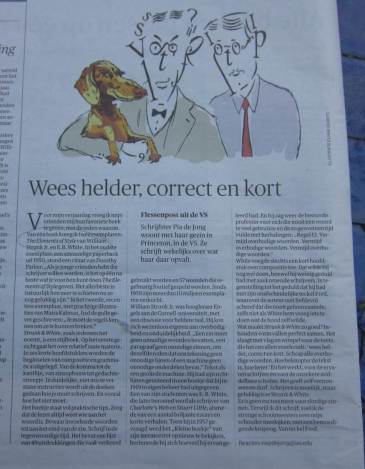
I don’t always read the Dutch writer Pia de Jong’s weekly column from the US in our paper, but last night, turning over the NRC, my eye was immediately drawn to the words Elements of Style: Strunk and White in NRC-Handelsblad, wow, a truly major event in Dutch newspaper writing. (Lovely image btw, Eliane Gerrits!)

In the article, Pia de Jong narrates how she received two (!) copies of the book as recent birthday presents, and enthusiastically reports on the useful writing advice she encountered in her reading of it. To be sure, Strunk and White is probably the most successful (in terms of publishing figures, that is!) usage guide of all times, but may we give you some serious advice here, Pia? Before you actually start implementing  what you find in the book in your writing, first read Geoffrey Pullum’s comments on the book. They may make you think twice – well, hopefully anyway.

Strunk&White in de NRC


Posted in news | Tagged , , , , | Leave a comment

Fingers crossed, please!

A few weeks ago, I submitted our HUGE database as a candidate for the Nederlandse Dataprijs. By mid-September, the jury will nominate three potential winners, and we hope to be among them. What is more, we would really like to be included in the list of winners below, so do please keep your fingers crossed for us!

Picture1

Posted in news | Leave a comment

“Basically … rather good”

Just decided to check up on the reception of Simon Heffer’s new (well, two years old by now) usage guide called Simply English, and found that Ben East, in The Guardian, described it as “basically … rather good”.  Interesting, in view of the rather substantial criticism this “journalist-turned-grammarian” as Ben East calls him, got on his earlier book Strictly English (2010). When confronted with this criticism in the online debate between usage experts “Between you and I the English language is going to the dogs” broadcast in 2014, Heffer seemed unaffected by what linguists like Geoff Pullum and David Crystal had said about his earlier book. So has anyone read Simply English yet, and is it indeed “rather good”?

Posted in usage guide | Tagged , | 4 Comments

Frank Sinatra and prescriptivism

This summer, driving through France, one of the CDs we played was “The best of Frank Sinatra”. Singing along with his very popular “That’s Life” (1966), my attention was suddenly caught by his use of laying for lying: “Each time I find myself layin’ flat on my face …” (sung here a bit faster than on our own version). Ha! Would that be one of the reasons why lie/lay is the most treated usage problem in the usage guides in the HUGE database?

Posted in usage features | Tagged , , | 2 Comments

9 December – Life after HUGE? Registration now closed

Registration for the symposium is now closed. Should you wish to attend the symposium after all, please leave a comment, and we will see what we can do.

Below, you will find the preliminary programme for the symposium Life after HUGE? which will be held on 9 December at the Leiden University Centre for Linguistics. Registration is now open, and you may do so either by leaving a comment to this message or by sending an email to Ingrid Tieken-Boon van Ostade (i.m.tieken@hum.leidenuniv.nl). There will be no fee for the conference, so we hope to see as many of you as are interested in the topic. Please note that coffee, tea and final drinks will be provided. There are several places for lunch in the direct vicinity of the Academy building where the symposium will take place.

Symposium: Life after HUGE?

Speakers:

Rebecca Gowers, “Another One?”

Why I wanted to write Horrible Words. What I thought I was after. Certain ways in which I know the book failed. Other ways in which I hope it modestly succeeded. How some of the responsibility for all this can be laid at the feet of Ingrid Tieken-Boon van Ostade, her colleagues and various of her PhD students. An undertaking never to try anything similar again.

Oliver Kamm, “Prescriptive Grammar: the Quest for Correctness”

Popular discussions of “grammar” are remote from the findings of modern language scientists. Yet pundits, politicians and journalists dominate these debates. Why do they exercise such sway when their message consists of little more than a list of arbitrary “rules” that were untrue even when they were devised? It has to do with antiquated notions of gentility and proper behaviour. Linguistic research is making belated inroads into education but has to constantly contend with popular worries about “incorrectness” in grammar and orthography. It’s a destructive opposition.

Harry Ritchie, “The Fearful Backwardness of the Natives”

Harry Ritchie describes the dreadful results in the English-speaking world of the continuing reign of prescriptivists and the complete ignorance of even the basics of linguistics. Rather than celebrating their linguistic expertise, native speakers  are taught to be ashamed of their English. Rather than celebrating dialect diversity, English-speakers are taught that only standard is correct, and any non-standard usage is inadequate or just wrong. The result is a perniciously effective and never-acknowledged system of linguistic discrimination, based on class in the UK, and class and race in the US.

Robin Straaijer, “Following Fowler: A birdseye view of the most influential English usage guide”

Last year, a book called Fowler’s Dictionary of Modern English Usage (Butterfield 2015) was published. Written, or rather compiled, by a lexicographer at the Oxford English Dictionary, it is the fourth edition of Henry Fowler’s Dictionary of Modern English Usage (Fowler 1926), or what we have come to know as ‘Fowler’. This latest edition, though still ‘a Fowler’, is understandably rather a different book than its ninety-year old original.

So how did we get there? I will take you through the various editions of the Dictionary of Modern English Usage and show how throughout its publication history it has been shaped by the development of the genre of usage guides, as well as how it influenced this process at the same time – not just in terms of content and methodology, but also in terms its wider place in the world.

I will show how other usage guide writers have been following Fowler: how the original Dictionary of Modern English Usage has changed the genre, since Fowler “is not just one in a long row of usage guides but a special case, and arguably the most influential usage guide throughout the 20th century” (Busse and Schröder 2010: 52) and has become “the generic model for prescriptive usage books” (Peters 2006: 763). Taking Butterfield’s new Fowler’s Dictionary of Modern English Usage as a jumping-off point, we will follow Fowler from book to institution to brand. I will illustrate how the content of ‘Fowler’ has changed with the times by showing some examples of usage problems drawn from the HUGE database (Straaijer 2014) and how they compare with Butterfield’s 2015 edition.

In addition, I will talk about one usage guide writer who followed Fowler: the American legal lexicographer Bryan Garner, who seems to have been actively branding himself as the American version of Fowler.

References

Busse, Ulrich, and Anne Schröder. 2010. “How Fowler Became ‘The Fowler’: An Anatomy of a Success Story.” English Today 26: 45–54. doi:10.1017/S0266078410000088.

Butterfield, Jeremy. 2015. Fowler’s Dictionary of Modern English Usage. Oxford: Oxford University Press.

Fowler, Henry 1926. A Dictionary of Modern English Usage. Oxford: The Clarendon Press.

Peters, Pam. 2006. “English Usage: Prescription and Description.” In B. Aarts and A. McMahon (eds) The Handbook of English Linguistics (759-780). Oxford: Blackwell.

Straaijer, Robin. 2014. The Hyper Usage Guide of English (HUGE) database. Leiden University. http://huge.ullet.net.

Lyda Fens-de Zeeuw, “The HUGE presence of Lindley Murray”

The grammarian Lindley Murray (1745–1826), by all accounts, was the author of the best-selling grammar book of all times. Not surprisingly, therefore, his work was submitted to severe criticisms by competitive grammarians and authors of usage guides, who may have considered that Murray’s success could negatively influence the sales figures for their own books.

The HUGE database comprises 77 usage guides from 1770 until 2010. I decided to find out in which of those guides Murray is referred to and more specifically, how his views on the dos and don’ts of the English language are dealt with by their authors.

Ingrid Tieken-Boon van Ostade, “The Bridging the Unbridgeable blog: Building an online research network”

The first thing we did when the Bridging the Unbridgeable project began in September 2011 was set up a blog and twitter and Facebook accounts. At the end of the project, between the various members but mostly by me, we’ve written 505 blogposts, produced 48 pages and received 784 comments. We have 374 followers, including Paul Brians, Paul Nance, Jonathon Owen, Tony Parr, Edward Finegan, and many others, and an amazing number of people have filled in our online surveys (including the blog polls repeated from Mittins et al. 1970) and so contributed in a very direct way to our research. The blog has been instrumental in tapping information from the general public about usage and their attitudes to usage, it has brought us in contact with people working in the field, and with usage guide writers who we wished to learn more about, such as Paul Brians, Kay Sayce, Harry Blamires (100th birthday in November) and Janet Whitcut (who died in January this year). It has brought us new friends and colleagues like Anya Luscombe, Tony Parr, Tim Waller and Rebecca Gowers (thanks to Timothy), and even brought old friends and colleagues back on the scene and into research (Adrian Stenton). This paper is first of all meant to thank all those who contributed to the blog and hence to the project, and secondly to report on the ways in which our project increased in visibility worldwide – an important requirement in modern research projects like ours. The blog has also allowed us to see what it is that the general public seeks information on as far as usage questions are concerned, and even that some controversial research topics are far from dead, despite assertions from scholars to the contrary. Blogging for the project proved addictive, but has been indispensable for our work and has proved a tool which we couldn’t have done without.

Carmen Ebner, “Proper English Usage?: Insights into an endeavour to bridge the unbridgeable”

Terribly fascinating, utterly complex and unbelievably entertaining are three ways to describe my experience of studying attitudes towards usage problems in British English. More than four years ago, I embarked on an endeavour to bridge the unbridgeable in nearly uncharted territory. Serving as my only map and guidance, Mittins et al.’s Attitudes to English Usage (1970) offered first insights into the dos and don’ts of usage attitude studies in Great Britain. However, more than four decades have passed and research into language attitudes has advanced tremendously.

While usage attitude studies seem to have found fruitful grounds in the United States, attitude studies focusing on usage problems in British English are few and far between. Why is this the case? What are current attitudes towards usage problems such as the split infinitive and how have they changed compared to the Mittins study? How are usage attitudes best elicited? Questions such as these and many more have driven my project “Proper English Usage: a sociolinguistic investigation of usage attitudes in British English” forward.

The application of a mixed-methods approach has enabled me to obtain a thorough insight into current attitudes towards usage problems such as literally as an intensifier and double negation. In this talk, I will not only present some of my main findings with regard to the sociolinguistic stratification of usage attitudes in England, but I will also share some insights into the terrible fascination, utter complexity and unbelievable entertainment I have encountered so far.

References

Mittins, W. H., Salu, M., Edminson M., & Coyne, S. (1970). Attitudes to English Usage: An Enquiry by the University of Newcastle upon Tyne Institute of Education English Research Group. London: Oxford University Press.

Morana Lukač, “Grassroots Prescriptivism: An analysis of individual speakers’ efforts in maintaining the standard language ideology”

Language speakers express their attitudes and correct each other’s usage on a daily basis. Conspicuously, however, in their theoretical models of language standardisation, linguists have traditionally marginalised “ordinary” language speakers and their metalinguistic comments as having no actual impact on what it is that constitutes the standard (c.f. Ammon 2015). By contrast, a number of scholars have recently argued for the need to explore the role of language speakers in the process of standardisation (Hundt 2009; Davies and Zigler 2015: 4).  In my own study, embedded in this research agenda, I explored bottom-up prescriptive practices of language speakers, which I dub grassroots prescriptivism.

Metalinguistic discussions involving usage features proved to be a good starting point in tackling this topic. Narrowing down all of the available metalinguistic discussions to a corpus suitable for analysis proved to be challenging, but ultimately the corpus that I created allowed me to explore the following questions:

  • Who are the people engaging in usage discussions?
  • What usage features are speakers particularly bothered with, and do these change over time?
  • Are Britain and the United States indeed two countries divided by different language ideologies as Leslie Milroy claims (2001)?
  • How, if at all, has the internet influenced the way language speakers discuss usage?

In my paper, I will describe how I methodologically approached these questions and how far I got in providing answers to them.

References

Ammon, Ulrich. (2015). “On the social forces that determine what is standard in a language – with a look at the norms of non-standard language varieties.” Bulletin VALS-ASLA 3, 53–67.

Davies, Winifred V. and Evelyn Ziegler (2015) (eds). Language Planning and Microlinguistics: From Policy to Interaction and Vice Versa. Basingstoke and New York: Palgrave Macmillan.

Hundt, Markus (2009). “Normverletzungen und neue Normen.” In M. Knopka and B. Strecker (eds) Deutsche Gramatik – Regeln, Normen, Sprachgebrauch (117–40). Berlin: de Gruyter.

Milroy, Leslie (2001). “Britain and the United States: Two Nations Divided by the Same Language (and Different Language Ideologies).” Journal of Linguistic Anthropology 10(1): 56–89.

Viktorija Kostadinova,“Usage guides and language use in American English”

Usage guides are books containing language advice, in which authors make judgements about language variants and prescribe correct language usage. As a consequence, their pronouncements are usually seen by linguists as conservative, sometimes as outright wrong and predominantly as strikingly divorced from the facts of actual usage. One of the goals of this project was to investigate the relationship between language judgements found in usage guides and the way in which language is actually used.

I approached this question by looking at a number of language features in various types of data from American English. In this talk, I will discuss some of the complexities and nuances which this investigation has brought to the fore, drawing on the examples of the intensifying use of literally and the split infinitive. More specifically, I will address the differences in the treatment of these two features found in usage guides and how this treatment has changed over time. I will also discuss the possible reasons why different features are treated differently by usage guide writers. Finally, I will compare the trends in language advice with language usage trends and address the issue of whether and how we can account for possible relationships between usage guides and actual language use.

Proceedings to be published in a special issue of English Today.

Here is also the detailed programme of our symposium.
Posted in news | Tagged , , , , , , | 3 Comments

How do sticklers react to linguistic findings?

Here is Lingyun Lai’s second blogpost:

Sometimes, grammar handbooks and usage guides address similar usage issues, but their conclusions are not always the same. Nowadays, quite a few grammar references are based on corpus linguistics, and many such descriptive findings disaffirm prescriptive beliefs. I am curious about how sticklers react to those contradictions. Do linguistic findings exert any influence on usage guide writings?

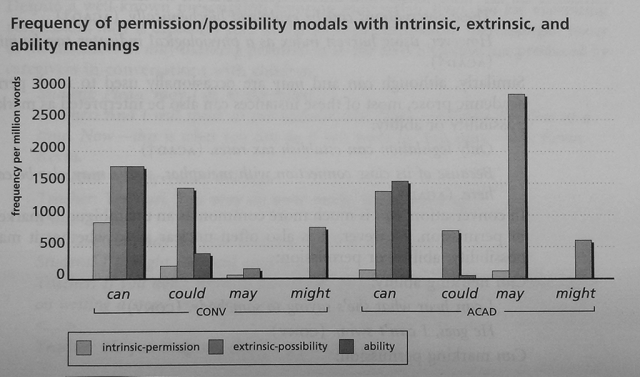
At high school, I learned that when asking for permission, ‘may’ is more proper than ‘can’. For instance, instead of asking “Can I borrow your pen”, I am supposed to say “May I borrow your pen”. However, the Longman Grammar of Spoken and Written English (LGSWE 1999) presents a different picture (from: LGSWE 1999, p. 491):

LGSWE Lingyun Lai

The graph shows the frequency of four modals, can, could, may and might, with the CONV column reflecting conversation, and ACAD academic prose. The statistics shows that all four modals are scarcely used to express ‘permission’ in academic proses. In terms of conversation, LGSWE writes: “May is rarely used in conversation. When it does occur, it typically marks logical possibility rather than permission”. This conclusion means that in actual language practice, most of time people use “can I” to ask for permissions, and that it is more customary to say “Can I use your pencil”. LGSWE highlights the inconsistency between their findings and the prescriptive preference, “Despite a well-known prescription favoring may rather than can for expressing permission, may is especially rare in the sense of permission” (Biber et al. 1999, p. 493).  More than fifteen years have passed since LGSWE published this result, and I wonder if it has ever influenced any usage guide author.

I looked into the HUGE database, and found sixteen usage guides published after LGSWE. After checking each entry, I noticed that most of them still consider may as the more suitable verb for asking permission. For instance:

“Don’t Say: Can I use your lucky bowling ball? Say instead: May I use your lucky bowling ball?” – When Bad Grammar Happens to Good People (Batko, 2008)

May I? requests permission. Can I? asks whether I am able to do something” – The Queen’s English and How to Use It (Lamb, 2010)

“It is still widely held that using can for permission is somehow incorrect” – Oxford A-Z of English Usage (Butterfield, 2013)

Pam Peters’ The Cambridge Guide to English Usage (2006) is the only usage guide that I found to be directly influenced by LGSWE. The Longman corpus was referred several times in her section on “can or may”.  Peters’ general opinions are in line with corpus findings; she acknowledges that may is mostly used to express the meaning of possibility. However, she still holds that may is more formal and polite than can, when used to express the sense of permission (Peters 2006, p. 88).

From this case study, I wonder if most of the usage guide authors are immune to the output of academic research. If they found out linguistic conclusions contravene their convictions, would they budge?

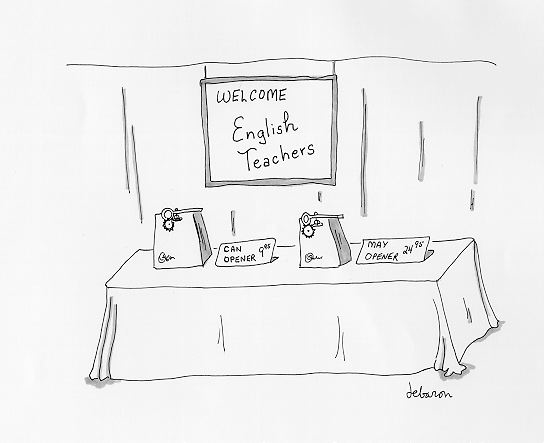
I couldn’t resist adding this cartoon to Lingyun’s post: it was made by Dennis Baron, as an e-card for Henry Fowler on th occasion of his 150th birthday:


Posted in MA Leiden | Leave a comment

Forever dangling? The unstoppable dangling participle under scrutiny

Here is Ina Huttenga’s second blog post:

The dangling participle is a pervasive structure in the English language. These “misrelated” modifiers have been used throughout English language history, but they seem to have become problems only recently, in the 20th century (as Ingrid Tieken and Carmen Ebner will discuss in a forthcoming article). There is even an Old English attestation of the structure, as  F.Th. Visser has shown in his phenomenal Historical Syntax of the English Language (1966, Vol. 1, Part 2, 1996, p. 1073), and even famous English writers like Shakespeare used dangling participles, according to J. Lesslie Hall in English Usage (1917). Has the rule against them been grasped out of thin air?

A dangling participle is a participle acting as a modifier, that seemingly modifies the wrong subject (or object). However, as Carmen Ebner discusses in an English Today article, the resulting meaning problem may be disambiguated by the larger surrounding language context.

While the dangling participle is only a recent usage problem, it seems strongly condemned. A survey by Mittins et al. conducted in the late 1960s found a low 17% overall acceptability for the structure. A more recent survey of English usage items by the Bridging the Unbridgeable project yields a similarly low acceptability: currently 15.7%. However, another survey I conducted this year led to a much higher acceptability of dangling participles, and I will discuss this survey in this blog.

In my survey, I examined the structure using the following sentences:

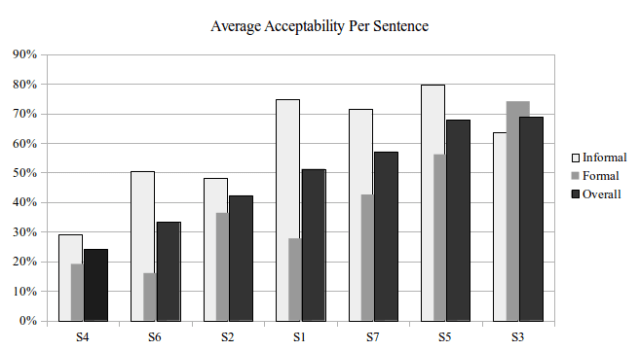
S1 – Lying in my bed, everything seemed different.

S2 – If found guilty, the lawsuit could cost the company US $12 billion.

S3 – Barring unforeseen circumstances, the meeting will take place next Monday.

S4 – Tired and lonely, the photograph depicted her tear-stained face.

S5 – Generally speaking, the weather in France is agreeable.

S6 – Driving along the road, the supermarket appeared on our left.

S7 – The children ran into the house calling for her.

Two of the sentences would be considered correct by many usage guides, namely S5 and S3. Many  usage writers feel that these participles have become grammatical parts of the language and no longer dangle (e.g. Fowler, 1926). One sentence, S4, did not contain a dangling participle, but two dangling modifiers, namely misrelated adjectives. (Dangling participles are a subclass of these dangling modifiers.)

Unlike in the Mittins survey, I did not highlight the usage problems in the sentences, nor did I state what the survey was specifically about. Instead, I told participants that they should “judge … [the] grammatical accuracy” of sentences. I wanted to see whether respondents even noticed dangling participles. They were asked to indicate whether they found the sentence acceptable in informal speech, informal writing, formal speech, and formal writing, or in none of these settings.

81 people participated in the survey, about half of them native speakers of English. I calculated the average acceptability per sentence for the different registers, and these can be seen in the graph below, from the sentence with the lowest acceptability (S4) to the one with the highest, S3. For all the sentences together, the average acceptability was 49%. This includes S5 and S3, which would be accepted by many usage writers. If these sentences are removed, the average acceptability is 33%. Forty-two (52%) respondents knew what a “dangling participle” or “misplaced modifier” was. Of these the majority (38) noticed them in the survey.

grafiek Ina Huttenga

The average acceptability of the dangling participle in this survey was higher than that found in the Bridging the Unbridgeable survey (15.7% across the different registers see above). Some of the reasons for this may include the larger number of sentences judged, as well as the fact that participants’ attentions were not drawn to the misrelated participles. However, another important factor that probably affected the judgements was age. The participants in my survey were fairly young. 48 of my 81 participants (59%) identified themselves as being between 18-30 years old. T-tests also showed that age and value judgements were related: those below 30 were significantly less critical of the sentences than those above that age. It is quite likely that the younger age of my respondents led to a greater acceptability of the structure. Age has often been mentioned as a topic worth investigating in prescriptivism, and is also something that Ingrid Tieken and Carmen Ebner discuss in a forthcoming article.

The higher acceptability of dangling participles by young people begs a question: could it be that in future, the rule against the dangling participle, like that against the split infinitive, will be considered an out-of-date usage norm? In any case, it seems that, with its long usage history, the dangling participle will not disappear from the language any time soon.

Reference:

Mittins, W.H., Salu, M., Edminson, M., & Coyne, S. (1970). Attitudes to English Usage. Oxford: Oxford University Press

Posted in MA Leiden, usage features | Tagged | Leave a comment

Write it Right: A very pedantic usage guide

Here is Madeleine Ibes’s second blog post:

Ambrose Bierce in 1882 (Wikipedia)

Ambrose Bierce (1842-1914) was an American short story author, journalist and satirist who authored books like The Devil’s Dictionary (1906/1909), which contained definitions like this one for grammar: “A system of pitfalls thoughtfully prepared for the feet for the self-made man, along the path by which he advances to distinction” and other hilarities, such as birth (n): “The first and direst of all disasters”. Bierce became known for his humorous, but often bitter and cynical take on life, and this as well as other matters in his writings earned him the nickname “Bitter Bierce”. In 1909, he decided to write a usage guide, entitled Write it Right, containing well over 100 usage problems in his “Blacklist”. The introduction is reminiscent of what many modern-day usage guide writers might say, but with a twist that is very distinctly “Bitter Bierce”:

Few words have more than one literal and serviceable meaning, however many metaphorical, derivative, related, or even unrelated, meanings lexicographers may think it worth while to gather from all sorts and conditions of men, with which to bloat their absurd and misleading dictionaries. This actual and serviceable meaning—not always determined by derivation, and seldom by popular usage—is the one affirmed, according to his light, by the author of this little manual of solecisms. Narrow etymons of the mere scholar and loose locutions of the ignorant are alike denied a standing.

He makes it clear later in his introduction that he is not drawing on research or even consensus to pass judgement on these usage problems. Meaning that none of what he is saying is based on authority; rather everything that he has to say is based solely on his own opinion.

Even by the standards of usage guide writers, the things that Bierce chooses to write about are outdated and odd. For example, he takes issue with last week as well as the past week and says the following in his entry for Last and Past:

‘Last week.’ ‘The past week.’ Neither is accurate: a week cannot be the last if another is already begun; and all weeks except this one are past. Here two wrongs seem to make a right: we can say the week last past. But will we? I trow not.

Other oddities include: dress for gown, ovation and fail. This latter entry is as hilarious as it is curious:

‘He failed to note the hour.’ That implies that he tried to note it, but did not succeed. Failure carries always the sense of endeavor; when there has been no endeavor there is no failure. A falling stone cannot fail to strike you, for it does not try; but a marksman firing at you may fail to hit you; and I hope he always will.

Bierce does, of course, take issue with some of the usage problems that other usage guide writers (both contemporary and later ones) comment on. His guide also contains usage problems such as: compare with, literally, can/may and aggravate. Some of his entries are short and succinct, and of little substance. However, it’s his odd choice in usage problems that make it an entertaining read for anyone who appreciates such books. To end our little discussion of Write it Right, here are a few more for you to enjoy:

Substantiate for Prove. Why?

Peek for Peep. Seldom heard in England, though common here. “I peeked out through the curtain and saw him.” That it is a variant of peep is seen in the child’s word peek-a-boo, equivalent to bo-peep. Better use the senior word.

Juncture. Juncture means a joining, a junction; its use to signify a time, however critical a time, is absurd. “At this juncture the woman screamed.” In reading that account of it we scream too.

Reportorial. A vile word, improperly made. It assumes the Latinized spelling, “reporter.” The Romans had not the word, for they were, fortunately for them, without the thing.


Posted in MA Leiden, usage guide | Tagged | Leave a comment