Fragment (consider revising)

We’ve all been there. You are writing (what you think is) a perfectly good sentence in a Word document when, suddenly, the MS Word grammar checker tells you that you should consider revising the ‘fragment’, because something is wrong. Very often, it is quite unclear what is wrong or how the grammar checker decides what is a ‘fragment’ or how it spots grammatical or stylistic errors in a document.

Ingrid Tieken wrote recently that reading Anne Curzan’s latest book, Fixing English, prompted her to find out the usage problems that the MS Word grammar checker deals with. Around the same time, I was prompted to do the same thing when, while working on a paper, the MS grammar checker decided (out of the blue) that my passive clause was incorrect, and suggested correcting it into an active one. I don’t remember this happening before. Here’s proof number one:

Correction_Passive 1

A couple of days later, while writing this blog post, and simultaneously working on another document, it happened again! Proof number two:

Correction_Passive 2

So, passive constructions are now flagged in Word as mistakes. I wonder when this error category was introduced to the grammar checker and for what reasons, because passives are perfectly normal – or, in prescriptivist terms ‘correct’ – and it seems to me that it should be the author’s (stylistic) decision to use a passive rather than an active clause. (If you are interested in reading more about the odd obsession with the passive as a grammatical error, I strongly recommend Geoffrey Pullum’s brilliant and thorough discussion of the subject.) What’s even more intriguing, as Ingrid suggested as well, is who makes those decisions and based on what. So, I tried to find out more.

Unfortunately, my investigation on this hasn’t come to fruition yet, but I did find out that the MS grammar checker gives you two options: grammar and style, and you can decide whether you want to have only grammar errors flagged or both, grammar and style. Details about all this can be found here and you can choose how your grammar and style checkers work here. According to the FAQ page on Word grammar proofing, the style proofing option only appears in versions after 2002, so it’s not all that new. My guess is that the style checker is predominantly based on usage guides discussions of usage problems. This is quite important because, as Curzan points out in her book, the MS grammar (and style) checker is a powerful prescriptive force, not only in grammar, but in style as well. I think a lot of people would want to know what that’s based on. Hopefully, we’ll find out soon.

In the meantime, stay calm, keep working, and don’t be intimidated by the grammar checker let the grammar checker intimidate you!
Posted in Uncategorized | Tagged , , , | Leave a comment

A Dutch letter-to-the-editor: at last!

tamelijk uniek

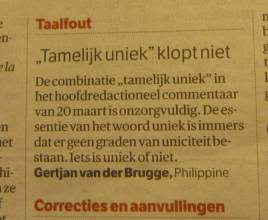
I have been watching NRC Handelsblad (a quality Dutch daily newspaper) ever since the start of the Bridging the Unbridgeable project for letters to the editor that deal with usage problems, but without any luck. Until last night! And interestingly, it deals with a very similar one to what we are used to finding in English usage guides: fairly unique. Robert Ilson will be pleased, because I can’t think of a neater example of what he calls “cross-cultural prescriptivism“.

The question of the acceptability of very unique was part of one of our usage polls (number 4). At the time Mittins et al. did their attitudes survey (in the late 1960s), very unique scored lowest of all features they examined: only 11% in terms of general acceptability. Since then, acceptability has grown, among our readers anyway, but with 19% only, it still isn’t very high.

And what do our Dutch readers think of tamelijk uniek? Is its general acceptability as low as that for its English counterpart? Let us know by filling in this poll. Dutch readers only, please! I’ll let you know about the results in a few weeks time.

(And here is some news for Gertjan van der Brugge: the complaint is not new at all!)

Posted in news, polls and surveys, usage features | Tagged , , | Leave a comment

Onto doesn’t exist?

Last week, Ingrid Tieken-Boon van Ostade published a post on Simon Heffer’s discussion of into on this blog. In his discussion of into in Strictly English, Heffer mentions a closely related usage item, the use of on to versus onto, of which he says the following…

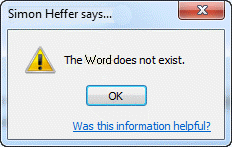
word-does-not-existThere is no such problem in distinguishing when a writer or speaker should use onto and on to, because onto does not exist.
However, this ‘non-existing’ item is discussed in as many as 34 usage guides in the HUGE database, and in most of them onto is accepted (sometimes grudgingly) since the early twentieth century. The OED gives citations for onto dating from the early 18th century onwards.

1715   Duxbury (Mass.) Rec. (1893) 105   [A] place gutted away by the rain down onto Mr. Wiswells land.

And although it appears to be virtually non-existent in American English usage, COHA shows steadily increasing usage of onto in the twentieth century.

capture_001_23032015_110015

use of onto in the Corpus of Historical American English, 1900-2000

Many (most?) online dictionaries (for example Merriam-Webster, Oxford, Cambridge, and Collins) accept onto as a word, with a distinct use that is separate from on to. But this is not new. The use of onto was approved of by Henry Fowler, who gave examples in which the ‘non-existing’ onto was allowed, but not on to in his Dictionary of Modern English Usage (1926)

Occasions for on or to or onto, but on no account on to: Climbed up on(to) the roof; Was invited (on)to the platform; It struggles (on)to its legs again; They fell 300 ft on(to) a glacier.

Later approvers of onto also include otherwise conservative usage guide writers as Patricia O’Conner in Woe is I (1996) and Bernard Lamb of the Queen’s English Society in The Queen’s English and how to use it (2010).

So the information in Strictly English on this usage problem is not helpful. Heffer’s denial of a use of onto not only fails to take note of the historicity of this usage item, but it also fails to acknowledge a useful distinction. When it comes to onto as a usage problem, it seems we had it sorted out quite some time ago. So let’s go …

BFFL6

Posted in usage features, usage guide | Tagged , , , , , | 3 Comments

Into or in to, really?

As I wrote earlier on this blog, I’m reading Heffer’s Strictly English (2010). In chapter 4, called Bad Grammar, he discusses the difference between into and in to. I never knew there was such a distinction in English! Is there really? So lets ask our readers, I thought: which of the two would you use when something like the event in the picture happens to you? And if you feel like it, please explain why you preferred one or the other (or perhaps both, or even neither).

Posted in polls and surveys, usage features | Tagged | 7 Comments

Final Mittins survey!

Here is the last set of the Mittins questions on which we welcome your feedback. This time the questions will be a little different, in that Mittins et al. asked their informants only to indicate the sentences’ acceptability for two … Continue reading

More Galleries | Tagged , | Leave a comment

On Heffer’s Strictly English

Please note: this image is not meant to be an advertisement for the book!

For the book I’m writing on the usage guide as a genre I’m reading several usage guides. Now it is Simon Heffer’s turn. Strictly English, first published in 2010, I find, is a disturbing book (and I have only got through the prologue and the first chapter yet). Not because he admits in the very first sentence that the book was not his own idea but that of the publisher: this confirms an important point I will be making in my book. But because he has no idea about grammar.

How can anyone claim that it is easy for native speakers of English to learn their mother tongue because it doesn’t have gender (p. 4)? Contrary to what Heffer seems to think, not all progressives are of course gerunds (p. 14). And is the passive voice really “part of the language of evasion” (p. 12)? Whom, he writes, is “an accusative that requires preservation” (p. 18), so I can’t wait to see what more he has to say on “Bad grammar” (the title of Chapter 4).

If his publisher, Nigel Wilcockson of Random House, really suggested to Heffer that he should write this book, why didn’t they ask a linguist to check the basic facts of what Heffer decided to write about? As I wrote elsewhere on this blog, there are plenty of us around, and we would love to help turning usage guides into better books. Linguists and publishers unite!

(David Crystal and Geoffrey Pullum reviewed the books: a pdf of Pullum’s review is available through Language Log; Crystal’s review can be found here.)

Posted in usage guide | Tagged , , , , | 2 Comments

Hopefully over?

Harry Ritchie, in English Grammar for the Natives (2013), writes that hopefully is “by far the most controversial adverbs of recent times” (p. 191). Usage of the adverb, he says, “has been met with fierce resistance”, and he quotes from Kingsley Amis’s usage guide, which reads that “when someone says or writes, ‘Hopefully, the plan will be in operation by the end of the year,’ we know immediately that we are dealing with a dimwit at best” (1998: 158).

Ritchie says that there are signs “that the resistance is nearly over”. Perhaps it is, but we can’t test it with the help of our regular usage surveys because the feature is not included in the study by Mittins et al. (perhaps because it wasn’t as yet as widespread as the others they deal with). So here is a separate usage poll, on hopefully only: please tell us what you think.

Posted in polls and surveys, usage features | 3 Comments

On Microsoft’s Grammar Checker again

A few years ago, Robin Straaijer wrote a blog post about Microsoft’s Grammar Checker. He had been inspired to write the post after hearing Anne Curzan speak on the topic during the ICEHL-17 conference at Zürich in 2012. Reading Anne Curzan’s book Fixing English: Prescriptivism and Language History (2014), which includes a chapter on the same topic, I feel similarly inspired.

The question the chapter prompted with me was to find out which usage problems the Grammar Checker deals with. As I’ve already explained a couple of times on this blog, I’m listing the usage problems dealt with in various usage guides for the book I’m writing on the genre, so what I want to find out now is how Microsoft’s Grammar Checker compares with Pinker (2014), Her Ladyship’s Guide to the Queen’s English (2010) or with Amis (1996) (and others as well, of course).

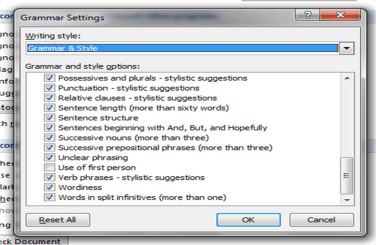
How to find out? At home, I use Microsoft Office 2007, and later versions may work differently. First click on the Home button in a Word document, then select Word Options at the bottom. Click on Proofing, then on When Correcting Spelling and Grammar in Word, set the option to Grammar & Style, and then go to Settings. You then get to see this:

Microsoft Grammar Checker

Not particularly helpful: all you see here are general headings like Sentence structure or Wordiness. How are these defined? When do they become problematical? What is the problem with Relative clauses, does Microsoft engage in which hunting perhaps? Two headings are more specific: Sentences beginning with And, But, and Hopefully (two “old chestnuts” that are treated in many usage guides, including Pinker’s) and the perennial Split infinitive, though only when more than one word is involved.

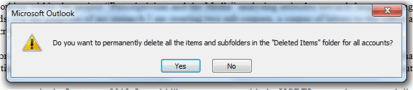
Very interesting indeed: I remember the time when split infinitives were banned altogether, though I don’t have any print-screen images from those days. I did notice about five years ago, though, that split infinitives had been accepted as correct language use by Microsoft’s linguists (if such people exist).

To permanently delete

No squiggle anymore, whether red or green! An earlier version contains a different, more polite phrasing of the same message. I did make a print-screen image of that at the time:

To permanently delete older version

Somewhere along the line someone must be making decisions about changes like these. I’d very much like to know how this works and who these people are. Linguists, hopefully.

Posted in usage features | Tagged , , , | 1 Comment

What kind of grammar nerd are you?

Today is National Grammar Day in the US and to celebrate this joyful occasion, Grammarly, a company providing a spell checker and grammar checker with the same title, has published a quiz: What kind of grammar nerd are you?

It contains questions on usage problems, such as preposition stranding and the split infinitive, as well as on your attitudes towards textspeak and other usage conventions. For those of you who always wanted to know whether you are a Pedant’s Grammarian or Enlightened Grammarian, simply take the quiz and find it out!

Happy Grammar Day!


Posted in news, usage features | Tagged , , , , | 1 Comment

Usage poll #10

And here is another usage poll, with sentences 46-50 from Mittins et al. (only one more to go!). Remember that multiple answers are allowed. And feel free to leave comments on the sentences as well. Enjoy!


Posted in Uncategorized | Leave a comment