#Fundilymundily the language of the UK general election 2015

With the UK general election just behind us, the talk of the language used in the debates still lies ahead. Last night, on the grammar phone-in of the BBC Radio 5’s Up All Night, the presenter Dotun Adebayo discussed the use of political phrases, buzzwords and clichés in the run-up to the election with his regular guests on the programme, Terry Victor, the co-author of The Concise Partridge Dictionary of Slang and Unconventional English, and Nevile Gwynne, the author of the highly prescriptive Gwynne’s Grammar. The programme is a rich source of complaints about perceived grammar mistakes, so it will certainly be a topic of future posts.

general-election-2015-what-you-need-know-100-days-go-before-polling-dayCallers submitted their favourite examples of obfuscating political doublespeak including spare room subsidy (as means of avoiding the word tax), cost of living crisis and the squeezed middle. On the same subject, in comparing the speech of politicians during a televised debate with a corpus of spoken British English,  Tony McEnery and Robbie Love from Lancaster University discuss in an article the large discrepancies between the two. Austerity, for example, became such a high-frequency word in the analysed debate that it matched the frequency of the pronouns your and these in normal speech.

Although public pleas for simpler language and the plain English movement in politics seem to be consistent, some of the Up All Night listeners complained about the usage of colloquial English and slang expressions among politicians. Ed Miliband was criticised for saying “Hell yes” and “That ain’t gonna happen” in a BBC interview, David Cameron was criticised for using the same infamous “non-word” ain’t, and Russel Brand’s speech in political discussions was described as lazy for his “dropping the ts from the English language”.

One of the main goals of the politicians’ public appearances is appealing to the majority of their potential voters. Avoiding giving specifics and making obligations is, however, yet another important goal manifested in obfuscating lingo. This all creates an interesting mixture of occasional colloquialisms, which seem unnatural coming from the (often public-school) educated politicians, and ambiguous muddled jargon.
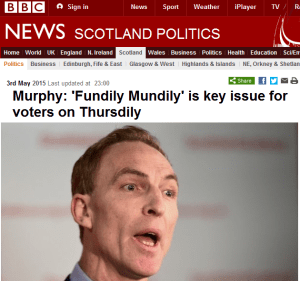
CaptureThis election showed that politicians can also become linguistic innovators, sometimes inadvertently. The Scottish Labour MP Jim Murphy created the word fundilymundily while trying to pronounce fundamentally in a live BBC debate. Since then, an Up All Night caller claims, the word has entered common usage in Scotland. To check the life of this new word and the contexts in which it can be used, search for #fundilymundily on Twitter.

Have you noticed any buzzwords, clichés or grammar mistakes in the political debates? Fundilymundily let us know about them in the comments below!
Posted in usage features | Tagged , , | Leave a comment

A matter of etiquette as well

If you thought that usage problems only occur in usage guides, you’re in for a big surprise: they are also discussed in a different genre altogether – etiquette books. This discovery was made by Paul Nance, one of the readers of our blog, and he wrote about it in a short piece with lovely illustrations which we included in the above section called Features.

In his research on usage problems and etiquette books Paul also came across Josephine Turck Baker (1873-1942), an American writer who made a career out of providing usage advice. Our own Viktorija Kostadinova gave a paper on this woman and her work, who is the earliest female writer of usage guides in the HUGE database, at the conference Margin(s) and Norm(s) in English Language(s) at the university of Aix-Marseille in April last year.

Josephine Turck Baker is not actually THE earliest woman to publish a usage guide: this was, as far as we know at the moment, Rosaline Masson, but we’ve been unable to find a copy of her book, Use and Abuse of English, published in Edinburgh in 1896. If you are able to help us, please get in touch!

Sorry, no illustrations this time, even though there is a lovely picture of Josephine Turck Baker online. You’ll find it if you google for her name. It is actually for sale, and though the asking price was recently reduced, we don’t have that kind of money in the project unfortunately.

Posted in usage features | Tagged , , | 1 Comment

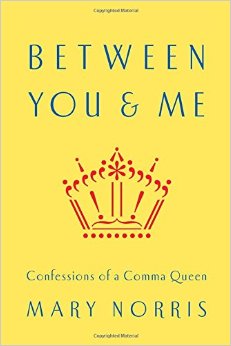
Between You and Me: Confessions of a Comma Queen

Editors and language advice seem to go hand in hand. When in doubt about language matters, who better to consult than those whose job description includes improving style, formatting, and proofreading.  Mary Norris of The New Yorker has joined the ranks of the editors-turned-usage guide authors such as Patricia T. O’Conner, the author of Woe Is I (2010) and the co-author of Origins of the Specious (2009), and the Daily Telegraph’s Simon Heffer (Strictly English 2010).

This book is not, however, your typical usage guide. Mary Norris tells the story of her lifeMAry Norris as a copy editor of thirty-five years in The New Yorker. The autobiographical narrative is interrupted by exposés on usage problems including which vs. that (it depends on the context), dangling participles (they’re not always wrong), singular they (don’t use it), between you and I (barbaric), whom (let’s keep it), and apostrophes (hang on to them). Norris lets the readers in on the editorial practices of The New Yorker such as: when in doubt, check Webster’s, preferably the second edition and not the easygoing third, practice a “close” style of punctuation, and do not close up style compounds, as in hair style.

Mary Norris profileThe author contextualizes her advice by inserting anecdotes from the history of (American) English. The stories of the birth of the comma, the hyphen in the title of Moby-Dick and dashes in Emily Dickinson’s poetry do a good job in keeping the reader’s attention. Although the usage advice does include many personal judgments, Norris confesses that “A lot of the decisions you make as a copy editor are subjective.” She engages in discussions with Bryan Garner, Eleanor Gould Packard, the late editor of The New Yorker, David Marsh, the production editor of the Guardian and the editor of its style guide, and Steven Pinker, whose views on language are too permissive for Norris’s taste.

The more lenient successor of the Lynne Truss punctuation guide tradition gives a good insight into the long career of a copy editor. Since I’ve been researching public comments on media language, it struck me to see how many times Norris referred to letters received from the readers of The New Yorker. Guarding language standards seems to be a joint endeavour of both the media and the public who expect journalists and editors to exemplify the highest writing standards, keep offering language advice, and, luckily for the publishers, write usage guides.

Posted in news, usage guide | Tagged , , , , , | 3 Comments

The term “usage guide”

Within the Bridging the Unbridgeable project we use the term “usage guide” to describe usage handbooks of manuals like Fowler’s Modern English Usage and many others, as included in our HUGE database. But where does the term come from? I checked the OED, which provides an American source, from a 1951 issue of the journal College Composition & Communication published by NCTE, as a first instance and a second example from the Toronto Globe and Mail (2007).

Could that mean that it is a North American term? Edmund Weiner used it too, in his very useful article “On editing a usage guide” (1988). (The title by itself would make a useful British addition to the v. short list of quotations in the OED.) Does anyone know of earlier examples of the term than the one provided by the OED? I’d like to know how old the term is, and also, if we can find out, who coined it. Perhaps not really important, but I’d just like to know.

My usage guides


Meanwhile, one of our readers, Paul Nance, let me know that he found an antedating to the OED‘s first quotation:

The earliest US example I’ve found so far is Seattle Daily Times 13 Oct 1946, in a discussion of teaching materials used in public schools. It also refers to a locally-produced series of three texts, titled “Usage Guide for Language Arts”.

Thanks for this, Paul!

Posted in usage guide | Tagged , , , , | 2 Comments

Vulgarities of Speech Corrected

Source: Wikipedia

The HUGE database includes as the second usage guide on our list, the anonymous Vulgarities of Speech Corrected. The copy included is the second edition, published in 1829, in London. A search in WorldCat produced an earlier edition from 1826, also published in London. But to my surprise, WorldCat mentions the novelist and educationalist Maria Edgeworth (1768-1849) as the book’s author. Could this be right? On what grounds did WorldCat make the identification? Neither the ODNB nor Wikipedia mention the book as one of her publications (though this is not unusual, since the ODNB doesn’t mention The Queen’s English in the entry on Henry Alford either).

Does anyone know more about the authorship of Vulgarities of Speech Corrected?

Posted in usage guide | Tagged , | Leave a comment

23 April: Correct-your-English Language Day

This blog features a Language Calendar, and it includes 23 April – English Language Day (UN). Why was 23 April chosen for this, and why have an English Language Day to begin with? As a World Language, English is important enough as it is. So … Continue reading

More Galleries | Tagged | 7 Comments

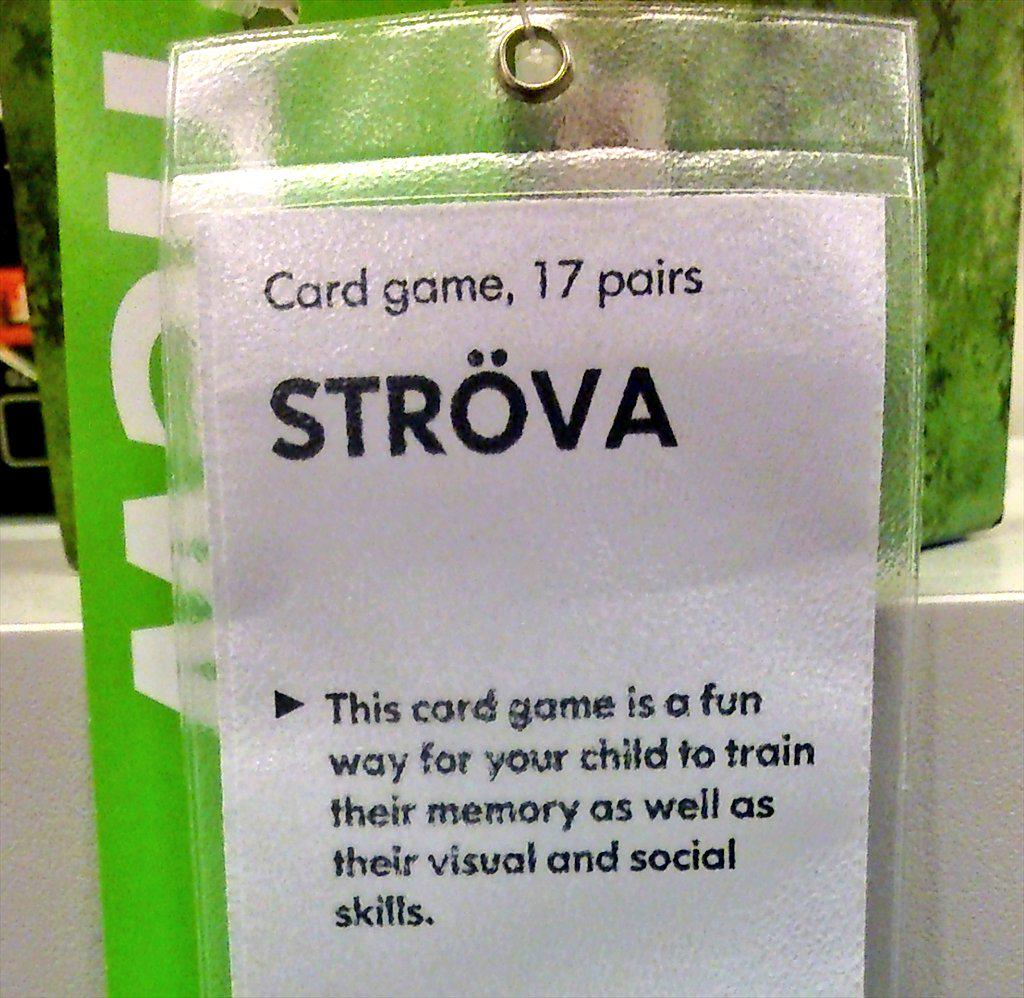
Thumbs up for IKEA!

One of Simon Heffer‘s pet hates is the use of singular they: “Being a pedant,” he writes, “I regard [its use] unacceptable” (2010:110). Unacceptable or not, singular they, as Mittins et al. point out in Attitudes to English Usage (1970!), has been in use since at least the fifteenth century (p. 102). If even someone like Jane Austen uses it, how can it be unacceptable?

Source: Gretchen McCulloch

So well done, IKEA (and thanks to Gretchen McCulloch for tweeting about it), for adopting it and helping singular they become more acceptable, even, hopefully, to writers like Simon Heffer (but then perhaps he doesn’t shop at IKEA).

Now what I’d also like to know if if IKEA splits infinitives, misplaces only and uses literally as a plain intensifier. Let us have more images like this!

Posted in news, usage features | Tagged , , | 2 Comments

10th Bridging the Unbridgeable Lunch Lecture

We are pleased to announce our 10th Bridging the Unbridgeable Lunch Lecture which will take place on 15 April 2015, from 12 to 1 pm at Lipsius, room 227. Our guest speaker, David Lorenz from the University of Freiburg will be giving a talk entitled “to-contraction in American English: The career(s) of a non-standard feature”.

You can find David’s abstract below, and if you decide to attend the event, do not forget to bring your own lunch!

 to-contraction in American English: The career(s) of a non-standard feature

(David Lorenz, University of Freiburg)

 – Abstract –

The pattern of to-contraction has often been noted as a feature of informal, spoken language, producing forms such as wanna, gonna, but also, for example, needa, oughta (cf. Bolinger 1981, Pullum 1997). This study offers a diachronic description of to-contraction from a Construction Grammar perspective, using data from the Corpus of Historical American English (COHA, Davies 2010).

While non-standard written representations of to-contraction occur since the 19th century, three specific forms – gonna, wanna and gotta – take a separate development and become increasingly conventional. In this process, their factors of use also change, showing the establishment of a connection across these items that fits the description of a ‘meta-construction’ (Leino & Östman 2005). Thus, the study shows how schematicity emerges in language from what started out as idiosyncratic cases of phonological reduction.

References

Bolinger, Dwight. 1981. “Consonance, dissonance and grammaticality: The case of wanna”. Language and Communication 1. 189-206.

Davies, Mark. 2010-. The Corpus of Historical American English: 400 million words, 1810-2009. http://corpus.byu.edu/coha/

Leino, Jaakko & Jan-Ola Östman. 2005. “Constructions and variability”. Grammatical Constructions: Back to the Roots, ed. by M. Fried & H. Boas. Amsterdam: John Benjamins.191-213.

Pullum, Geoffrey K. 1997. “The morpholexical nature of English to-contraction”. Language 73.   79-102.

Posted in events | Tagged , , , , , , , | Leave a comment

Your help is needed, I mean: I need your help!

I’m about to start analysing the results from the Mittins surveys that have been a regular feature on this blog from its earliest days. Many people have let us have their views on the sentences the past few years, for … Continue reading

More Galleries | Leave a comment

Fowler’s Modern English Usage: new but not New

It was February 1997, and Robert Burchfield’s The New Fowler’s Modern English Usage had been out for three months. Just as the 1st and 2nd editions of the Dictionary of Modern English Usage came to be known as ‘Fowler’, The Economist asked itself whether the next edition would be known as ‘Burchfield’:

The 1926 Fowler is already a period piece, though no one has ever gone wrong by taking its advice. The same, no doubt, will in time be true of “Burchfield” – as, perhaps, by 2097 the publisher of its latest revision will dare to call it.
The Economist 1 February 1997.

It turns out The Economist didn’t have to wait for 100 years to get an answer, and it is ‘No’.

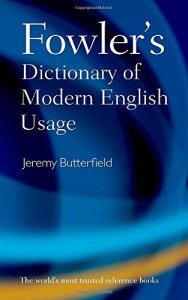
Ed4-HWF-JBYesterday, the 4th edition of ‘Fowler’ was published: Fowler’s Dictionary of Modern English Usage, edited by Jeremy Butterfield. It seems that Fowler is still THE name when it comes to guides to modern English usage.

Since I have been writing about Burchfield’s 3rd edition, my attention was immediately drawn to the fact that the publisher left the word New off the title of this new, 4th edition.

When it appeared in 1996, The New Fowler’s Modern English Usage received a lot of criticism from conservative reviewers, who accused Burchfield of trading Fowler’s name. The editor, Robert Burchfield, possibly put too much emphasis in his Preface on how the 3rd edition was different to the 1st and 2nd.

In his Preface, Butterfield begins by stating that it is indeed a new edition, but doesn’t emphasise that it is different from what came before, stating its mission in positive terms.

jeremy-butterfield

This new, fourth edition of Fowler’s Modern English Usage has been thoroughly revised and updated to reflect how English speakers the world over use the language now, in the twenty-first century. (vii)

Those that published The New Fowler’s Modern English Usage underestimated how much of an institution ‘Fowler’ had become (see also the article in English Today by Ulrich Busse and Anne Schröder). OUP seems to know better now. Leaving the word New off the title is another way to reaffirm that this edition is just another ‘Fowler’, not New, but just new.

Posted in news, usage guide | Tagged , | 4 Comments