“Will everyone put down their phone?” is quite common in English today. It has been around as a construction since at least the 14th century, developed into quite a controversial feature in the language, but as our Usage poll #10 shows, is barely considered unacceptable any more.
But today, for the first time, I spotted the construction in Dutch, used by a 16-year-old: “Iedereen heeft hun telefoon weg gelegd.” Is this the beginning of a new trend in Dutch? And should it indeed be marked as a mistake? The context is relatively informal. Comments, please?
On reading a PhD thesis from the University of Sheffield on the phonology of West Cornwall English (excellent data collection, detailed and very meticulous methodology description) I encountered the word inputted, which set me thinking. The context was very clearly past, so to my mind input would have done the job. This made me wondering if perhaps the form overtly marked for past tense might be on the increase today?
A good tool to check this is the Google n-gram viewer, which provides written data across time that can be separated to see what is going on in British and American English. The data showed that very different processes are going on within these two varieties:
Two very different patterns. What would explain them? Any role played by prescriptivism here, with a stronger effect on American English? Further research would definitely be of interest!
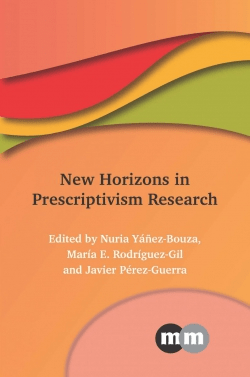
New Horizons in PrescriptivismResearch, edited by Nuria Yáñez‐Bouza, María E. Rodríguez‐Gil and Javier Pérez‐Guerra, will by published by Multilingual Matters in the Spring. Congratulations, editors! Looking forward to seeing the book in print soon! Further details here.
Over the past few years, quite a few scholars have requested access to our HUGE database. We are always happy to do so, and usually ask them to let us know how they made use of the database in their research. Today, an article came in that did so, and this led to a page in this blog’s banner that keeps track of such publications. Also to encourage other scholars to tell us about their publications!
The seventh edition of this wonderful conference series will take place from 26 to 28 June 2024 in Aix en Provence, in France. Plenary speakers will be Ian Cushing (Manchester Metropolitan University, UK), Jane Hodson (University of Sheffield, UK) and Nuria Yáñez-Bouza (University of Vigo, Spain).
This edition’s topic will be Transmitting Prescriptivism and Norms, and the deadline for submitting abstracts is 15 January 2024. For more details, see the conference website.
Looking forward to another great conference on prescriptivism!
Rereading Salinger’s The Catcher in the Rye (1951) this summer reminded me of one of the last BA theses I supervised before I retired nearly three years ago. The student writing the thesis was analysing twitter messages, and told me he was hoping to come across tryna in his data. Tryna? He said it was a common form on social media platforms, meaning “trying to”. It was all new to me.
Not so as it happens, for I actually would have come across it when I first read The Catcher in the Rye some time during the mid-1970s, only at the time it probably didn’t strike me as a form worth noticing. Nor did it when I reread the novel ten years later for a paper I wrote for a retiring colleague’s Festschrift. I’ve reproduced the paper elsewhere on this blog.
Third time lucky, it seems: tryna I now noticed occurring several times in the novel, as on p. 50 of my Penguin copy: “I was tryna sleep before you guys started making all that noise.” This is not the main character, Holden Caulfield, speaking, but his roommate. Another instance in the novel is highlighted by Jane Hodson in her book Dialect in Film & Literature (2014: 100), where she comments on the sociolinguistic contrast between Holden’s use of trying to and the pimp’s response: “Nobody’s tryna chisel nobody.” So in writing, even though it reflects fictional speech, the word is at least some 75 years old. But it has no entry in the OED. Should it have? I’m interested to hear what readers of this blog think.
Doing a Google Ngram check confirms that the word was in (written) use already during the 1950s, with an interesting bleep at the time for British English. Could this have been a Catcher-in-the-Rye effect? The graph also shows a steep rise for British English since the 2000s (top), but a decline for American English setting in about ten years ago (bottom). What is going on here, I wonder? Any thoughts?
We finally decided to watch this series, the best series ever, according to some people we know. Netflix of course. It happened after we finished watching all of Better Call Saul, its prequel, which got a very favourable review in our paper after it had just come out. And of course I couldn’t help noticing a metalinguistic comment in Breaking Bad, the only one so far (down to the end of series 4). There were none in Bettter Call Saul. Or none that I noticed anyway.
It happened when Walt, “Mr White” according to his former science-student-turned-assistant-in-serious-meth-production Jesse Pinkman, corrects his brother-in-law Hank Schrader saying learned (learnt in Amerucan English) when it should be learnéd. This is a well-known shibboleth: as Partridge writes, “the participial adjective learned is pronounced with two syllables” (The Concise Usage and Abusage, 1954, p. 101). There is an entry on learnt/learned in Garner’s Modern American Usage as well ( apologoes to Bryan Garner for citing only the 3rd edition, when this year the 5th has already come out).
So Walt in effect puts down his brother-in-law for being uneducated. Hank is a DEA officer (Drug Enforcement Agency), and gets closer to Walt’s illicit activities with every episode. One more series to go!
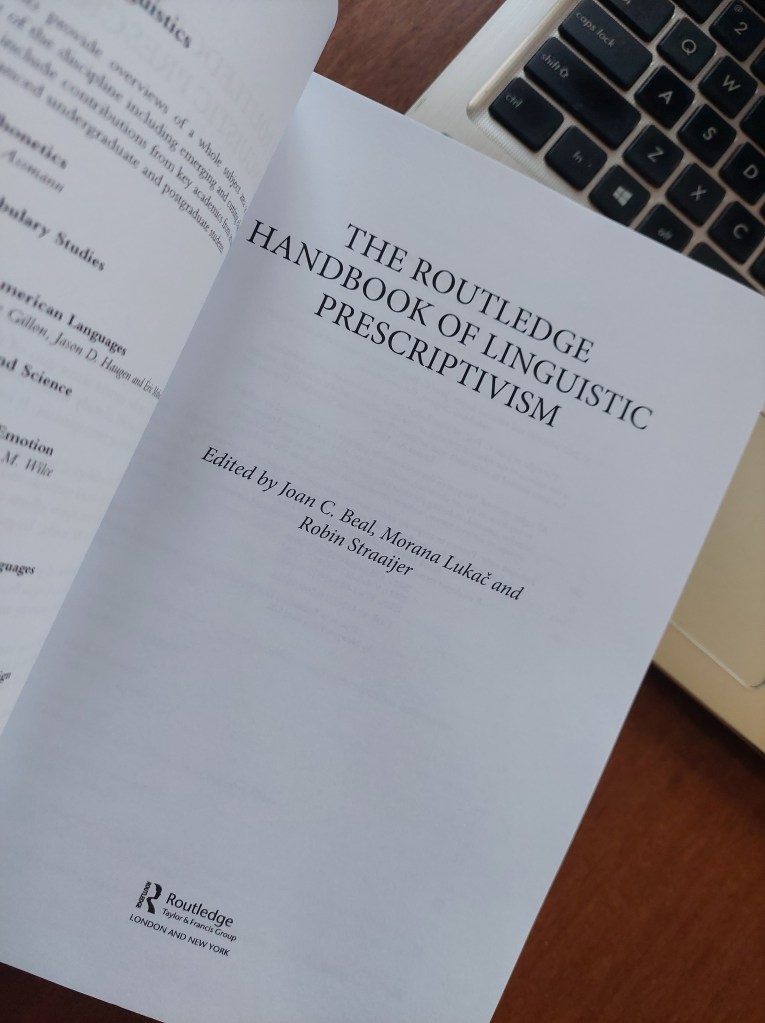
Focusing on German, English, French, Italian and Croatian, this multingual handbook looks extremely interesting for our field. Articles are published both in German and in the language of the field it deals with, so they should cater for interested scholars worldwide. More information here.