Cambridge English Usage (Guides) Symposium

Don’t miss it! On 26 and 27 June, we are organising a symposium at the English Faculty of the University of Cambridge on Usage Guides and Usage Problems. The registration fee is £30 only. Don’t wait too long to register, since space is limited. Please note that registration is obligatory, and that doing so is only possible until a week before the symposium. For further details, including the programme and the venue, see the Conference Page in the menu.

Continue reading

Posted in events | Tagged , , | 2 Comments

Whom and Len Deighton (and like)

There have already been several posts in this blog about the disappearance of whom, and also about prescriptivism in English literature. Here is one that combines both.

Funeral in Berlin, which I came across when looking for the third part of Len Deighton‘s trilology Game, Set and Match in the Leiden boekenzolder where there are thousands of books to be had for free …

Give-away bookstore

On p. 20 of the copy I read:

“But not Dorf,” I said, ” especially not Edmond Dorf [the main character’s alias]. I don’t feel like an Edmond Dorf.”

“Now don’t go metaphysical on me,” said Jean [his secretary]. “Whom do you feel like?”

I like that “whom” – you’ve got to pay real money these days to get a secretary that could say that.

This was 1964. Any more such examples will be welcome additions to my growing collection! (And it turns out I got a copy of the first edition, according to wikipedia, well, third impression: still, not bad.)

wikipedia

And here’s another, towards the end of the novel:

They wouldn’t let us offer [him] a job partly because he was foreign, and partly because I [the main character] wore woollen shirts and said ‘like’  instead of ‘as though’.

We dealt with the question of like for as in the very first post in this blog.

This was the second novel by Len Deighton that I ever read: I love his style. And I also love his interest in language, prescriptivism and all. Len Deighton is definitely my man.

Posted in usage features | Tagged , , , | Leave a comment

Some words are(n’t) better than others

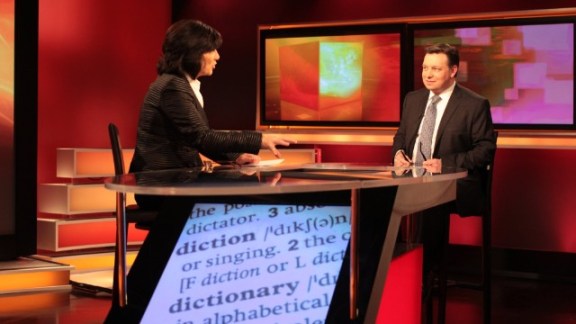
Michael Proffitt, the new Chief Editor of the Oxford English Dictionary, was recently interviewed by CNN’s Christiane Amanpour (see video here) commenting on the place of the largest English dictionary in the modern age.

140130164942-aman-michael-proffitt-christiane-amanpour-oed-oxford-english-dictionary-horizontal-gallery

Although the O.E.D. was one of the first dictionaries that was launched online in 2000, its creators are still thinking of ways of catering to new generations of users who are turning to web searches rather than looking up terms in the dictionary. The O.E.D. currently lists 800,000 words (double the size of its first edition) and a new revised edition will come out in only about 20 years. It remains to be seen if the new edition will exist in its traditional print form by mid-2030s.

oed_20_bind_2

The interview touches on the prescriptivism-descriptivism debate at 4:38, when Amanpour addresses the question of the newest words in the English language, such as selfie, unfriend and defriend, which have, according to popular opinion, entered the language from the social media scene.  Proffitt reveals that this is not exactly the case, as the O.E.D. would show. Many of these so-called neologisms have actually been around for centuries. The verb unfriend was used long before Facebook or even the Internet for that matter. Its first use was recorded in 1594, albeit with slightly different meaning. The abbreviation OMG, which is nowadays commonly associated with netspeak, is found in as early as 1917 in an admiral’s letter to Winston Churchill. Proffitt also comments on the criticism of the use of the word literally, which is picked out by pedants as particularly problematic, although words such as actually or really reflect similar changes in meaning. The biographies of these ‘problematic’ words that are compiled by lexicographers question the claims about language decline brought about  by neologisms or variations in spelling and orthography. Many such innovations are not great changes at all, and linguistic developments are surely not restricted to the present. On another note, as Proffitt concludes in the FT interview, lexicographers would quickly lose their jobs if there weren’t for language change.

Posted in news | Tagged , , , , , | Leave a comment

Something must have went on

The first time I read about have went as a usage problem was in the context of what 18th century prescriptivists wrote about it: Robert Lowth and Noah Webster, two 18th (and, in the case of Webster, 19th) century grammarians, both noted the widespread  variation in the usage of past simple and past participle forms with have, in such sentences as I think we would have went down or She would have went to the ends of the Earth for anything he wanted. They both strongly proscribed it as well. Upon reading about it, I thought that it must be a variation that has died out by now. Almost concurrently, Ingrid’s usage poll results showed that some speakers still notice the use of have with a past simple form occurring in present-day usage. A quick corpus search showed that this is, indeed, the case. The examples I give above are taken from the COCA concordance for have went (have went occurs in 95 instances in total).

Since discovering this, Ingrid and I have both become very interested in this atypical usage problem. Atypical because unlike popular usage problems, or old chestnuts, this usage item doesn’t seem to be used often enough for it to spark significant prescriptivist commentary. Another reason for this seems to be the fact that it’s virtually non-existent in written language. Corpus evidence from COCA and BNC suggests a stronger occurrence of this structure in American English than in British; in both cases, however, in spoken register.

With this initial evidence on the table, we were naturally interested in the attitudes of speakers towards this usage item and I included it in a series of interviews I conducted with native speakers last summer in Ann Arbor, Michigan. My expectation was that most speakers would recognise it as a mistake and would have an opinion about it. Much to my amazement, however, not only did some speakers not qualify it as a mistake, they also said it was a dialectal feature, or something that people certainly say, even though it’s ‘certainly not grammatically correct’. One speaker pointed to a possible difference in the meaning of have went  and have gone, in cases such as You must have went to one of them fancy schools as opposed to You must have gone to one of them fancy schools, although she wasn’t able to be more specific than saying that ‘gone is an almost stronger past tense’.

All this data singles out have went (and other occurrences of have + past simple forms) as a structure that can possibly reveal why and how certain usage items become problematic for language users and others don’t. Why is it that the split infinitive can provoke such strong reactions, while (according to my findings at least) people seem to be fine with have went? In order to discover more about the usage and speakers’ perceptions of have went, we have launched a survey to help us get a better idea of the way in which this item is used and the kind of (social) meaning (if any) that is assigned to it. And we are very much looking forward to your input!

Posted in polls and surveys, usage features | Tagged , , , , | Leave a comment

update About page

OLYMPUS DIGITAL CAMERAIt was long overdue, but we’ve updated the About page. It now also features our new project assistent Inge Otto, whose post you will have already seen come by if you regularly visit this site. Inge joined the project in September 2013, after serving as an intern from February of that year. She primarily works on the database of usage guides and usage problems that we are compiling.

Posted in announcement, news | Tagged | Leave a comment

Symposium on early American English usage guides

On 13 February 2014, the Bridging the Unbridgeable project organises a one-day symposium called “English Usage Guides: The Early American Tradition”. Speakers will be Ulrich Busse (University of Halle, Germany), Viktorija Kostadinova and Ingrid Tieken-Boon van Ostade (both from the … Continue reading

More Galleries | Tagged | Leave a comment

A Word on Asphalt

Did you ever see the word “ashfault” in a newspaper, book, article ­– or anywhere else at all?

Well, until recently I was unaware of this word’s existence (too). It was only when I read Paul Brian’s usage guide Common Errors in English Usage a few days ago, that I happened to stumble on an entry of this spelling variant. Brians remarks that:

“ashfault is a common misspelling of asphalt” (p. 17).

At this point, a somewhat tedious question, which can be applied in any situation where qualitative remarks are made, came to mind: What is “common”? How widespread is the use of “ashfault” really in written material? Or could this spelling variant be the result of a variant pronunciation?

To get some idea of the usage-frequency of “ashfault” as compared to “asphalt”, I decided to look up the former word in the Oxford English Dictionary (OED). This search yielded no results. The OED did contain an entry on “asphalt”, however. The Merriam Webster Dictionary, in addition, also did not include “ashfault”, and it advised me to try “asphalt” instead. Eventually, only the Urban Dictionary provided me with an entry on “ashfault”, saying that:

“ashfault is a word meaning the same as assfault but said ashfault. Origin: Michigan”

From this dictionary, it seems that another variant joins the competition: besides “asphalt”, and “ashfault” the spelling variant “assfault” apparently also exists. Whether “ashfault” and “assfault” are truly competing with “asphalt seems implausible however. None of the three spelling variants occurs in another recent usage guide: The American Heritage Guide to Contemporary Usage and Style (2005), which seems to indicate that according to this guide’s usage panel no noteworthy usage problem concerning “asphalt” exists at all. Google Ngrams, furthermore, gives zero results for “ashfault” and “assfault”, and it only proved the existence of “asphalt” in both British and American English.

From the results of these quick searches, it seems disputable whether “ashfault” should be included in dictionaries or usage guides. In fact, it brings us back to a major question: at what point is something considered a usage problem?

Posted in usage features, usage guide | Tagged , , , , , , , , , | 10 Comments

Of compound words and the doom of English

Have you ever noticed a difference between American and British English when it comes to compound words? Lynne Truss, author of the bestseller Eats, Shoots and Leaves, argues in her weekly column in The Telegraph that the American tradition of compounding words, such as anymore and everyday, has a negative influence on British English, which ultimately leads to the doom of English.

Lynne Truss connects this development with the falling literacy standards in the UK and furthermore argues that linguists are supposed to act.

“Obviously one hates to be a stick-in-the-mud about English. But occasionally it’s important to speak as you find. When I was deeply mired in linguistic debate a few years ago (for which I was seriously unqualified), it became clear to me that the academic study of the English language (and this includes the lexicographers) was entirely concerned with looking cool and broad-minded and “descriptive”, when what was required was some positive action to remedy literacy levels, and so on.”

Lynne Truss

There is no doubt that the prescriptivism and descriptivism debate has been on-going, but Truss seems to step up the game. She argues that there is no prescriptive approach to language, but that descriptive linguists are supposed to monitor language. By calling the term ‘prescriptive’ a “powerful juju word used against bad people who model themselves on King Canute”, she removes one side of the debate and assigns a new role to descriptive linguists which so far has been part of the prescriptive tradition.

Whether it is just a matter of incorrect spacing, saving time, or spell-checkers needing a thorough revision, the compounding issue seems to have struck a chord with those who are looking for a panacea to save the English language. I doubt that compounding words is going to be the doom of English as similar techniques have been used in txting, which with its numerous abbreviations has also been blamed for the falling literacy levels and ultimately for the end of the English language. But the debate is still open…

Posted in Uncategorized | Tagged , , , , , , , | Leave a comment

Who was, is Janet Whitcut?

(I am grateful to several people, particularly Robert Ilson and Moca Mace, for telling me about their acquaintance with Janet Whitcut.)

Janet Whitcut is important for our work as the author, along with Sidney Greenbaum (1929-1996), of The Longman Guide to English Usage (1988). Together, they revised Sir Ernest Gowers’s Complete Plain Words, of which one edition was published by His Majesty’s Stationary Office in 1986, while a third edition came out the year after that (Penguin).

Chloe White, one of the contributors to this blog, wrote a paper about the Longman Guide to English Usage and tried to find out who Janet Whitcut is (or was). But other than Sidney Greenbaum, Janet Whitcut has no entry in the Oxford Dictionary of Biography, nor in Wikipedia.

A Google search for her produced various book titles, including The Penguin Book of Exotic Words (1996) and Better Wordpower (Practical help on how to improve your use of the English language), Mastering English Usage (1994, written jointly with Robert Ilson) and Edgbaston High School, 1876-1976. Janet Whitcut also revised Partidge’s Usage and Abusage (1994). An article appeared as well, called “Sexism in dictionaries”, which is a paper she presented at the first EURALEX conference in 1983.

Dr Robert Ilson

Chloe was unable to find any trace of Janet Whitcut beyond 1999. Asking around didn’t help: David Cystal told me to contact Bas Aarts, who remembered meeting her thirty years ago, but that was it. Taking up the link with Robert Ilson took me to the website of Thornton’s Budgens, a “community supermarket”, which features Robert Ilson as their “poet laureate”. Is their picture of “Dr Robert Ilson” that of our man?

Robert Ilson’s name is familiar to me as the author of the article “Usage problems in British and American English”, published in a collection called The English Language Today (1985), edited by Sidney Greenbaum. And, yes, that produced another link: the collection also includes an article by Janet Whitcut: “English, my English?”.

Sidney Greenbaum

So even if this search has not told us much more of who Janet Whitcut is (or was), it did produce a small network of writers on English usage: Sidney Greenbaum & Janet Whitcut, Janet Whitcut & Robert Ilson, Sidney Greenbaum & Janet Whitcut & Robert Ilson. If Robert Ilson is the only one who is still alive, I hope he will read this and tell us more about his colleague and collaborator. But perhaps other people can help us, too.
Posted in usage guide | Tagged , | 14 Comments

Is Fay Weldon having us on?

It’s an occupational hazard, I suppose, but I find it hard to read a novel without noticing particular usage features. So while reading Fay Weldon‘s The Heart of the Country (1987) last week, I stumbled over this sentence, as it has an extreme case of pied piping (= avoidance of preposition stranding):

and then eight thousand pounds of Val’s money disappeared overnight into some great vat of coffee beans, if you put your hand in which you might pull out a fortume (p. 60)

In which??? Which if in? I can’t work out this sentence. Was this Fay Weldon’s editor attempting to get rid of a stranded preposition or avoiding a double object construction (“which, if you put your hand in it, might …”)? Or is it Fay Weldon herself, having us on grammatically so to speak? (I suspect the latter actually.)

But there are other sentences that set me thinking, primarily because in this project we are trying to identify new usage problems, or to see if old ones have disappeared from the prescriptivists’ agenda so to speak. Here is one:

She would have liked to have cried (p. 38)

Then they’d have had to have gone away (p. 48)

These are double perfect constructions, which prescrivists don’t tend to approve of, and haven’t done so since Robert Lowth first raised the issue in his grammar (not in 1762 actually: see The Bishop’s Grammar, 2011, p. 105, for more details).

Strict grammarians would prefer “She would have liked to cry”, and “Then they’d have had to go away”. I suppose people happily went on using double perfects, why should they bother about them? But what I’d be interested to know is if editors correct them, or if text writers avoid them. How much are users aware of the stricture against the double perfect? I know I am, but then I’m not a native speaker, and I am a teacher as well as an editor.

Posted in usage features | Tagged , , , | Leave a comment