Jack Lynch on proper English

Clearing up my mail box, I found a New York Times book review of Jack Lynch’s  book THE LEXICOGRAPHER’S DILEMMA. The Evolution of ‘Proper’ English, From Shakespeare to ‘South Park’ (Walker & Company, 2009). Useful for anyone interested in our topic, I imagine. And now I finally know what Jack Lynch looks like. Hi, Jack!

And thanks to Doug Kibbee (who has a prize named after him) for sending me the link a great while ago.

Posted in Uncategorized | Tagged , | Leave a comment

Touchy about questions of usage

In a wonderful new book that came out last year, called The Language Wars: A History of Proper EnglishHenry Hitchings writes that “English-speakers are touchy about questions of usage” (p. 4). What English speakers does he mean, I wonder, Brits, Americans, Canadians, Australians, New Zealanders, speakers of Other Englishes? Is it indeed touchiness that makes speakers of British English complain about the influence of American English on their language, as well, as we saw yesterday, as the reverse?

Such “touchiness”, Hitchings continues, “is not uncommon among speakers of other languages, but English is the most contested language”. The most contested language, by who (whom?), who by? And why should this be so? I’d really like to know.

Posted in Uncategorized | Tagged | 1 Comment

Annoying Anglocreep

So the irritation is mutual! We’ve reported several times on Americanisms in British English in this blog, but if you want to read on the increase of British expressions in American English (toff, cheers, brilliant, loo), take a look at this article in the online New York Times: Americans are barmy over Britishism.

With thanks to Bob Ackerman (an American in the UK), as usual.

Posted in news | Tagged , | 1 Comment

Partridge being polite?

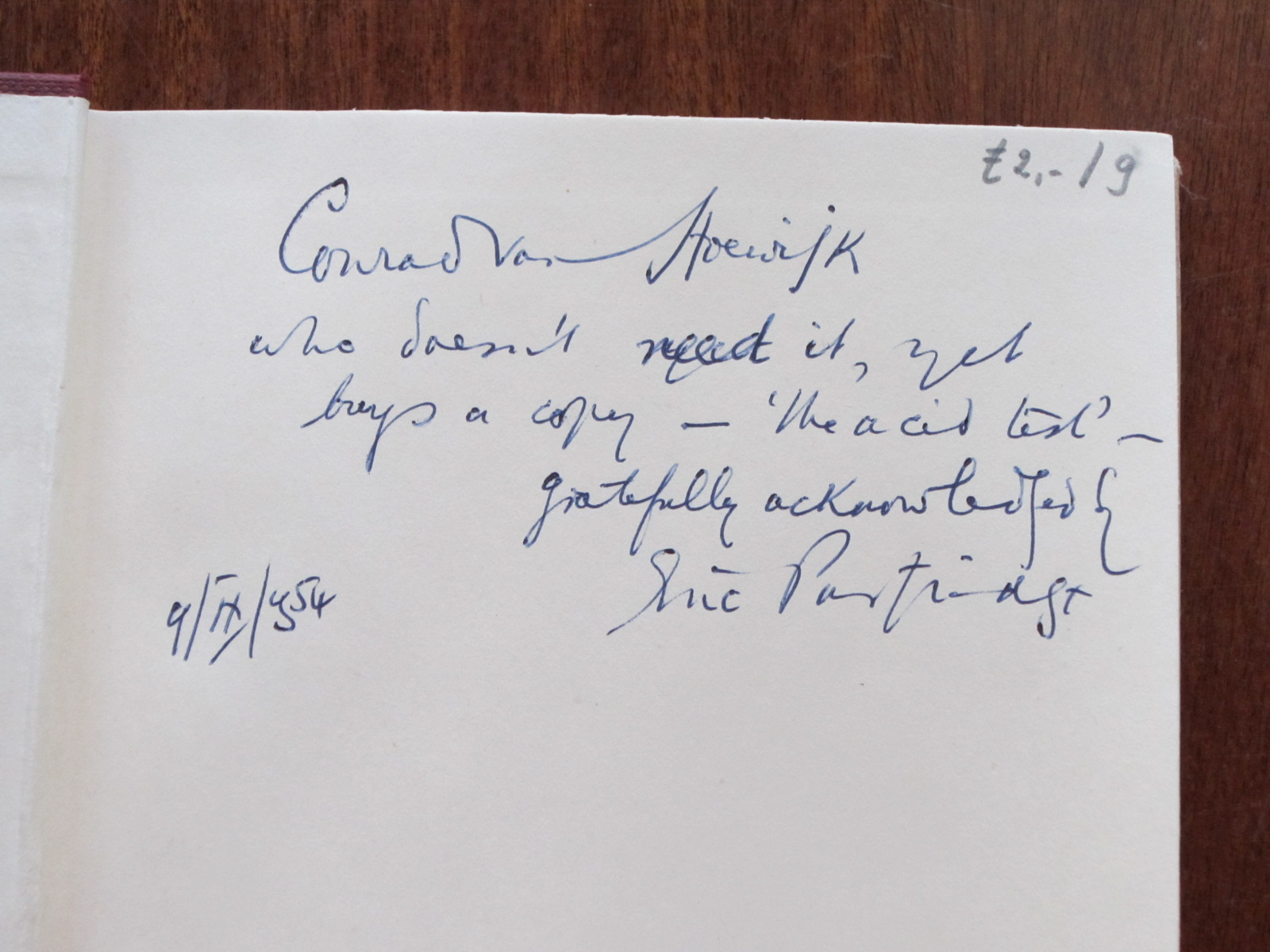
In the dedication to the buyer of the first edition of his Concise Usage & Abusage which I reported on the other day, Partridge complements Conrad van Hoewijk on his command of English: this Dutchman really doesn’t need to buy a usage guide, is what the text implies, his command of English is that good:

Conrad van Hoewijk/ who doesn’t yet need it, yet/ buys a copy – ‘the acid test’ – /gratefully acknowledged by /Eric Partridge/9/ix/954

A non-native speaker myself too, I frequently get similar comments from people I meet in Britain, often phrased in the form of the astonishment at how good the English of Dutch speakers tends to be, as well as that of speakers from Scandinavian countries. Why is that? they all want to know.

A similar comment occurs in Asta’s Book, a novel by Barbara Vine, published in 1993:

Attached to this with a paper-clip was a letter and the publishers’ usual compliments slip. The letter was in English, the very correct English of the well-educated Dane (p. 412).

Barbara Vine’s comment isn’t intended as a compliment to the letter-writer, as the protagonist is not meeting her face-to-face. So it confirms to me that such comments, well-intentioned as they are, I’m sure, may not be complimentary at all. In the University of Leiden, where I took my degree in English, we try to take our students to what is referred to as “near-native-speaker level”: this, as I am only too aware myself, is usually quite impossible.

So what do people mean when they say that your English is so good? Do we, in using the sort of “very correct English” that we’ve been taught to use, in fact not speak good English at all? Is our English rather more idiomatic perhaps than the real thing? Certainly that is what it feels like much of the time. Perhaps Partridge was right, and non-native speakers do not need usage guides but learner’s guides, targeted at our specific native speaker problems when speaking English (or any other language). And is there indeed an “acid test” for this? I’d really like to know.

Posted in Uncategorized | Tagged , , , | Leave a comment

Dialects and prescriptivism

If you have ever visited Scotland, you are probably well acquainted with Scottish dialects or at least with what you have been able to decode from the torrents of words you are encountered with. Even though I am not an expert, I can rightly claim to be able to understand some Scottish dialects after having lived a year in Scotland. Well, only until I meet the odd Dundonian or Glaswegian that shatters my illusions. Sadly, these occasional encounters have become the rule.

Having spent a few days in Scotland last week, I was shocked and amazed at how fast one can lose the ability to understand dialects. Getting one’s ears attuned to a specific dialect or accent is a hard piece of work. Not only being able to understand a dialect but speaking it, is even more difficult. In this BBC article, with the lovely title In yer ain wirds – What might we lose if we all began to speak like each other?, the question is raised concerning the loss of dialects due to favouring more standard varieties. Only recently the last speaker of the Cromarty fisherfolk dialect has died. (You can listen to a short recording of this dialect here.)

Technology, but also ideologies have taken their toll on the great variety of English dialects. Being forced to speak a more standard variety in formal contexts or at school is something I can personally relate to. For me, my dialect is my mother tongue. One has to bear in mind that language is always more than just words. It is about identity and culture. Why then prescribe a certain accent or imply that one dialect is inferior to another one? Sounds familiar?,a project of the British Library, allows you to eavesdrop on speakers of different British dialects and accents. Have a go and if you do not understand everything remember to haud yer weesht an’ get oan wae it!

P.S. Just to be clear about the distinction between accents and dialects: Accents concern pronunciation, whereas dialects involve even other features of language such as vocabulary.

Posted in usage features | Tagged , , | 1 Comment

4th Bridging the Unbridgeable Lunch Lecture

Our fourth lunch lecture will take place on 29 October 2012, from 12 to 1 pm, in van Wijkplaats 4, room 004.  This time, the lunch lecture will take the shape of a small mini-symposium, with two papers on usage guides and usage problems by

Carmen Ebner – “Perspectives on Language: Correctness vs. Usage”

Matthijs Smits – “‘Garnering’ Respect?’ The Emergence of Authority in the American Grammatical Tradition”.

All those interested in the topic are welcome – Bring Your Own Lunch!

Posted in news | Tagged | Leave a comment

A Partridge first edition

It sometimes pays off to visit second-hand bookshops in search of usage guides: yesterday, I found a first edition of The Concise Usage & Abusage by Eric Partridge. A signed copy as well! The book was published in 1954, there is a dedication on the flyleaf, which reads:

Conrad van Hoewijk/ who doesn’t yet need it, yet/ buys a copy – ‘the acid test’ – /gratefully acknowledged by /Eric Partridge/9/ix/954

We all know who Eric Partridge was: he has an entry in Wikipedia, complete with picture and all. Partridge is the author of many usage guides. But who was Conrad van Hoewijk, who bought what is now my copy of The Concise Usage & Abusage on 9 September 1954?

Googling for the name brought me in touch with a namesake, Jaap van Hoewijk, who told me he is not a relative, but who helped me identify Conrad. It turns out that Conrad, or Coen, was the first newsreader in the history of Dutch television. Coenrad van Hoewijk (1922-2007), too, has an entry in Wikipedia, as yet without a picture. Unfortunately, he is no longer alive. But the dedication by Partridge at least tells us how good his English was.

With thanks to Jaap van Hoewijk for helping me search the cloud. There will be more on Partridge and the book soon.

Posted in news, usage guide | Tagged , , , | Leave a comment

Another prescriptivist joke

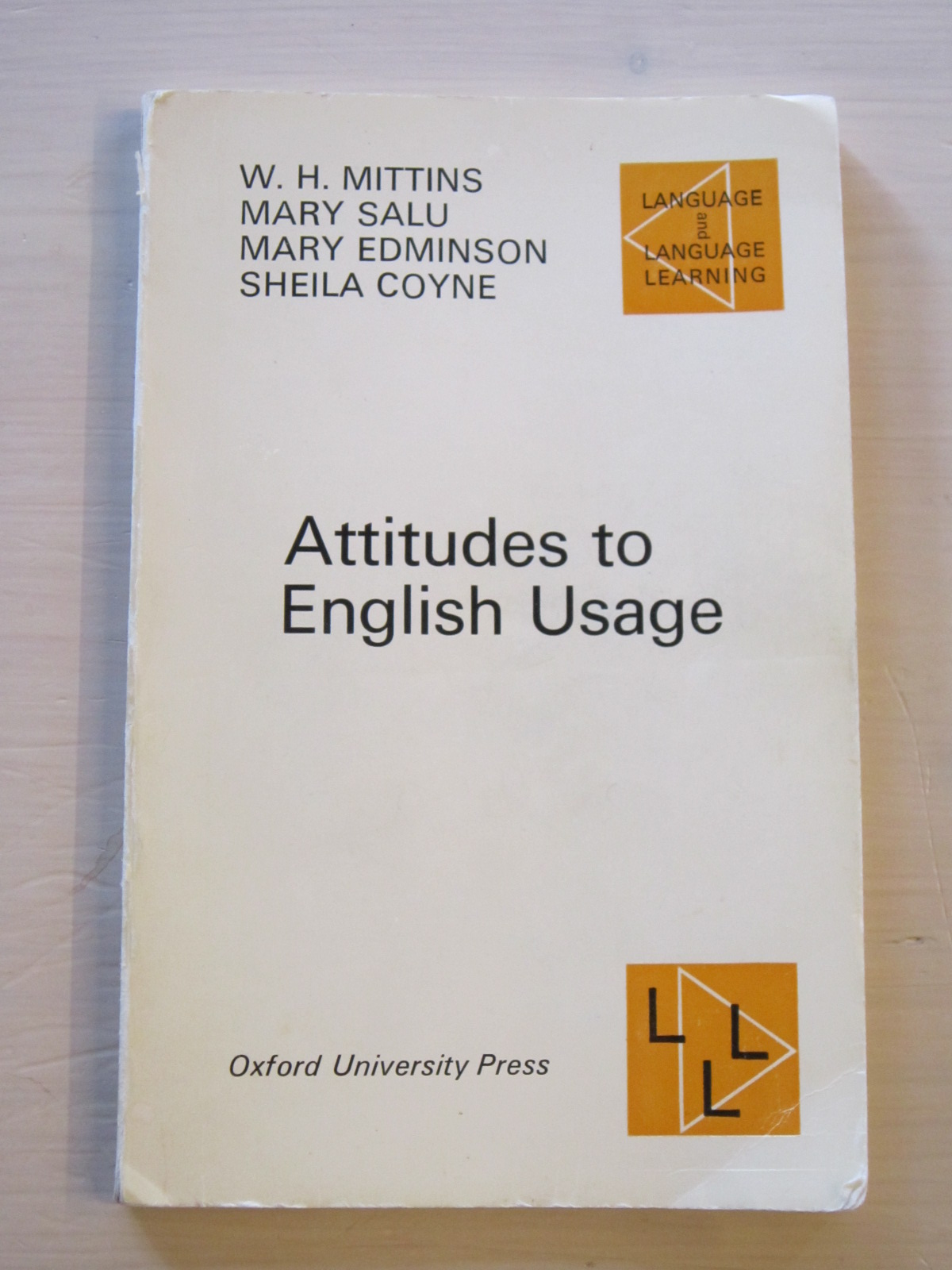
For a paper I’m giving at the LUCL Colloquium on 2 November, I started to analyse the response I got to the Attitudes Survey I have been carrying out since early May this year. The response, btw, has been truly phenomenal: I have 642 comments on the three sentences I asked people to write their opinions on. Well over 30,000 words of text to analyse, fantastic! The comments are great to read (yes, I did read them all), and they contain lots of interesting stuff, such as the following joke, which I’d like to share with you:

At a party someone used the sentence, “I only read one chapter.” Someone asked “What did you do with the other chapters? Eat them?” The group laughed and I quietly explained the joke to the original speaker. He was not amused.

Does anyone know any other such jokes, on other usage items, in English or in other languages? And should you be around on 2 November, you will be very welcome at the Colloquium.

Posted in usage features | Tagged , | Leave a comment

Creativity and/or Prescriptivism

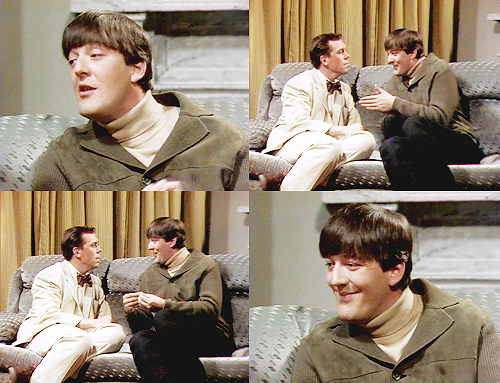
In a cult sketch on language, Stephen Fry compares the inexhaustible creative potential of language to that of music. The structure of language comprises a limited set of parts, just as a piano keyboard has a limited set of keys. However, they are both capable of producing an infinite number of combinations, each representing, as Fry puts it so vividly, “a unique child delivered of a unique mother”. And yet, he continues, we end up saying the same things over and over again. Could prescriptivism have something to do with that?

The genius of Fry is that he manages to touch upon a very serious subject and make a very valid point about it while being hilarious at the same time. What he is actually referring to is how we have tried to stifle linguistic creativity with rules regarding just about any part of language usage, starting from simple grammatical rules, to complex rules referring to collocational patterns, style, appropriateness, the logic of a construction, and so forth.

As a non-native speaker of English, I have always felt that English is one of the rare languages in the world that has that great creative potential which allows a speaker to express exactly what they feel even if they are using an unusual combination of words. I always felt that, for instance, you can unleash your linguistic creativity and combine any verb or adjective with any preposition as long as it makes sense and expresses what you are trying to say more accurately, even though usage guides advise otherwise. It turns out, I have been living in delusion. Native speakers of English tend to have really specific ideas about which combinations are acceptable and which are not; these ideas do not differ greatly from what one would encounter in a prescriptive usage guide. Allan Metcalf, professor of English, author, blogger, AND a native English speaker, was recently the subject of scathing criticism regarding the non-standard use of ‘centered around’, instead of ‘centered on’, in one of his blog entries. He was accused of being careless about language rules, which is especially unacceptable for someone careful about language.

You might wonder how someone like him would react to accusations of using wrong/bad English. Explaining the etymology of the term and citing a dictionary entry is a very good option and the standard way of proving the point, which Metcalf did. However, he went one step further and created a prescriptivist contest! People are expected to come up with their own prescriptive rule, explain and exemplify it. Pullum succinctly expresses his views on this by calling it ‘fake prescriptive poppycock’, which I agree with. Nevertheless, after a few minutes of browsing through the newly invented rules, I came across some very interesting – and I have to admit, impressive – pieces of linguistic prescription. It struck me to what extent native speakers are aware of patterns of usage and how rule-conscious they are.

I am not sure whether that was the author’s goal in creating the contest, but I felt that one purpose of it was to make people aware of the absurdity and redundancy of prescriptive rules. By this, I do not mean that rules are bad in general; they make learning a second language easier and offer language users a sense of security about linguistic correctness. Some areas of language, however, should remain beyond the realm of rules. Language users should always be able to have some room left for unbridled linguistic improvisation.

How about you? Have you ever felt that rules restrain your linguistic freedom?

Posted in Uncategorized | Tagged , , , , | 2 Comments

Check your grammar checker

During her plenary lecture at the 17th International Conference on English Historical Linguistics in Zürich, Anne Curzan reminded us of the enormous influence of the grammar checker in Microsoft Word.

My first thought at hearing the checker mentioned is that it is the thing I immediately turn off when I compose a new Word document. But are those green squiggly lines merely an annoyance or has the grammar checker more sinister consequences? Concern over the great impact that Microsoft Word has on the English language is not new. Ten years ago, Tim McGee & Patricia Ericsson already called the program ‘the invisible grammarian’ when they took a critical look at its influence in English composition classes.

Because Word is on millions of desktops and Grammar Checker is turned on by default, it has many more, practically invisible, “over your shoulder” opportunities to be a grammar teacher than the typical English teacher

It is unlikely that this invasive position of the MS Word grammar checker has become less over the past ten years, in fact the opposite is rather more likely.

The limitations of the MS Word spelling and grammar checkers are well known. Sandeep Krishnamurthy at the University of Washington has shown that it is easy to hoodwink the checkers. He performed experiments using some blatenty incorrect texts which nevertheless passed the spelling or grammar check. The files are here if you want to repeat these yourself.

But what are the grammatical rules the checker uses, and where do they come from? It should be possible to find out by trawling through the program, but I haven’t been successful yet. Anne Curzan suspects that the rules are put in by the programmers themselves.

If that is the case, and no linguists or other language experts are consulted, that means that the level of expertise of the English language probably doesn’t exceed that of an American college freshman. This could mean that millions of users of MS Word have their grammar checked at this level, which is a questionable state of affairs at least.

As I mentioned, my first action on seeing the green squiggly lines is to turn off Word’s check-as-you-write features, but not everyone does. How aware have you been of this feature of MS Word? And how has the grammar checker influenced your usage of the English language? Do you, for instance, accept its suggestions if you yourself aren’t sure whether they are correct? Or do you check them with other sources?

Posted in technology | Tagged , , , , | 4 Comments