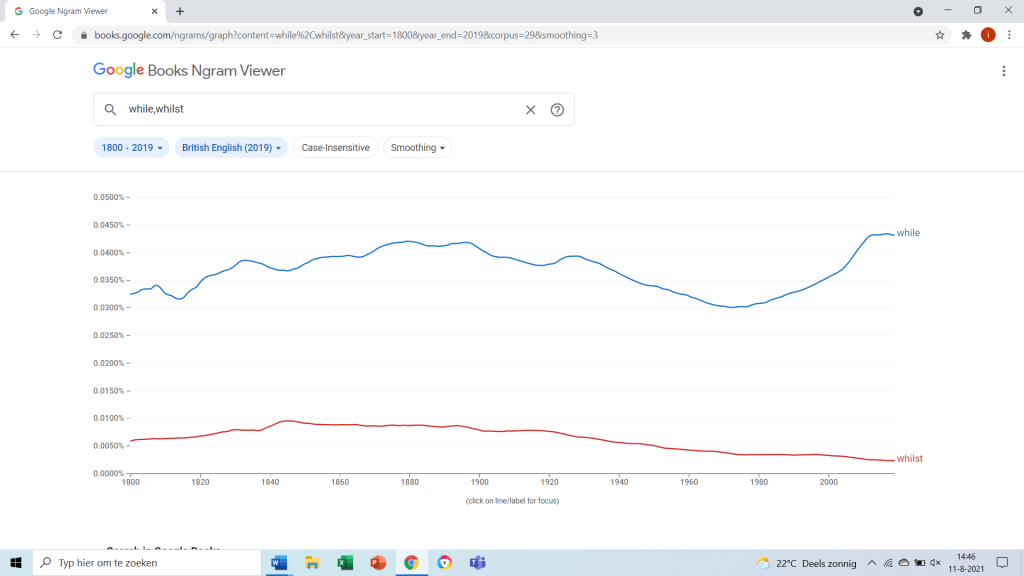
Reading the work of my younger academic colleagues, I get the feeling that whilst is making a comeback. Why would that be the case?
Strangely though, I don’t see this perceived increased frequency reflected in usage as we can access it through the Google ngram interface (I checked it for British English), nor does the OED record any instances more recent than those that are over a century old. So what is going on here?
I expect readers of this blog will also be interested in the grammar by Robert Lowth (1762 and many later editions). And if so, does any of you possess an original copy, from whatever date? If you do, please help me find out more about the grammar’s original owners. As explained on the Robert Lowth blog, I’ve set myself the more than ambitious task to identify as many of the owners of the 34,000 copies that were printed as possible.
Yesterday, the Guardian posted a call asking readers to express their personal thoughts on what the terms “working class” and “middle class” actually mean. These are terms well-known from sociolinguistics, so I’ll be curious to so how readers will respond.
The distinction is actually much more fine-grained, and has been so since Labov’s famous sociostratificational study carried out in New York and published in 1966. And to place the question into the context of a paper I’m preparing for the sixth Prescriptivism conference to be held in Vigo, Spain, in September this year, I’d like to refer here to Martin Amis’s latest novel called Inside Story, where on p. 313 he describes a character as “upper middle, yet her voice was […] pleasingly accentless ” . Another character is described on the previous page as “Minor public school with pretensions. He sounded the t in often”.
So: I bet a lot of comments will be coming in, and I’m looking forward to the article as it will appear on Sunday.
Two weeks ago, I reported on the opening of Bryan Garner’s exhibition Taming the Tongue at the Grolier Club in New York. The video of the event is now available online. So if you wish to know more about this amazing exhibition, you will be able to watch it here.
But the website includes a whole lot more, such as the exhibition’s online tour and many other very interesting Grolier Club events.
Two of my colleagues at the Leiden University Centre for Linguistics are working on the collocation of dat “that” and als “if” in sentences like Hij dacht dat als hij drukte, het luikje open zou gaan (“He thought that if he pushed, the trap would open”). In Dutch, the combination of two conjunctions is considered unacceptable, and writing manuals brand its use as a stylistic error.
The question was put to me whether this was also a usage problem in English, even though the construction is apparently regularly used. An English example they gave is the following:
De Saussure was so determined to have the mountain conquered that if he was not to be the one to do so, someone else should […]
Doing a full-text search in the HUGE database produced many similar examples, so this that if construction seems quite acceptable. But I promised to consult the readers of this blog, so my question is whether this sentence is considered problematical at all, and if so, in what variety of English.
If Dutch and English do indeed appear to take different stands on the acceptability of the construction, I would be interested in finding out why this would be the case. And also, whether the construction is considered fine (or not) in other languages than English or Dutch.
Like my colleagues, I’d be very interested in hearing what you think!
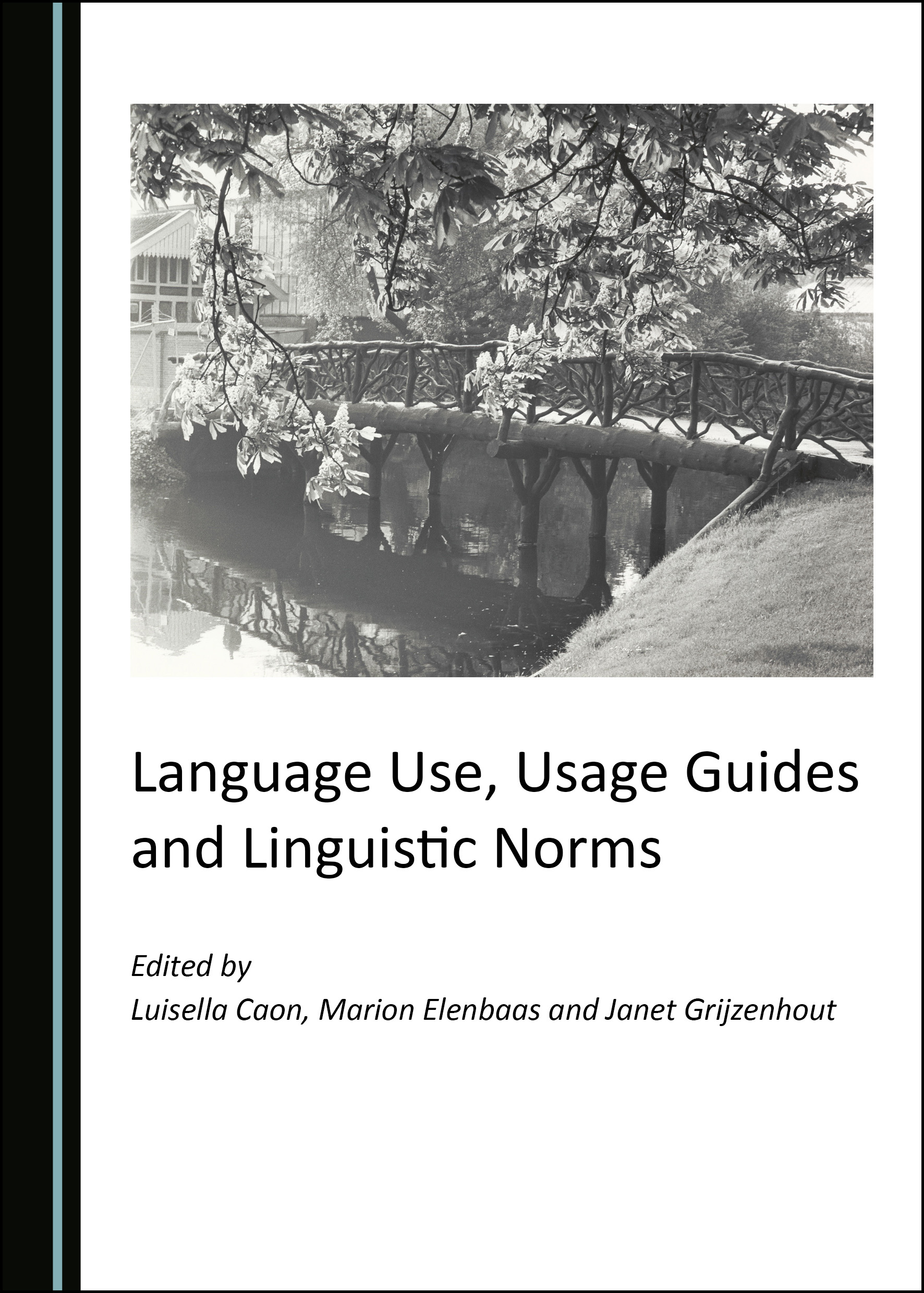
For all those interested in the relationship between usage, usage guides and linguistic norms, this book has just come out. With warmest thanks to the editors Luisella Caon, Marion Elenbaas and Janet Grijzenhout, as well as to all contributing authors: Marina Dossena, Raymond Hickey, Wim van der Wurff, Dick Smakman, Terttu Nevalainen, Carol Percy, Marijke van der Wal, Thijs Porck, Andreas Krogull, Gijsbert Rutten, Wim Tigges, Joan Beal and David Crystal.
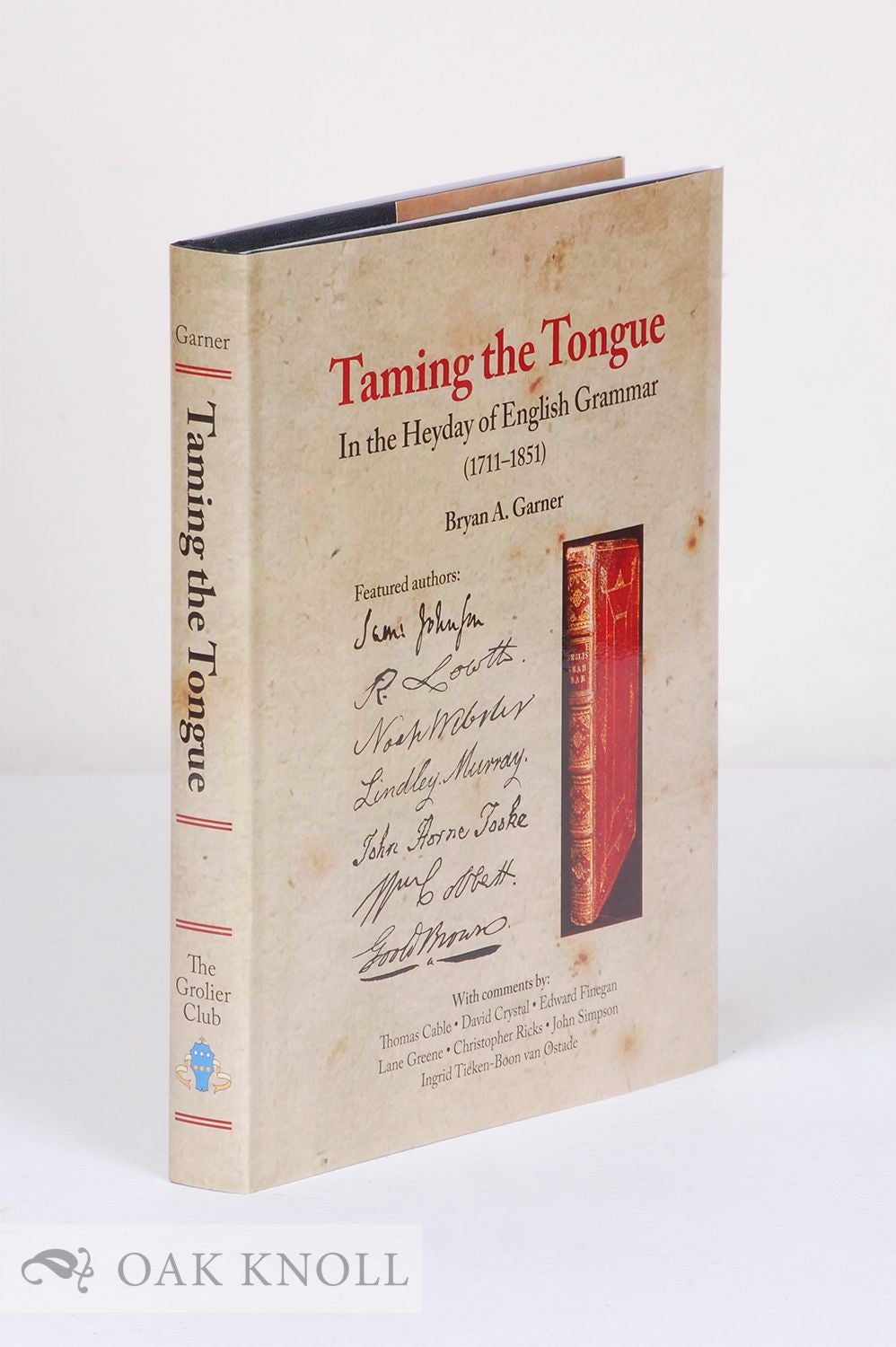
We all know Bryan Garner as the author of Garner’s Modern American (now English) Usage (4th ed. 2016), but not everyone may be aware of the fact that he is also a collector of 18th and 19th-century books, grammars as well as dictionaries. And not only of books, but also of letters and other original documents from the period. Last night (midnight in this part of the world) was the opening of an exhibition at the Grolier Club in New York called Taming the Tongue, celebrating his great collection.
The opening was – obviously – an online event, attended by a large number of people from the US and elsewhere, and we were given an overview of the selected books and other documents from Bryan Garner’s truly amazing collection, which comrpises as many as 38,000 items. The exhibition is also open online, and it takes you through the collection in a topical manner, ranging from Swift’s attempts at establishing an English academy, through the Lowth and the Murray years, to the early 1850s.
Bryan was asked for his most spectacular find (cliffhanger: watch the vimeo of the opening if you want to hear about it!), but my favourite, apart of course from the sections on Lowth’s grammar and the letter addressed to Robert Dodsley, would have been a first edition of Robert Baker’s Remarks on the English Language (1770), the first usage guide ever to have been published. I had no idea that the book would still be around.
There is a wonderful book accompanying the exhibition, filled to the brim with illustrations, called Taming the Tongue: In the Heyday of English Grammar (1711-1851). It is a must-have for anyone interested in the subject (I know, because Bryan kindly sent me a copy earlier this year), and despite its rich contents, very affordably priced.
For a paper I’m planning to write on the breaking of prescriptive rules by literary authors for characterisation purposes, I’m looking for specific examples of the breaking of the who/whom rule. I have several examples of them already, and have occasionally posted them on this blog. But more would be very welcome!
Also, I’d be interested in your thoughts about why Martin Amis, in his recent book Inside Story (2020) bothers to explain the rule for the use of who and whom. In a novel, as well. Why would he have done so? Any suggestions from people who’ve read his book already?


 Bridging the Unbridgeable