More than th-fronting

I keep on looking for instances of prescriptivism or metalinguistic comments on prescriptive issues in English literature. My call for examples in English Today recently did not produce any more examples unfortunately. The solution? Keep on reading, and even rereading. This summer will go down in my books as my David Lodge summer (last year it was books about classical ballet, the year before that all the Dutch Indian novels by Couperus). And look what I found.

It all started with a site visit of a well-known Dutch consultancy in Utrecht in April this year, which reminded me of David Lodge’s Nice Work, which I then reread. How little things have changed in academic life since the mid-1980s! Not a reason for optimism, I’m afraid. I next read Thinks … and am now half-way through Deaf sentence. Where I found a reference to prescriptivism, and even Lynne Truss’s Eats Shoots and Leaves!

The protagonist is a linguist this time (not, indeed, someone who knows languages, as recently-turned-deaf Desmond Bates informs his GP, p. 20),  who tries to keep on good terms with his step-son-in-law Peter. Peter is rather in awe of Desmond, “because he thinks you must be silently criticising his English all the time because you’re a Professor of Linguistics”, Desmond’s wife Fred explains. Happens to us all all the time! This made Desmond laugh, “because modern linguistics is almost excessively non-prescriptive”. But his wife was right, he has to admit, since “Peter is from a working-class background, speaks with a perceptible local accent and uses the occasional dialect word”. AND loves “Lynne Truss’s bestselling book on the apostrophe”, which Desmond had hoped to introduce him to, but which Peter uses “as a kind of bible”. Great, thanks, David Lodge, I’ll just keep on rereading and hope to find more.

And if anyone has any more such examples for me, I’d be very grateful!

But to end with a question: Deaf sentence is brilliantly dedicated to all those who translated David Lodge’s novels in the past. With the challenge added to translate the title of this particularly one. Has anyone come across any translations of the novel, or did the challenge prove too great?

Posted in usage guide | Tagged , , , | Leave a comment

Only 35?

Here’s a UK Guradina newspaper fluff piece for Harold Evans’ new book on writing dos and donts. He seems very confident!

Posted in Uncategorized | 3 Comments

Pullum: “Strunk simply doesn’t bother to look”

For readers of this blog and those who have followed the debate between prescriptivists and descriptivists closely, it’s hardly surprising to hear that Geoffrey Pullum, Professor of General Linguistics at Edinburgh University, is not particularly fond of William Strunk’s The Elements of Style, to say the least. Pullum has made no secret of his disapproval of the advice provided by Strunk. Describing Strunk’s advice as ranging from “limp platitudes to inconsistent nonsense”, Pullum takes a firm stance against The Elements of Style, which, he argues, has enjoyed great popularity on American campuses. (Read his full comments here.)

Now Pullum has taken on Strunk again on The Chronicle of Higher Education. In “Dracula, Strunk, and Correct English Usage, Pullum illustrates Strunk’s “limp platitudes to inconsistent nonsense” on the basis of literary evidence found in the usage of Strunk’s christopher_lee_tot_body_p-4623342contemporaries. Bram Stoker’s classic novel Dracula was published in 1897, which was soon to be followed by Strunk’s The Elements of Style published in 1918. Pullum uses example of disputed usages such as sentence-adverbial however to show how Strunk’s proscriptions are merely “personal peeves with no basis in either classic literature like Shakespeare or fine novels of his own time”.
Even though Pullum’s aversion to Strunk’s language advice is not surprising, I am still fascinated by how usage guide writers’ personal preferences can be completely contradictory to contemporary usage. We can find this pattern throughout the usage debate and even today (see Heffer’s attitude towards split infinitives in Tieken-Boon van Ostade & Ebner, 2017). Another proof of how correct usage is used to distinguish speakers. Us vs. them, correct vs. incorrect, intelligent vs. stupid, humans vs. vampires. And the debate goes on…

Posted in usage guide | Tagged , , , , | 2 Comments

Pedant – to pedant

Can pedant be a verb? So it seems. Read more about pedants and pedantry in today’s Guardian online edition. With many thanks to Joan Beal for the link. One question to our readers though: does anyone object to nouns being turned into verbs like this?

Posted in news | Tagged , , | Leave a comment

Bryan Garner review

An interesting review of Bryan Garner’s (2016) Modern English Usage has just been posted HERE on Linguist List.

Posted in news | Tagged | Leave a comment

Just out (surprise)

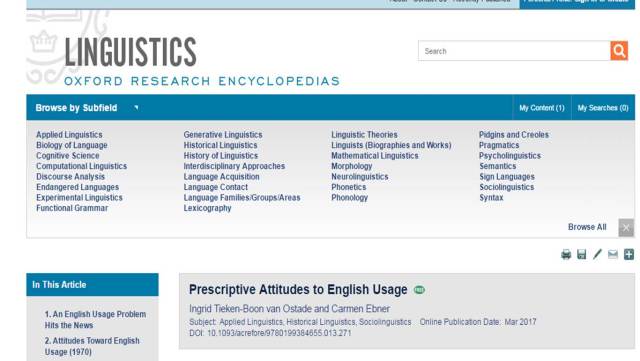
Today, we found out that our article “Prescriptive attitudes to English” is published, that it has been out for two months already. Thanks, Carmen, for tweeting about it, or I wouldn’t have known. Still, I’m really pleased, and expect Carmen will be, too: it is as interactive as we could make it, with loads of links (lots of prescriptivism goodies), and of course plenty of interesting (we hope!) content. We hope it will be widely read and quoted of course.

Oxford Research Encyclopedias

Posted in news, usage features, usage guide | Tagged , , , , , , , , | 1 Comment

Grammar Badgers

A few weeks ago, I gave a guest lecture through Skype for students at the University of Wisconsin. Interesting experience, and fantastic students they were. Their teacher, Anja Wanner, told me they were busy preparing an outreach project (obligatory at the university there, and what a great idea!), for which they used the university mascot, a badger. The project, called Grammar Badgers, is now available online, and it looks very interesting indeed. It contains a grammar quiz, videos, podcasts and a lot more besides. Browse around, I would say, and take the test! And give them your Likes in the process.

Posted in announcement, polls and surveys, usage features | Tagged , , | Leave a comment

Metalanguage usage in the UK primary school classroom

Here’s an article from the UK Guardian newspaper on the use of grammar metalanguage in UK primary school tests!

Posted in Uncategorized | 1 Comment

Microsoft Word, or: what is wrong with prescriptivism?

I’m reading through Carmen Ebner’s PhD thesis one more time (defense coming up soon!), and it strikes me in my own writings, too, every time – the red squiggles under prescriptivism, as in the header to this post. It makes me terribly insecure: is the second r in place? What is wrong with the word, why don’t they like it, over at Microsoft?

Posted in usage features | Tagged | 2 Comments

How many d’s in Grand(d)ad? No riddle

This post is dedicated to Clive Upton, who was surprised that I spelled Granddad with two d’s in the middle. I’m no native speaker, and just told myself: surely it must be grand + dad. Since then I looked it up in my copy of the Concise Oxford Dictionary, which allows for either: grand(d)ad, but this doesn’t help the linguistically insecure or those of us who just want to know which of the two is the correct spelling. Surely one must be better than the other? So, tell us what YOU think is better or more correct? Or if you think either is fine, in which case it wouldn’t be a usage problem?

Even if most people on this blog voted for granDDad (71.4% at the moment of writing), Penguin seems to prefer granDad. Or seemed to do so in the mid-1980s: I’ve just reread Nice Work by David Lodge (p. 373, where Grandad is spelled with a capital G as well).

Posted in Uncategorized | 5 Comments