You should not borrow that!

Here is Sara Sánchez-Molina Santos’s second blog post:

Should we blame on language users the borrowing of words from other languages? Are speakers mistaken when they borrow words that are apparently already present in the language? Is this a new phenomenon?

Some time ago, I came across this opinion article about the borrowing of the word spoiler into Spanish with the meaning given in the online Oxford Dictionaries under entry 1.3: “A description of an important plot development in a television show, film, or book which if previously known may reduce surprise or suspense for a first-time viewer or reader”. The author of the article, Álex Grijelmo, argues against the use of this word for two reasons: there are words/expressions in Spanish that already cover this meaning and, secondly, the way it is used in Spanish is wrong.

Interestingly, Grijelmo is not against borrowing words that are needed. He praises the borrowing of the word fútbol ‘football’ since there was no lexical item covering that concept in Spanish (the word balompié [balón ‘ball’ + pie ‘foot’] is a calque from the English word and it was coined after the entrance of that term into the language (DLE 2016)). However, he does not feel the same way about the word spoiler. He mentions that Spanish has a wide range of terms and expressions to imply this meaning: no me estropees el final ‘don’t ruin the end of the film for me’ , no me cuentes cómo termina ‘don’t tell me how it ends’, or no me destripes la película lit.’don’t gut the film to me’ (destripar means “to gut” in Spanish). I personally believe that the use of the word spoiler is not threatening the use of any of these expressions. Moreover, I do not think that the way speakers use it is wrong. It normally occurs in sentences with the verb hacer ‘to do’ such as, “no me hagas un spoiler” (‘don’t do a spoiler to me’). However, Grijelmo points out that spoiler can only function in English both as a noun and as an adjective referring to the person that tells the end of the story (I did not find this definition neither in the Oxford dictionaries online, nor in the Cambridge dictionary). But he understands spoiler in the sentence above as referring to the person for whom the film is being ruined. In my opinion, that is not the way most people use this word either in English or in Spanish, but they use it in the same way as the definition given by Oxford (at least, that’s how I use it!).

So, are we facing a case of overproscription? I would say so. But, is this a new practice among language sticklers? Probably not. As pointed out in this other article from 2011, also from El País, about the adaptation of Anglicisms to the Spanish orthography (for instance, the author talks about the failed attempt to introduce güisky for ‘whisky’ or pirsín for ‘piercing’), lexical borrowings have always raised controversy among language purists. Thus, if today we see purists complaining about the introduction of unnecessary English words into Spanish, in the eighteenth century it was the  adoption of French words that caused the debate (and, these words are now very entrenched in the language, e.g. detalle ‘detail’, favorito ‘favourite’). Similar to the case of spoiler is the case of restaurante ‘restaurant’; there were already words referring to the place where food is served (words that are still used in Spanish as mesón ‘tavern, inn’, casa de comidas lit. ‘house of meals’), but, speakers borrowed this word anyway (according to Corominas 1980 :1099, the Academia already presented and entry in the dictionary for this word in 1817) . Probably, the reason behind this may be that French was considered a more sophisticated language at that time, as José Antonio Pascual explains in the article. And the same with spoiler nowadays, speakers may see English as a more modern language.

I think is a mistake to blame speakers for the borrowing of words. The history of language is probably full of examples like this and some words stayed and adapted to the language of adoption (phonetically and orthographically), but others did not stay long. In any case, lexical borrowing has not threatened the life of languages so far. So, why should borrowing be a matter of proscription?

A final question, are borrowings only a matter of concern among Spanish language purists or is there any particular loanword in English that especially worries or worried language guardians?

References

Corominas, Joan (1980) Diccionario Crítico Etimológico de la lengua Castellana. vol. 3 Madrid: Gredos.

British and world English Dictionary online. Oxford Dictionaries online. Oxford: Oxford          University Press

Source image: http://vignette4.wikia.nocookie.net/universosteven/images/b/bc/Spoiler-Alert.png/revision/latest?cb=20160107201744&path-prefix=es.


Posted in Uncategorized | Tagged , , , , | 1 Comment

Your Top 5 of grammatical errors in English?

Hielke Vriesendorp is a research master student of Linguistics at Leiden, who is trying to collect data for his paper for Ingrid Tieken’s MA course Testing Prescriptivism. To this end, he compiled a brief survey asking about people’s Top 5s of most important grammatical errors. Please help him get data for his paper by filling in this poll!

Some further explanation perhaps? In The Cambridge Encyclopedia of the English Language, David Crystal discusses a “Grammatical Top Ten” which includes shibboleths like the split infinitive, preposition stranding and the double negative. Hielke suspects that nobody is worried about the split infinitive as a usage problem anymore (though perhaps they are!), and would like to know what other usage problems people encounter in their day-to-day communications.

Posted in news, polls and surveys | Tagged | 6 Comments

I’m good, I’m fine

About a year ago, Morana and I posted a survey on this blog to try and collect data about attitudes to the flat adverb. We wanted to use the data for a paper we were writing at the time. But we also asked if people could tell us about other usage problems they saw or heard around them, or at least, in as far as they perceived them as such. Amazingly (at first sight that is, since the survey was on the flat adverb), some people mentioned the increasing use of “I’m good” in reply to the question “How are you?”.

But something else is at stake here than the idea that well should be used instead of good. As a Spanish website for learners of English explains the difference, well is used when you are not sick (ill?), and good when you are feeling happy. It seems to me that the complaint rather has to do with the increasing use of “I’m good” in a context where in the past “I’m fine” would be the expected reply, to express both that you were in good health and feeling happy. At least, that is what I was taught to say in school – a long time ago, I admit.

Often, people start commenting on particular features of usage when there is a noticeable increase in frequency of the feature in question. This definitely goes for me: I still remember when I first started noticing the use of “I’m good” in contexts where I expected “I’m fine” – 2011 when we were living in the UK for six months. So is there a real increase of the usage? Not if you check frequencies on Google books, where you can see (with the help of Google n-gram) a spectacular increase not of “I’m good” but of “I’m fine”, both in British and American English. (So the Brits would not be able to blame the Americans for this feature!)

Is there a real or only a perceived increase of “I’m good” at the expense of “I’m fine”? And if there is, is this an age-related feature, and will “I’m good” eventually take over? And for our interests in this project, will “I’m fine/good” develop into a usage problem?

Posted in usage features | Leave a comment

Whether or not?

My colleague Ton van der Wouden would like to know if whether or not  is a usage problem – or not. He noticed an enormous increase in usage (Google Books) over the last eighty years or so. As far as I know, it is not an issue dealt with in any of the usage guides I’ve seen. Can anyone help him find any literature about it?

Posted in usage features | Tagged | 5 Comments

Seeing usage problems around every corner!

Here is Bram Steijn‘s second blog post for the MA course Testing Prescriptivism: 

I was sitting in the train, checking my Facebook messages, when I stumbled upon the following mistake in someone’s profile text: “living life at full”. The person in question wasn’t a native English speaker, so I let him off (as you do as a student enrolled in a course like “Testing Prescriptivism”). Instead, I internally corrected the sentence to “living life to the fullest” and put the case to rest.

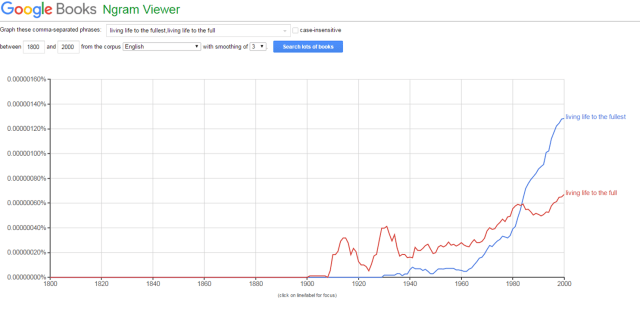
However, the second I did so, I started questioning my correction. Can something be fuller than full? Surely it cannot. Suddenly, “living life to the fullest” sounded odd. Yet the alterative, “living life to the full”, felt even more out of keeping. Which version was correct? As someone who holds a BA in English literature and language – and is currently pursuing his MA – I felt horribly incompetent when I realised that I could not answer this clearly simple question with a certain resoluteness and authority. I also did not have my copy of Oliver Kamm’s usage guide with me at the time I spotted the mistake, so I could not consult his wisdom either. A quick search in Google nGram revealed that in the English language “living life to the fullest” became significantly more popular than its “living life to the full” counterpart after the year 1983.

Living life to the full fullest

Based on this, it seemed that “living life to the fullest” was the way forward. So just when I thought I had found the answer, the train stopped at some station and an advertisement like the one below came into sight: “taste life to the full”. It was now no longer just a minor annoyance.

As soon as I got home, I turned to my volume of Oliver Kamm’s usage guide. While there was no entry dedicated to “full vs. fullest”, there was a section on absolute adjectives. Kamm mentions that language pedants are of the opinion that absolute adjectives such as peerless, matchless, eternal, and also full, “cannot have superlatives” (Kamm 2015: 147). Kamm believes differently and remarks that “you can go right ahead and use comparatives, superlatives and intensifiers with absolute adjectives; the best writes do” (Kamm 2015: 148).

Even though I now had my answer, I decided to consult the British National Corpus and the Corpus of Contemporary American English to find out which version was more popular among users of the English language. The results from the BNC are overwhelmingly in favour of “life to the full” (49 hits vs. 3 for “life to the fullest”). The situation is reversed when we look at COCA. Not only is “life to the full” recorded less frequently than “life to the fullest”, the corpus also shows that the former is in decline, whereas the frequency for the latter is steadily increasing. After I discovered that Google nGram can differentiate between British and American English, I queried it again. The results are striking (you can find out exactly how striking, by setting the language in the box below the query box to either British or American English).

I decided to put these results to the test and ask both a Brit and an American to finish the following sentence: “Living life to the …”. The results, while by no means scientific, were entertaining. My American classmate (thank you, Madeleine) immediately finished my sentence by saying “fullest”. My British and Scottish friends, however, did the same! Both went for “fullest” over “full”.

Having given this topic more thought that it probably deserves, I have decided that even the initial ‘mistake’ I spotted was altogether fine. After all, I knew what the person in question meant. He thus communicated perfectly with me and, in all likelihood, with everybody else who read it. Besides, Milton employed a similar construction in his writing when he wrote: “[h]is Regal State Put forth at full” (OED) – a construction which, although obsolete now, was considered legitimate at the time Milton was writing his epic Paradise Lost. Personally, I can see the point that a glass cannot be fuller than full, and that one encounter cannot be more fatal than the next, but if you are only living life to the full, then you simply are not trying hard enough!

Posted in MA Leiden, usage features | 3 Comments

And the winner is …

This morning, I’ve been going through the HUGE database to find out which of the 123 usage problems was treated most by the usage guides (77 in all). Does anyone want to make a guess?

huge_logo-neat_colour1


Posted in usage features, usage guide | Tagged | 2 Comments

Can your local accent hold you back?

Do people need to change their local accents to get on in life? The answer is “yes” according to those advocating a prescriptivist approach to language use who often emphasize that in professional settings and in job interviews local accents and nonstandard English can hold you back.
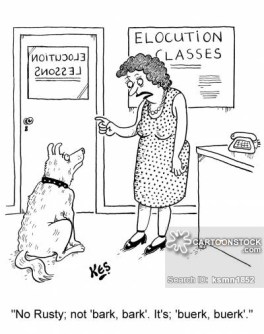
Local accents seem to be a real obstacle for trainee teachers in the UK according to a recent study conducted by Dr Alex Baratta, a lecturer at the University of Manchester. Baratta interviewed trainee teachers both from the northern and t'No Rusty; not 'bark, bark'. It's; 'buerk, buerk'.'he southern English universities and found that the ones from the north of England were told to modify and tone down their accents in the classroom by their teacher training mentors. He goes to conclude from the data analysed that intolerance towards accents constitutes “the last form of acceptable prejudice” and that a culture of linguistic prejudice is part of the teaching profession in the UK. The study has received much attention from the press and it was reported on in The Telegraph, The Guardian and The Sun. BBC Radio Cumbria featured a segment on the topic in which the host Kevin Fernihough (a dialect speaker himself) talked to William Hanson, an etiquette expert, and Jane Setter, Professor of Phonetics at the University of Reading. You can listen to the entire segment here (00:38:16 – 00:59:40). Surprisingly perhaps, the two guests who respectively represented the prescriptive and the descriptive side of the debate agreed on their views regarding Baratta’s study in stating that regional accents, as long as the speaker’s words are pronounced clearly, should not be banned from the classroom or as Setter puts it “What on Earth does it matter as long as the speaker is clearly spoken, it shouldn’t matter that they have a regional accent”.  Any thoughts on the results of the study? Leave your comments below.

Posted in news | Tagged , , , , | 2 Comments

We’re/were: huh?

Recently, one of my English Facebook friends wrote that she and her family had just survived a very cold May Bank Holiday weekend camping with snow on the hills. “We’re you in a caravan?” one of her friends asked. We’re for were? I understand problems with there/they’re/their, its/it’s, your/you’re, since these are homophones, and the absence or presence of the apostrophe is merely a matter of convention. But we’re/were are not homophones, so what is going on?

If you google for “we’re or were”, you get to a Dutch site called “Nu beter Engels”, which explains the difference between where, were and we’re. The site calls these words twijfelwoorden, a lovely word I hadn’t come across before either, which may be translated as “confusables”, a word I first came across in Her Ladyship’s Guide to the Queen’s English by Caroline Taggart (2010). The book has as many as THIRTY pages of them, but we’re/were is not included.

Googling for we’re/were also took me to Paul Brians’s website accompanying his book Common Errors in English Usage (2003): it was actually the first hit. Brians explains the difference between the two forms. I can see that they might be problematical for non-native speakers of English, but for native speakers of English, too? I would never have guessed it, but apparently so.

Posted in usage features | Tagged , , , , | 10 Comments

Pinker’s Sense of Style translated into Dutch

Yesterday, I accidentally came across the translation into Dutch of Pinker’s The Sense of Style in a bookshop here in The Hague. Amazing, an English style-cum-usage guide translated into Dutch. A much earlier similar attempt, the translation of Lynne Truss’s Eats Shoots and Leaves into Dutch, under the title Eten, Vuren en Beuken, by Wim Daniëls, fell quite flat. It was a peculiar mix of English and Dutch, that to my mind didn’t quite seem to work. This same criticism is also levelled at the Pinker translation by a reviewer for the Dutch newspaper De Volkskrant, though, awarding the book three stars (out of five), the author is still fairly positive about the book’s general message. It’ll be interesting to see how well this translation is going to do.

Posted in news, usage guide | Tagged , , | Leave a comment

9 December: Save The Date!

On 9 December 2016, the Bridging the Unbridgeable project will organise a usage guides symposium at the Leiden University Centre for Linguistics. Speakers will include Rebecca Gowers (author of the revised edition of Plain Words and of the recently published Horrible Words), … Continue reading

More Galleries | Tagged , , | 1 Comment