Stephen Fry telling off his guests

Here is Joachim van Gelder’s first “Testing Prescriptivism” blogpost:

Stephen Fry has hosted – with generous helpings of his usual charm and panache – the annual British Academy of Film and Television Arts (BAFTA) awards ceremony for the past 11 years. During the 2014 edition of the show, he humourously commented on the acceptance speeches of David O. Russell and Jeff Pope, after they had just won the awards for Best Original Screenplay and Best Adapted Screenplay, respectively.

As soon as David O. Russell had delivered a speech in which he complimented his actors, Stephen retook the stage and made the following correction: “David, it’s a writing award. I think what you meant was not ‘who it was a great privilege to work with’ but ‘with whom it was a great privilege to work’. Never mind.” Not much later, Jeff Pope suffered a similar reprimand after thanking his producer, who, Pope said, “brought Steve [Coogan] and I together.” Stephen immediately explained that it should be “brought Steve and me together” instead.

Stephen was, of course, joking – half-joking, at the very least. He is a pedant no more, after all. Still, did the phrases uttered by David O. Russell and Jeff Pope actually contain grammatical errors? Opinions are divided on the issue, and the answer you will get is likely to depend on who you ask.

Sticklers will say that the pronouns I, he, she, we, they, and who (and whoever and whosoever by extension) require a different form when they occur in object position. That is, Stephen Fry tells me, him, her, us, or them whom he likes. *He certainly doesn’t tell I. *Nor does he tell we. The phrases uttered by David O. Russell and Jeff Pope contain errors, sticklers will say, by the same token. The pronouns in their utterances do not occur in the subject position, but look as if they do, and must therefore be changed.

Linguists would probably argue that it is all up to the native speakers of the language. If many or most people feel that phrases such as the ones I have been discussing do not present an issue, then such phrases are, to state the obvious, acceptable, and should be considered as such. It is for the same reason that utterances like It’s me are acceptable and have actually become the norm, while sticklers may insist on It is I because the I/me element is a subject complement, which requires the nominative case, i.e., I.

What do you think? Does it simply come down to stylistic choices and personal preference? Or do the sticklers – and Stephen Fry in particular – have a point?

Posted in usage features | Tagged , | 1 Comment

Commonest. Common or not?

And here is Madeleine Ibes’s first blog post:

Whilst doing my weekly reading for the course Testing Prescriptivism, I stumbled across a term I had never heard before. The book I was reading was a study done by Mittins et al., Attitudes on English Usage (1970), which was on the acceptability of certain usage problems in the late 1960s, one of which has been written about on this blog before.

What I stumbled upon was an interesting usage problem, or perhaps an interesting reaction to such a problem. Instead, it was a word that I found in the following passage:

The invitation to extend the list of debatable usages produced well over two hundred different items, of which the great majority were explicitly or implicitly condemned. There were one or two pleas for tolerance (e.g. ‘of such local habits of speech as “To get a hold of”’) and a few expressions of genuine uncertainty (e.g. ‘ “five foot/ feet high”’ ). But (incidentally, the initial use of but or and was included on the black list!) by far the commonest sentiments expressed were those of disapproval, irritation, shock and guilt. (Mittins et al. 1970:12)

Can you spot the word that I was most struck by?

In case you couldn’t, it was the word commonest, used by the authors here instead of most common. Growing up as I did in the Northern United States, this was not a word I had ever seen or heard used before. For me, common was a word that I was taught to have the following degrees: common, less/more common and most common. Not commoner or commonest, in other words. Now I wondered how I hadn’t, in all my academic years, come across this word before! Was I ignorant? Was I simply a bad native English speaker?

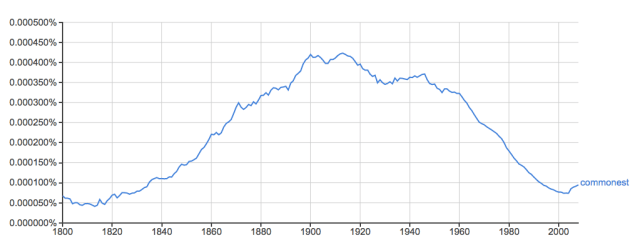
The answer to why I hadn’t seen this word before, it seems, is actually quite simple. Upon further research, I discovered that this word had seldom been used in the U.S., and since the 1910s, has been on a relatively steady decline in terms of actual usage. This can be seen in the following graph, produced by using Google N-Gram, whilst searching the American English corpus for the word commonest:

Commonest AmE (2)

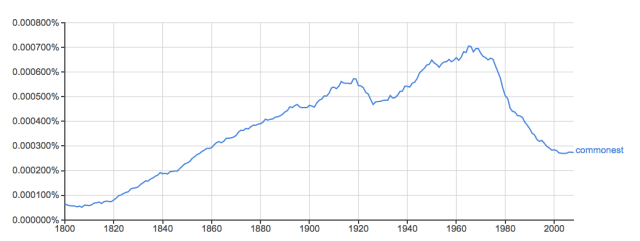
However, the Google N-Gram graph for the British English corpus paints a different picture:

Commonest BrE

Indeed, the word commonest has led a fairly different life in British English. Instead of steadily declining from the 1910s onward, the word experienced an almost uninterrupted general incline until the 1970s, when it sharply declined and eventually levelled out.

The Mittins et al. survey was published in 1970 by  Oxford University Press, close to the height of this word’s usage in British English. It makes sense, then, that it was used in the same way that I would use most common. Furthermore, these graphs also explain why I hadn’t seen this before in my life, academic or otherwise, having grown up reading and dealing with largely American texts.

Do you like the word commonest? Or do you prefer more common? Why? Please tell us by filling in this poll, and by leaving a comment to this post if you wish.


Sources:

Mittins, W.H., Mary Salu, Mary Edminson and Sheila Coyne (1970), Attitudes to English Usage. Oxford: Oxford University Press.

Posted in MA Leiden, usage features | Tagged | 3 Comments

Ashamed of your English?

If you are, and even if you are not, you might like to attend our monthly lunch lecture on Friday 22 April. Our speaker this time will be Harry Ritchie, the author of English for the Natives (2013). We’re delighted … Continue reading

More Galleries | Tagged | Leave a comment

Si volet usus

Here is Sara Sánchez-Molina Santos’s first blogpost:

Grammatical rules change si volet usus (“if it be the will of custom”, according to Horace, in his Ars Poetica, c.  19 BC). This is what the Spanish Royal Academy says in the prologue to their usage guide El buen uso del español (“The good usage of Spanish”) which was released in 2013, coinciding with the 400 anniversary of the institution.

The goal of the academy since it was established in 1713 has been to dictate the grammatical norms that govern the Spanish language, following the prescriptivist tradition. But, surprisingly enough — at least it surprised me — it is claimed in this guide that all the rules are based on usage. Let me develop this point further. Of course, the authors of the book appeal to the normative tradition in Spanish. Our lives are governed by rules and also language is governed by them. However, they say that they have moved from a “monolithic concept” of the grammatical rules to a more flexible one. They are aware now of the mutable nature of language. Change is in the genetics of language, they say.

The book is intended as a tool to solve the possible grammatical or orthographical doubts that speakers may have and, as such, is a book of rules. But their aim is not to censor and prescribe, but to educate. The authors consequently take a more positive attitude to the grammatical norm they set down. Their perspective is one in which users choose to use the norm because it will help them to succeed in life. But do they succeed in thus distancing themselves from prescriptivism? Once you look at the contents of the books, you certainly find useful topics on orthography and punctuation, but also hot topics in prescriptivism such as laísmo, leísmo, loismo or dequeísmo (see below for what these words mean and why they are issuses of presciptivism). So, sticklers, don’t worry, the Academy is still with you.

Explanation:

Loísmo/Laísmo are features characteristic of the certain varieties of Spanish from Spain. They consist of the use of the object clitic pronouns lo (third person, masc, sing) and la (third person, fem, sing) in the place of the inidirect object clitic pronoun le.

Leísmo is a feature of certain varieties of Spanish in which the indirect object clitic pronoun is used in the place of the direct object pronouns lo/la. The Spanish academy accepts its use when referring to animate entities, but it condemns it when it refers to inanimate ones.

Dequeísmo is the use of the preposition de “of” in front of the complementizer que “that” when the preposition is not selected by any of the words in the sentence (e.g Me dijo de que estaba cansada instead of the accepted form Me dijo que estaba cansada “She said to me that she was tired”).

Posted in MA Leiden | Tagged , , | Leave a comment

The -isms around the prescriptiv- …

… and how they are (almost) non-apparent in Dutch

Here is Merijn Kooijman’s first blogpost:

Although no prescriptivist will probably ever admit this, prescriptivism is often just a cog in the machine. Obtaining perfect linguistic purity always seems to be done in the name of a higher purpose: nationalism, pan-<fill in>-ism, conservatism, Zionism, elitism, globalism, idealism, and the list goes on. The following quote from Ilker Aytürk (2008:281) about the position of the Language Council at the beginning of the big language reforms in Turkey, shows the exact position of a prescriptivist in any circumstance:

From the very beginning, the Language Council was far from being an autonomous, scientific committee. When some members of the Council acted on the false premise that they alone would be responsible for the script reform project and started weighing the advantages of romanisation against its disadvantages, they soon came face to face with reality.

In other words, even if a prescriptivist would want to be open-minded, he simply can’t be. The -ism in power will hold him (or her) back and he (or she) will get face to face with reality. Let’s say that I’m going to write a usage guide of English in which I prescribe the total opposite of what Fowler prescribed in his Modern English Usage on every possible usage problem. My publisher probably wouldn’t publish my usage guide and even if he would, every buyer of my book would return it, since “it’s incorrect”.

In this light, it is interesting to look at the following comment I came across on Facebook. This comment was made to another comment that contained a standpoint that is often considered a right-wing nationalist standpoint that was formulated quite poorly:

Think about spelling, punctuation and grammar! They who “love” the Netherlands the “most”, shouldn’t mess up the language that much. (Translated from Dutch)

What could this possibly mean? It looks as if the commenter is propagating proper Dutch usage on a meta-level of prescriptivism: ‘hey, your language use is not compatible with your political profile, fix it!’ or even ‘since you’re a nationalist, you should be prescriptive yourself!’ Oddly, this claim presupposes that the commenter links nationalism to proper Dutch use, while a. the Dutch in the comment above is correct and b. the commenter does not consider himself a nationalist (given the use of “They” in the quotation). This seems a kind of prescriptivism or language ideology that is not based on an -ism, but claims to be based on some sort of self-prescription: ‘I advise you to prescribe yourself, but I don’t prescribe anything.’

This claimed interested self-prescription also becomes apparent on the language advice page of Genootschap Onze Taal, where the following sentence is found as part of an instance of advice offered about how to write ‘the seventies’, ‘the sixties’ etc. in Dutch:

De jaren twintig (twenties), dertig (thirties) et cetera is preferred: round/whole decades are best written in letters since this reads most pleasantly (literal translation from Dutch. Note that the subject of to read is kept implicit in this so-called middle construction.)

This almost seems to be an aesthetic argument in favour of prescription. However, the comment doesn’t explicitly say that writing twenties in letters rather than numbers (20s) looks prettier: it only says that a writer could benefit from writing it that way, because a reader might have a more pleasant reading experience as a result.

Now, how can we catch this Dutch prescriptivist attitude in an -ism? Since Dutchmen have, on this blog, already been characterised as active complainers on everything but language, I’ll add another characterisation and go for individualism. ‘Just take my advice; it will make you the successful individual you want to be!’

Reference:

Aytürk, I. (2008), The First Episode of Language Reform in Republican Turkey: The Language Council from 1926 to 1931, Journal of the Royal Asiatic Society of Great Britain & Ireland  18(3), 275-293.

Posted in Uncategorized | 2 Comments

Introvert pedants?

Robin Queen and Julie Boland, both from the University of Michigan, recently conducted a study on attitudes towards spelling variation, which has now been picked up by The Guardian. What they call “typos” and “grammos” are errors everyone has come across when using the internet and computer-mediated communication. Numerous internet memes illustrate computer users’ outrage about spelling mistakes such as the one below.

 While typos are errors Queen and Boland link to keyboarding issues, such as spelling <the> as <teh>, grammos constitute “traditional peever errors that are only relevant in written language”. Thus, a grammo would be the use of to instead of too, for example. Typos are often considered simple mistakes caused by carelessness and rushed typing. Grammos, on the other hand, seem to be evaluated more harshly and to affect the writer’s personality, as the writer’s abilities and knowledge are questioned. Queen and Boland sought to identify whether the participants’ demographics and personality traits can be linked to attitudes towards such mistakes.  83 English-speaking Americans participated in their study which showed no significant correlations between attitudes and social variables such as gender, age or level of education. However, Queen and Boland found that personality traits (introvert/extrovert) showed differences in how spelling errors are perceived. Introverts, according to their study, seem to be bothered more by typos than extroverts.

What is striking is not only that they found such differences in personality traits and attitudes, but their methodology needs to be highlighted. While usage attitude studies have often been criticised for providing no context, Queen and Boland managed to incorporate their stimuli into email responses to an ad for a housemate. A similar study by Queen and Boland (2015) also incorporated so-called “hypos” which are errors that result in technically ungrammatical sentences and are often caused by hypercorrection. The distinction between I and me as in It’s I/me can be considered a hypo, which is also considered a so-called usage problem. Queen and Boland’s study (2015) includes a further usage problem: could of and would of.

Since I am studying usage attitudes in England, such studies are indispensable. However, it is intriguing to see how many studies have been published in the United States and how little work has been done in the United Kingdom. If you have come across any UK studies, please share them with us by commenting below!


Queen, R. & Boland, J. (2015). I think your going to like me: Exploring the role of errors in email messages on assessments of potential housemates. Linguistic Vanguard 1 (1). pp. 283–293.

Posted in news, polls and surveys, usage features | Tagged , , , | 1 Comment

Horrible Words

is the title of Rebecca Gowers’s new book, subtitled “A Guide to the Misuse of English”. It is coming out this Thursday, but for those of you who can’t wait, read all about it in The Guardian Online.

(With thanks to Adrian Stenton, and of course to Rebecca herself.)

Posted in news | Tagged , , | Leave a comment

Literally and figuratively

The use of literally has been a frequent topic on this blog. Here is another contribution, from my MA student Iméne Walles, this time on Dutch.

The opposite of literally is figuratively. Of a sentence one could say ‘I meant it literally’ or ‘I meant it figuratively’, but it could also be the case that it is both ‘I meant it literally and figuratively’. Well, in Dutch, that is.

In that language,  the combination letterlijk en figuurlijk (literally and figuratively) is used a lot. One example is form Dutch late night talk show, RTL Late Night, in which Ronald and Michel Mulder talked about

de letterlijk en figuurlijk zenuwslopende ziekte multiple sclerose “the literally and figuratively nerve-wracking disease multiple sclerosis”.

But the phrase letterlijk en figuurlijk  is not only used to refer to the ambiguity of a word. The free daily newspaper Metro, for instance, recently wrote:

De band 5 Seconds Of Summer is letterlijk en figuurlijk hot in 2015 “The band 5 Seconds Of Summer is literally and figuratively hot in 2015“.

Do they mean that 5SOS really is hot in the literal and figurative meaning of hot? I don’t think so. It could be that two senses of the word hot are meant: attractive and popular, but neither of them is literal, in the sense that the boys would be having a fever.

I can’t help noticing an increasing use of letterlijk en figuurlijk as an intensifier in Dutch (as with literally in English) instead of referring to the ambiguity of the word it modifies. You might think that using letterlijk en figuurlijk as an intensifier is wrong. But I would rather call it an oxymoron, which the online version of the Merriam Webster Dictionary defines as “a combination of words that have opposite or very different meanings“. When used together, as in the Dutch example letterlijk en figuurlijk, the result is a more emphatic meaning.

The boys of 5SOS are not just hot, they are not just really hot, they are perfectly hot. They are ‘hot’ (literally hot: attractive) and ‘cool’ (figuratively = the opposite of literally hot: popular) at the same time. They are literally and figuratively hot, but not ill. They are exactly as hot as a boy band should be.

Posted in MA Leiden | Tagged , , , , | 6 Comments

Sticking up for the “sticklers”

Ina Huttenga is the next student from the MA course Testing Prescriptivism to present her first blog post:

What I have here in my bookcase is The Wadsworth Handbook, a manual for students about writing. I use it mainly for citing references according to APA style and (perhaps cockily) trust that I don’t need it for anything else. However, it does contain a lot about style and usage as well. For example, it contains sections on misplaced and dangling modifiers, run-ons, as well as topic sentences.

I remember my frustration when I heard my English Proficiency professor tell me that I always needed to put the topic sentence at the very beginning of each paragraph even though these can be put in variable positions. I felt all the rules constrained my linguistic creativity. We have a word for those who cringe at our word crimes. We call them “sticklers”. Perhaps that is what we hate about “sticklers” – their tendency to box up all our freedom.

Yet I can’t handle it when a group of people gets bashed too much either –  I then have the weird tendency to stick up for the other side. Lately I have heard too much anti-stickler sentiment, so I started wondering. Perhaps sticklers have a function after all.

I know that in academic discourse, it greatly helps readability if topic sentences are put at the beginning of each paragraph. Sentences with dangling modifiers can easily be misunderstood. Having standard forms of citation makes life easier (though simultaneously annoying). And as Oliver Kamm notes in his usage guide Accidence Will Happen, there are rules of standard English that people need to observe in order to be taken seriously.

As I write this, I’m thinking of Middle English, a period, roughly from the years 1100 to 1500, in which people from different areas of England wrote in their own dialect. Additionally, there was no standard spelling. All dialects of English were transcribed the way people pretty much chose themselves. If you study Middle English texts, you may get a sense of linguistic chaos.

As Horobin & Smith (2002: 35-36) cite Benskin, one of the most logical reasons for the ensuing standardisation of English spelling was quite simply the need to be able to communicate on a national level. Variation could easily lead to misunderstanding after all. This may have gone beyond mere spelling. William Caxton (c.1422-c.1491), the first English printer, admits in his preface to his translation of Virgil’s Aeneid that language variation could cause problems. In this preface, he mentions a very interesting example of cross-dialectical misunderstanding (see also Caxton and the ‘Eggys’ Misunderstanding).  He says it is difficult to please everyone due to the variability of the English tongue, and discusses the problem of choosing adequate diction as language changes over time (see Baugh & Cable, 2013: 190-191).

Caxton’s preface sheds light on the problem, which still existed at the end of the Middle English period, of variability in the written language. Standardisation is helpful in order to achieve understandable English communication across a large amount of geographical space, especially now that it is a world language. Simultaneously, standardisation is difficult, and it is impossible to achieve on the spoken level, as both Milroy & Milroy (2012) and Baugh & Cable (2013) and many other linguists argue. If standardisation is such an impossible endeavour, perhaps we need staunch people to correct and ‘defend’ the language?

What do you think. Do sticklers have a function? And what is it?

References

Baugh, A.C. & Thomas Cable (2013). A History of the English Language (6th ed.). London: Routledge.

Horobin, Simon & Jeremy Smith (2002). An Introduction to Middle English. Edinburgh: Edinburgh University Press.

Kamm, Oliver (2015). Accidence Will Happen: The Non-Pedantic Guide to English Usage.  London: Weidenfield & Nicolson.

Kirszner, Laurie G. & Stepehn R. Mandell (2011). The Wadsworth Handbook (9th international ed.). Boston: Wadsworth.

 Milroy, James & Lesley Milroy (2012) Authority in Language: Investigating Standard English (4th ed.). London/New York: Routledge.
Posted in MA Leiden | 4 Comments

Prescriptivism in the classroom

Boudewijn Steenhof, another student in my Testing Prescriptivism course, is a teacher, and combines his two interests in the post below.

From my perspective, the course Testing Prescriptivism I’m following this semester has an extra layer. Being a teacher, it’s my job to prescribe the rules of the English language to my students. Or isn’t it? What good does learning the exact grammar rules do when our – i.e. the teachers’ – ultimate goal is to prepare the students for the scary English-speaking world?

From my own L2-education in English, I most vividly remember learning the rules for verbs, adjectives and adverbs by heart. What is allowed where? What is not allowed somewhere else? There wasn’t a lot of time in class for speaking, discussion and role-playing for situations we could encounter in the real world. The exact opposite was the case when I did a course in education at Sydney University. My German peer and I ended up explaining concepts like the present progressive and how to use it to the Australian native speakers in our class, because the latter had never learnt these rules and concepts at school.

The discussion on how to incorporate grammar in high schools is all but new. For decades, educationalists, teachers and other interested parties have been debating about whether grammar discussions should take up most of the time allocated for learning English or not. In my opinion, it shouldn’t. Prescriptivism is a very useful trade, especially to prepare for things such as writing formal letters or preparing important business meetings. However, this should not be the most important thing students learn in the classroom. Luckily, a lot of ‘modern’ instruction books, such as English in Mind, aren’t focusing just on prescribing the grammar rules, but use a more descriptive method of training the students’ knowledge of the English language. It uses stories and comics, for instance, in which students are asked to point out certain grammatical treats, such as being asked to describe the language used. This seems to be a natural way of learning the language and it almost always results in a positive attitude towards English grammar from the students. I find that Teaching Prescriptivism provides me with a new context and perspective on grammar in the classroom, and my opinion on this topic seems to be backed up by the content in the classes. Therefore, I hope to incorporate more content from this course in my lessons at school.

Posted in MA Leiden | Leave a comment