
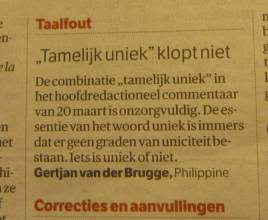
I have been watching NRC Handelsblad (a quality Dutch daily newspaper) ever since the start of the Bridging the Unbridgeable project for letters to the editor that deal with usage problems, but without any luck. Until last night! And interestingly, it deals with a very similar one to what we are used to finding in English usage guides: fairly unique. Robert Ilson will be pleased, because I can’t think of a neater example of what he calls “cross-cultural prescriptivism“.
The question of the acceptability of very unique was part of one of our usage polls (number 4). At the time Mittins et al. did their attitudes survey (in the late 1960s), very unique scored lowest of all features they examined: only 11% in terms of general acceptability. Since then, acceptability has grown, among our readers anyway, but with 19% only, it still isn’t very high.
And what do our Dutch readers think of tamelijk uniek? Is its general acceptability as low as that for its English counterpart? Let us know by filling in this poll. Dutch readers only, please! I’ll let you know about the results in a few weeks time.
(And here is some news for Gertjan van der Brugge: the complaint is not new at all!)
 There is no such problem in distinguishing when a writer or speaker should use onto and on to, because onto does not exist.



 Harry Ritchie, in English Grammar for the Natives (2013), writes that hopefully is “by far the most controversial adverbs of recent times” (p. 191). Usage of the adverb, he says, “has been met with fierce resistance”, and he quotes from Kingsley Amis’s usage guide, which reads that “when someone says or writes, ‘Hopefully, the plan will be in operation by the end of the year,’ we know immediately that we are dealing with a dimwit at best” (1998: 158).



 Bridging the Unbridgeable