Hypercorrect whom

It has been a recurring topic on this blog, but whom definitely seems to be on the way out. I’m in the middle of reading a pile of third-year essays, and have already come across two instances of hypercorrect whom this morning (and it is still fairly early):

  • as to whom these clerks were
  • whom had some dresses made for his daughters

The students, who are both non-native speakers of English, may have felt that whom fitted the style of academic essays better than who. But their hypercorrect usage may also be due to the fact that the use of whom is not really taught in Dutch secondary schools any more. Is the hypercorrect use of whom typical of Dutch speakers only? Alison Edwards, what do you think?

Source: Pen to Paper Communications


Posted in usage features | Tagged | 1 Comment

The HRT a new usage problem?

Is the so-called High Rise Terminal, HRT for short and also called Upspeak, developing into a new usage problem? Robert Ilson, in an article in The English Language Today (1985), mentions three criteria that define linguistic features as potential usage problems: “actual occurrence, fairly widespread occurrence, and discussability without giving offence”.

Twice now this week (and it is only Wednesday today), I came across a reference to the HRT. The first time was when I had just started on the novel Solar, by Ian McEwan (2010). The main character Michael Beard, Nobel prize winner for physics, describes his reluctance to engage with a group of postdocs working for him. They all wear ponytails and behave identically, even as far as their language use is concerned:

Much of the time he did not know what they were saying. The ponytails spoke at speed, on a constant, rising interrogative note, which caused an obscure muscle to tighten in the back of Beard’s throat as he listened. They failed to enunciate their words, going only so far with a thought, until one of the others muttered, ‘Right!’, after which they would jump to the next unit of utterance – one could hardly call it a sentence (p. 21).

And the second time was yesterday, when I read the Dutch writer Pia de Jong’s weekly column in NRC Handelsblad about her experiences as a newcomer to Princeton, USA. This time, Pia de Jong wrote about a thirteen-year-old American friend of her daughter, who apologised for not having put on her little-girls’ intonation.

Toontje hoger (NRC)

Pia de Jong in vain tried to convince the girl that she would be fine using her regular voice. Even her own daughter had already acquired the HRT in her new language, along with all kinds of other Valleyspeak expressions, like OMG, like, totally, whatever. Even more peculiar than the ability to switch the accent on and off according to perceived need according to de Jong, is that the mothers of her daughter’s friends also speak like that.

Ian McEwan is caricaturing the speech of young (male) academics, but de Jong is describing the conscious acquisition process of the HRT by girls in their early teens – fascinating. Both are critical of the feature, and it seems that Ilson’s criteria are met. Does all this mean that the HRT is becoming a new usage problem, to native speakers, that is?

(And btw, I was the first to share Pia de Jong’s article on Facebook!)

Posted in usage features | Tagged , , , , , | Leave a comment

Wanted: Rhymes on Usage

nutritioneducationstore.com

The Dinner Guests
They
seem to have taken on airs.
They’re ever so rude with their stares.
They get there quite late,
There’s a hand in your plate,
And they’re eating what’s not even theirs.
O’Conner- Woe is I (page 14)

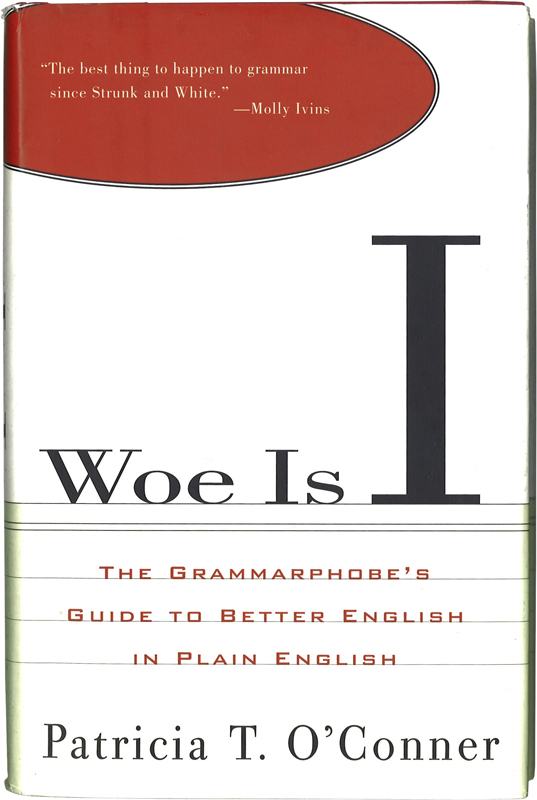
Rhymes on usage may help people to remember the prescribed correct usage. The limerick above on they’re, their, there’s and theirs I found in a usage guide written by Patricia O’Conner called Woe Is I (1996). O’Conner explains that people tend to mix up possessive forms (their, theirs), contractions of the pronoun and the verb (they’re), and the shorthand form of the pronoun there plus the verb is (there’s). To help the reader, she does not only give the correct usage of an item, but also “little memory aids” (p. 4) like the poem above.

1996-OConner-WoeIsIA few months ago you might have come across one of my blogposts about the Alphabet of Errors (part I or II). The posts showed that about a century ago, students at a Girls’ High School in Boston were encouraged to write rhymes on usage during a special event called Speech Week. At the time, I thought that few poems on usage existed – but now that O’Conner seems to rely on them as well in her usage guide, it appears that there may be a market for them after all.

But: Where are they? Do you know any rhymes? Have you stumbled upon any when reading usage guides? For a paper that I am writing, I would love receive any suggestions you have. Please leave a comment on this post or send an email (i.m.otto@hum.leidenuniv.nl ). Thanks!

Posted in Uncategorized | Tagged , , , , , , , , , , , | 2 Comments

Another Thin’ Coming

Cassandra Nijon‘s second (well, really her first) blog post follows below.

Many so-called “old chestnuts” boast a long history of appearance in usage guides, but it seems the most prestigious source that managed to muster some attention for the contentious expression to have another thing/think coming is the Oxford English Dictionary. And here’s its verdict (in its entirety): “to have another think coming: to be greatly mistaken” and “to have another thing coming [arising from misapprehension of to have another think coming]” (see thing, subentry P15).

However, when members of Team Thing and of Team Think encounter each other in the wilds of the internet, the confrontation tends to look more like this:

[W]hen I see people write “another thing coming” I always assume they’re illiterate halfwits, or even that they know what the proper phrase is but are too arrogant to admit they used it wrongly before realising, and are now determined to carry on writing something nonsensical rather than ever admit they were an idiot in the first place. — Anonymous, Team Think

When I see “you’ve got another think coming,” I assume the person is a grammar presc[r]iptivist who freaks out at the notion language changes over time and still insists on the original meanings of words like “slut” and “idiot” despite their changed use in modern vernacular. It’s a sure sign that someone is a pretentious twit who incorrectly believes in their own mental superiority. — Anonymous, Team Thing in facetious reply to the previous one.

I chose these two quotes because they were entertaining, but really because they represent the levels of vitriol and condescension the argument can sink to whenever the two sides meet, usually either when enquiries are made into the ‘correct’ variant or when complaints are made about the use of the ‘wrong’ variant. So we have here a really interesting example of prescriptive trench warfare.

The greatest weapon in the arsenal of Team Think is that another think coming is the original expression, and another thing coming an innovative variant – i.e. a mistake, a corruption, a mangling of the English language and so on. For what it’s worth, the consensus is that think is indeed the original variant of the expression, but the (current) first citations of the original (1898) and the innovation (1906) are within only ten years of each other, so even though the think variant predates the one with thing, the two seem to have arisen nearly concurrently and have both been in use for over a century now. As Mark Libermann says, “it seems (…) the two versions of this expression have been more or less in sociological equilibrium since the beginning”.

It also seems to be agreed upon that the innovation arose out of a “misapprehension” of the original: due to the assimilation of the word-final /k/ of think to the word-initial /kh/ of coming, the two sound functionally identical – they can, on the whole, only be clearly disambiguated in writing – speakers produced the original think variant, but some listeners (perhaps aided by the fact that think was not a noun in their idiolects) heard and understood thing and consequently reproduced the innovative variant with thing.

Perhaps unsurprisingly, the greatest weapon on Team Thing’s side is the supposed ungrammaticality of the think variant because (to them) think is not a noun – although I was quite surprised to see several people on Team Think calling their variant (deliberately) ungrammatical, so it seems that the status of nominal think is not a primary factor.

Interestingly, though, there appear to be few appeals to linguistic authorities or dictionaries (even the OED only pops up occasionally): this seems to be an issue of bottom-up prescriptivism, with both sides claiming the other variant makes no sense, is only used in mistaken ignorance, quite possibly is a blight on the English language, and only theirs is correct.

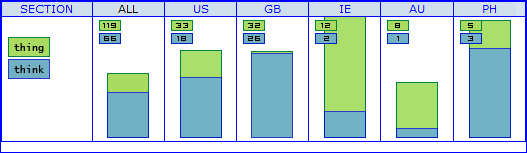
Although another think coming still seems to be more common in formal published writing, the more-commonly used variant in more informal discourse seems to be another thing coming: search engine results generally indicate a higher prevalence of think but are quite variable. In the Corpus of Global Web-Based English (GloWbE, which contains 1.9 billion words taken from 20 international varieties of English) there are 33 instances of thing in US English versus 18 thinks, compared to 32 and 26 in British English; and 119-66 overall in favor of thing.
another thin GloWbE

Instances of another thing coming (green) and another think coming (blue) in the GloWbE corpus in six varieties of English where either variant occurred more than 5 times (the total is of all occurrences). Varieties included are: US English (US), GB English (GB), Irish English (IE), Australian English (AU) and Phillipine English (PH).

another thin Ngram

Instances of another thing coming (red) and another think coming (blue) in the Google NGrams, showing a majority of another think coming and a recent rise of another thing coming (source:  Throw Grammar from the Train).

At Language Log, Arnold Zwicky concludes: “[t]he fact seems to be that the line between mere variation and error is largely a matter of intellectual fashion – lord knows why [some] get picked on while other variants thrive without criticism – rather than a result of observation and reasoning.”
Posted in MA Leiden | Tagged , , | Leave a comment

What do you think about van?

This is Cassandra Nijon’s first blog post. It is actually her second, but I’m still in the process of editing the earlier one, so have a little patience! This one jumps the queue because she’d like to have your feedback. If you are a speaker of Dutch, that is.

In Dutch, as in many other languages, an innovative quotative construction gained widespread popularity from the 1970s on. This construction, which introduces a report of speech, thoughts or attitudes, is (zo)(iets) van (lit. “so of”, “something of”), perhaps most (in)famous in its guise as ik heb zoiets van (“I have something like,” lit. “I have something of”), and comparable to English be like in many ways.

Although this construction is quite common in contemporary spoken Dutch (listen carefully and you’ll most likely hear it used multiple times a day), it is neither listed among the senses of van in the Van Dale online dictionary nor does the Dutch Taaladviesdienst (Language Advice Service) website have anything to say on it.

Some individual maintainers of language advice blogs and writers of language-related columns have struck out on their own, and their advice is: don’t use it. At some point at the turn of the millennium the construction even had its own anti-website, but sadly that has been irretrievably lost.

However, these anti-van spaces have a limited readership, so what I’m interested in is what individual speakers think about this construction. And to that end I am currently running a questionnaire on the topic (the questionnaire can be found here). Please consider helping me with my research by taking the time to fill it out. (If you have tips, comments, or questions, please leave a comment below.)

Posted in polls and surveys, usage features | Tagged , , | 3 Comments

The Guardian on language

It makes you wonder if they know the difference between grammar and spelling, but the pictures are still great for a good laugh! And there is more where this one came from.

tasteless sugar


Thanks for the link, Alison!

Posted in news | Tagged , , | Leave a comment

What is English Grammar?

And this is Kate Taylor’s second blog post. Help her collect data by filling in her brief survey below!

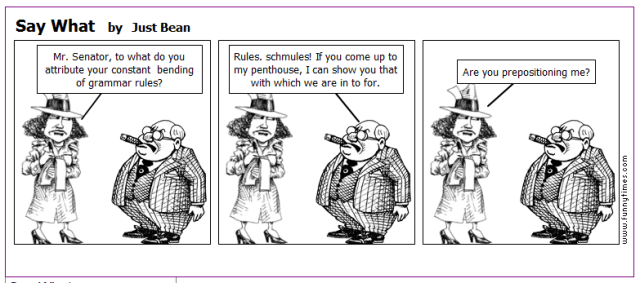
say what cartoon
There are many different attitudes with regard to grammar; some people are born to learn grammar, some people work to achieve grammar and some people have grammar thrust upon them.  You may love, hate, or be indifferent towards it, but do you actually know what grammar is for, or even what it really is?  Harry Ritchie states in his recent book English for the Natives (2013):  

What almost everyone assumes it to be is a weird combination of finicky word usage and obscure social etiquette, like knowing how to address a viscount or where to place the sorbet spoons.

These people think that grammar is when you have to say fewer rather than less if you have under ten items in the supermarket or that you can’t use the word literally  like literally ever (or like for matter). Do you think that anyone hearing the phrase my head is literally about to explode is really thinking about how to avoid the splatter zone?  Nobody takes literally that literally.  If you were truly speaking English ungrammatically, people would not correct you, they wouldn’t know how to because you would be speaking nonsense.

Richard Grant White, author of Words and their Uses, Past and Present. A Study of the English Language (1870)goes to the other extreme and states that English is “untrammelled by the rules of grammar” as it has almost no inflection, no agreement in number or case, no gender and almost no distinction of mood, tense or person.  Essentially, because it uses almost none of the rules of grammar which govern Ancient Greek and Latin, the two languages revered by English grammarians.  But if English grammar is not the same as Greek or Latin grammar, does that mean it doesn’t exist?  The Collins English Dictionary defines grammar as “the abstract system of rules in terms of which a person’s mastery of his native language can be explained.”  “Abstract” is the key word here.  The rules may not be obvious or easy to understand but they do exist: they are what makes the difference between an intelligible phrase and one that makes no sense at all.

I am very interested in the way people know and use English grammar, particularly in the difference between native speakers and second language speakers and am currently writing a paper on this topic.  In order to gather data I have prepared a questionnaire with a select few items of grammar usage and want to know if people believe the grammar in these sentences to be correct and whether they use them or not.  You will be able to access the questionnaire by clicking on this link; please help my research by taking the time to fill this in.

Posted in MA Leiden, polls and surveys | Tagged , | Leave a comment

Which dialect?

image from Existential Ennui

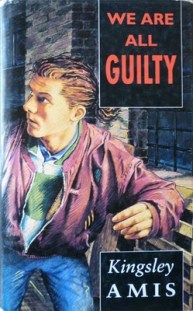
I’ve just finished another of Kingsley Amis’s novels, a children’s book called We are all guilty (1991). Kingsley Amis (1922-1995) also wrote a usage guide, The King’s English, which was published two years after his death. Amis’s fascination with language is evident in all his work, and this is something I will be speaking about in my paper at our Cambridge English Usage (Guides) Symposium on 26 and 27 June.

The main character is 17-year-old Clive, who causes an injury to a watchman during a break-in in a local warehouse. Accent is – as in most of Amis’s novels – an important issue in the book. Clive’s stepfather is described as speaking “with an accent from somewhere up the north of England” (p. 10). Further on in the book the accent is referred to as “silly” (p. 20).

But Clive’s own language, too, is full of non-standard features, though Amis never specifies where the boy is from. I’d be interested to see if his dialect can be located, or whether Amis  just drew on a random collection of non-standard features merely to indicate Clive’s lower-class origins (though I doubt this very much).

So my question is if readers can help me identify the dialect. Here is a list of features I noted, all representing Clive’s language:

  • worse than anything I ever done
  • he come, I come
  • ennit
  • I rung up
  • it don’t
  • I was just trying to get away from him, like,
  • if I hadn’t of broke in
  • double negatives
  • you was
  • I’m sorry you’re hurt so bad

All that is clear is that it must be an urban dialect, since the boy is described as living “with his mother and stepfather in a small terrace house near one of the approach-roads to the western flyover” (p. 9), and that this western flyover was very likely the M1. But which dialect is it?

Posted in usage guide | Tagged , | 1 Comment

New English Today, new Feature!

Another chance to get involved in our project! The latest issue of English Today is out now and it contains another feature article from this project. In this feature I ask the following questions about how linguists should engage with the public, on which we would like to get your input.

  1. Who are engaged in public and academic discussions on usage and normativism in the Anglophone world, and who lead them? Academics? Lay linguists? Language professionals? Educators?
  2. Is there public critical language awareness when it comes to issues of usage and normativism?
  3. How can linguists or others raise or increase critical language awareness?
  4. Is there a role for linguists to engage in this discourse outside academia?

Please leave your comments and suggestions!

Note: You can read the full article on the English Today page of this website, or if you have access, download the original pdf from the website Cambridge Journals Online.
Posted in announcement | Tagged , , , | Leave a comment

“Raadstaalbingo”: Protest against political jargon by Dutch local councils

This is a blog post written by Ratih Suwitra, another student from my MA course Testing Prescriptivism:

Maybe it is a coincidence, maybe it is the linguistics courses rubbing off on me, but lately I have been noticing a few things on language conservatism in my daily routine. Browsing through my stack of Dutch food and cooking magazines, I came across an article by Marjan Ippel, foodtrend watcher and monthly column writer for delicous. magazine in which the author changed the English expression  signature dish into Dutch handtekeninggerecht (Delicious. May 2011: 38-39). Doing this, she explicitly noted, was for the language purists amongst us.

It seems a bit ironical that the author of an article for a Dutch magazine that carries an English name is concerned about language purism, but then, only two days later, I read in the newspaper De Volkskrant about an initiative relating to language purism and Anglophobia. It’s called “Raadstaalbingo” (council language bingo).

Raadstaalbingo plays on the concept known as “Bullshit bingo” or “Buzzword bingo”, and cards for the game can be freely downloaded.

A Raadstaalbingo playing card

Raadstaalbingo attacks the jargon of local council members during their meetings, and if we take a closer look at these Bingo words, we see that almost half of them are originally English terms, such as benchmark, revolving fund, social return on investment, outcome criteria, and challengen (the latter verb was turned into a Dutch infinitive by the addition of the –en suffix). All Dutch local council meetings are open to the public, and citizens seem to be annoyed by the political jargon used when councillors are debating the current and future affairs that concern them. The game involves marking the ‘bullshit’ words on the card during council meetings, and the challenge is to dare calling out ‘Bingo!’ when the right number of words has been reached.

De Mystery Burger

This new Bingo game that aims to teach Dutch local council members to use more intelligible language was created by the Periklesinstituut, a Dutch institute that promotes the improvement of the political processes, including effective communication between government bodies and the people. Two members of the institute, John Bijl and Kemal Rijken, sat in on over 85 council meetings during the past two years, and concluded that the communication between council members and citizens leaves room for improvement, lots of it. They collected their findings into a book, called De Mystery Burger (2014), and they are also the ones who came up with Raadstaalbingo.

This brings up the interesting question of the extent to which Dutch speakers should use English terms and expressions when dealing with national or local matters. Do Dutch speakers feel excluded when local council members do so in public meetings? Should local council mmbers be more sensitive to their audience, whose interests they are after all representing? If doctors are taught to communicate with their patients in a jargon-free language, shouldn’t council members do so too? Many foreign terms have taken root already in the Dutch language, but perhaps now we have reached a point where we need to draw the line. What do the readers of this blog think?


Posted in MA Leiden, news | Tagged , , , | Leave a comment