Lexicon Valley: A Most Delightful Dale

Lexicon Valley 2For many months now, I’ve been intending to write an epic review of one of my favorite podcasts: Lexicon Valley presented by Slate. Well, this weekend I invoked the muses – otherwise known as Lexicon Valley hosts Mike Vuolo and Bob Garfield – and got to work. I spent the weekend re-listening to all 26 of the available podcasts. It was great. I took diligent notes in both blue and red pen. This review was going to be thorough and fantastic. I had a ton of material. Mike and Bob have spoken with many expert linguists such as Arnold Zwicky, Anne Curzan, and Geoffrey Nunberg. They’ve discussed great books like Found in Translation, Woe is I, and The Story of Ain’t. And they’ve covered a variety of interesting language-related topics such as grammatical gender, the discourse marker so, and r-dropping – to name just a few.

I ran into a problem though. After taking twelve pages of notes, I realized my plan had been foiled by exactly what makes Lexicon Valley exceptional among podcasts. This is namely the hosts’ ability to pack so many interesting, funny, and remarkable facts and perspectives on language into a mere 28 minutes of podcast.

So as not to let my re-listening marathon go to waste, I’ll go ahead and share a few of my favorite episodes. The shows on preposition stranding and the phrase between you and I/me were particularly enjoyable in my opinion. However, my interests are clearly flavored by my work assisting with the compilation of this project’s database of usage guides and usage problems. Not to worry though – in my opinion there is something for everyone in the Lexicon Valley oeuvre.

wiley-ancient-grammar-policeMeanwhile, it’d be great to hear from readers of this blog about other quality language-related programs. Is the preferred medium radio, television, podcast, or perhaps something completely different? Tips on programs available in other languages and countries are also very welcome. Perhaps we can compile a list: I love lists!

scrabble2So, in lieu of the more extensive Ode to Lexicon Valley which I had planned, I will simply extend my heartfelt appreciation for the content of these podcasts and the program’s knowledgeable, well-prepared, and witty hosts. For those who appreciate learning about language and how it works in its different social and cultural contexts, Lexicon Valley is a real treat. Enjoy!

Posted in cartoons | Tagged , , , , , | Leave a comment

Jafaican: “Ali G would understand it perfectly”

aliG1In recent years, linguists across Europe have described new language varieties spoken by young people living in multicultural and multilingual communities of large cities. In Germany the variety is referred to as Kiezdeutsch (“neighbourhood German”), in Norway as kebabnorsk (“kebab Norwegian”), in the Netherlands as straattaal (“street language”). Professor Paul Kerswill gave a talk yesterday at Lancaster University on the UK print media representations of the London multiethnolect, Jafaican (“fake Jamaican”). The innovative features of Jafaican include, most prominently, pronunciation, vocabulary and non-standard spelling. A stereotypical utterance thus produced by a speaker of Jafaican would be, “Raaass man, me gwan me yard see me babymother/babyfather”, or in plain English, “I’m off home to my better half”.

According to Kerswill, there are two sides of the coin when it comes to media reception of Jafaican. The variety is often stigmatised and related to “bad social practices”, such as teenage abortions, stabbings and gun crime. David Starkey (in)famously related Jafaican to the 2011 riots, and, more generally, to the violent, nihilistic gangster youth culture on the rise. Right-wing populists even warn of the “dangers” of Jafaican as a potential replacement of its native British counterpart, Cockney.

More positively, many describe Jafaican as a product of natural language change, and even as cool, contemporary and classless. The London-based magazine, Time Out, humorously included Jafaican among the three dialects of London English (next to Estuarine and Mockney). The TripLingo app, a tool for deciphering slang in a number of languages, included Jafaican in the TripLingo (2012 Olympics) UK edition.

Although speakers of Jafaican have little awareness of the impact of their variety and of its exact place among the London speech communities, Jafaican seems to be opening a range of discourses. How do people establish relationships between language and social practices? What is the nature of the “backwash effect” of minority languages on the majority language? And, more generally, what is the future of multicultural language varieties? Kerswill’s research doubtlessly provides plenty food for thought.

Kerswill

Posted in usage features | Tagged , , , | 2 Comments

Spellergies, or the Rise of the Usage Problem

Over the last couple of years I have been plagued with an unusual allergy, and to this day I have no idea what the cause might be. I have been tested for pollen, dust mites, particular types of food groups, aka as the most common allergens. What I wasn’t aware of is that there is another, possibly new, kind of allergy that is not caused by any of these usual suspects. It is not caused by something in the air you breathe, nor by something in the food you eat; it is in the language you speak. Apparently, the strong feelings people have about what they perceive as incorrect language usage can sometimes induce actual physical reactions, which can be described as chills, small tics, painful and watery eyes.

Steffen Madsen, a linguistics student from Denmark, coined the term ‘spellergy’ to refer to this ‘common disease’. In a talk he gave at the 52nd edition of the StuTS student conference in linguistics, Steffen explained that his interest in spellergies was triggered by a Danish Facebook group whose name can roughly be translated into “Forgetting to mark the present with the letter ‘r’ on verbs should be punished by caning” (being hit by a cane).

What led him to identifying spellergies was the realisation that “these guys in the group love to hate spelling errors. They will take photos of spelling errors from their everyday lives and then post them on the group wall and make fun of them because they want to react on them. To express their contempt for spelling errors. To express to the world how their sensitive eyes get swollen, red, watery, puffy, itchy from looking at these errors” (Madsen, personal conversation).

In English, most spellergies are induced by already established spelling mistakes, similar to not marking the present with ‘r’ in Danish, or the t/d mistake in Dutch. One such case, which, I admit, could be the cause of my mysterious allergy is the your/you’re confusion. And I am not the only one. There are numerous online communities and Facebook groups devoted to a common struggle against this annoying spelling mistake. The reason why these, and similar spelling mistakes have become so frowned upon – and this is an understatement! – is that they are hardly about spelling. Saying ‘Your wrong’ instead of ‘You’re wrong’ shows not only carelessness with spelling, but also a lack of some basic grammar knowledge, which makes such mistakes intolerable for many. Such reactions among language speakers, coupled with the ubiquity of the mistakes, have given these language mistakes the status of  newly emerging usage problems. They are increasingly being featured on websites and fora offering language usage advice, such as the Grammar Girl website or the Wiki How. How long will it be before we see appropriate therapy advice prescribed in actual usage guides on the best ways to fight these new evil spellergens?

Posted in usage features | 1 Comment

The aim of my REsearch

What is happening to the word “analysis”, or perhaps “study” (though this might be considered a bit grand for a student paper)? Marking large batches of BA and MA essays this month, I’m beginning to realise that this is developing into something of a pet peeve for me. Where is this (new?) usage coming from? Am I the only one who is annoyed by this word? Should I correct students for using it?

Thanks to: Ventura County Star

Posted in Uncategorized | 1 Comment

Gruesome Twosomes

persecution

The above picture, in which persecution is confused for prosecution, was featured in a recent episode of a sitcom aired on Fox Extended, “It’s Always Sunny in Philadelphia”.

To remind the reader about the distinction between the two, The Oxford Online Dictionary defines persecution as “hostility and ill-treatment, especially because of race or political or religious beliefs” (a common collocation would thus be religious persecution). The noun prosecution, on the other hand, refers to “the institution and conducting of legal proceedings against someone in respect of a criminal charge”.

The persecution/prosecution is just one among many commonly mistaken pairs of words, or “gruesome twosomes”. Others on this list include: affect/effect, lie/lay, accept/except, loose/lose, flaunt/flout, and, the here formerly discussed, healthy/healthful.

A BBC article reports that, sometimes, in spite of the best efforts in stopping the replacement of the two words, one of the words expands its semantic scope and enters common usage. Disinterested might be becoming synonymous with uninterested, and nauseous is replacing nauseated.

We will have to wait for a bit longer for a similar process to take place in our persecution/prosecution example. Mistaking persecution for prosecution, however, fits perfectly the mischievous gang of the Philadelphia-based sitcom.

Posted in usage features | Tagged , , , | 1 Comment

Tape your ducks in a row!

scotch-duct-tapeSometimes you’ll find interesting explanations about why specific usages are problematic. This one caught my eye recently. It’s from the entry for duct tape in Bryan Garner’s Dictionary of Modern American Usage. Garner quotes a newspaper articles to explain why people spell it duck tape (or ducktape).

duct tape. So spelled—not duck tape. One writer explains the origin of the misuse: “Duct tape is so seldom used on heating ducts that most people mispronounce it ‘duck tape’ as they use it to mend parkas and sheath short cables. I came close to using it on a duct once . . . .” Ed Quillen, “It Even Works for Hanging Pipes,” Denver Post, 20 Feb. 1994, at E3. And the misuse is common […] In the early 1990s, one company—Manco, Inc.— developed the brand name Duck Tape for its duct tape; the trademark, if the product is successful, will only aggravate the confusion.

This explanation that the spelling is lost because the tape isn’t used to repair ducts is fairly ridiculous. The argument is that users don’t’ associate the tape with ducts anymore, because it’s used for mending parkas and sheathing cables. But how on earth does that lead to an association with small waterfowl? Has anyone ever used this product to tape up ducks? And if they have, were these people ever reported to any kind of animal protection organisation?

ducktape-yellow-1

There is a simpler and more plausible explanation for the ‘erroneous’ spelling of duct tape as duck tape. It is a linguistic one, based on pronunciation. Since in casual or rapid speech it is difficult and awkward to pronounce the two consecutive ts in duct tape separately, they will merge into one. The pronunciation becomes ‘ductape’, which in spelling has been reanalysed as duck tape. There is also another possible explanation that says that the original name was duck tape because it was based on a canvas (also called duck cloth) that was covered with a rubber adhesive to make a waterproof tape. So either it’s a case of reanalysis or of two different but co-existing names for the same thing.

P.S. The product ‘Ducktape’ has become very successful. A Google image search for duck tape reveals that it comes in many colours & designs. It even turns up if you search for duct tape!

(This post was not in any way sponsored by Scotch duct tape or Duck Tape)
Posted in usage features, usage guide | Tagged , , , | 3 Comments

The WordPress.com stats helper monkeys prepared a 2012 annual report for this blog.

Here’s an excerpt:

4,329 films were submitted to the 2012 Cannes Film Festival. This blog had 21,000 views in 2012. If each view were a film, this blog would power 5 Film Festivals

Click here to see the complete report.

Posted on by BtU Admin | Leave a comment

All new faces

It was long promised and took a while, but we’ve finally updated the photo of our project members on the About page.

Posted in announcement, news | Tagged , | Leave a comment

Donna and the Oxford Comma

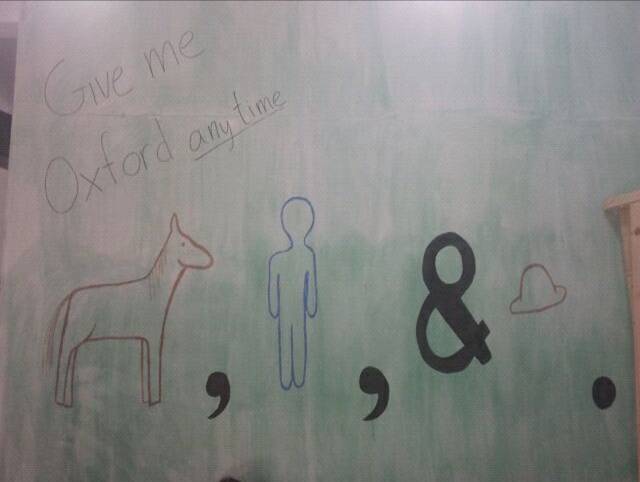
During a British Academy lecture in 2011, David Crystal mentioned that language was rarely the object of a work of art. Well, here is a work of art created by Donna Piët for an exhibition called “Een Poging tot Nieuwe Vriendelijkheid” (“An attempt at new kindness”), which was held in the art gallery of the Free Academy, Gemak, in The Hague in The Netherlands earlier in December. And it is about language. What is more, it deals with what we consider to be a usage problem in the Bridging the Unbridgeable project.

Donna

This painting has been reproduced with permission from the artist.

The painting (apologies for the quality: I had to rely on my mobile phone to take a picture of it) illustrates Donna’s fascination with the Oxford Comma: “Give me Oxford any time”, it reads.

Personally, I don’t like the Oxford Comma (sorry, Donna!), but because Oxford University Press insists on it, my book The Bishop’s Grammar is filled with them. They are not mine! The reason I don’t like the Oxford Comma is that as a student, I was taught that in a coordination like “A and B and C”, the first and can be substituted by a comma: “A, B and C”. So if a comma is insisted upon before and, as the OUP style sheet does, the sentence would read: “A and B and and C”, which doesn’t make sense to me. But Donna, tell us, why do you like the Oxford Comma so much that you used it for a work of art?

Eighteen months ago, there was a brief twitterstorm, created by the rumour that the Oxford Comma would be abolished. Nothing could be further from the truth it turns out. Yahoo News reports about it, and cites Lynne Truss, author of Eats, Shoots & Leaves (2003) (no Oxford Comma there!), saying “that there are strong opinions on both sides”, and advising: “I’ll just say this: never get between these people when drink has been taken”!

(Donna Piët studies Autonomous Art at the Royal Academy of Arts in The Hague. And here is another example of her work for the exhibition, called “Insidious Restlessness”.)

(And thanks to Colin Jones, former visiting fellow at Clare Hall, Cambridge, for telling me about the twitterstorm.)

Posted in news, usage features | Tagged , , , , | Leave a comment

Prescription Conference: June 2013

This gallery contains 1 photo.

As of now, the opportunity to submit abstracts for the conference has passed. We have received a large number of abstract on a wide variety of languages and topics. We will notify those who submitted their abstracts before the end … Continue reading

More Galleries | Tagged | Leave a comment