New articles on prescriptivism

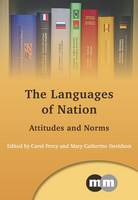
And today I found the book itself (see previous post): thanks for this, Carol Percy, and congratulations on the book.

The book includes various articles that are of interest to the Bridging the Unbridgeable project, but the article I will read first is the one by Don Chapman, called “You say nucular; I say yourstupid: popular prescriptivism in the politics of the United States”. Though more will soon follow I expect. And let us have your opinions on this article or any of the others in the book.

Posted in Uncategorized | Leave a comment

New publications on prescriptivism

This morning, I found the following email from Carol Percy in my mailbox

This email is being sent to the addresses of people who presented and/or attended and/or in some way supported the 2009 conference on Prescriptivism & Patriotism. I hope that the last three years have been good for you. Thank you again for your interest in the conference, and my apologies for the monolingualism of this message and for any duplication across lists.

I’m writing to let you know about some related publications.

In March 2011, a selection of papers in and/or on French was published, edited by Anne-Marie Brousseau.  I am very happy to say that  Identités linguistiques, langues identitaires : à la croisée du prescriptivisme et du patriotisme is freely accessible online, with abstracts in both French and English.

A selection of papers written in English has just been published by Multilingual Matters. You can view the Table of Contents of Languages of Nation: Attitudes and Norms on the publisher’s web page. If you are based at a university or college and think that Languages of Nation would be appropriate for its collection, please feel free to ask your librarian to order it. (It should be appearing at the University of Toronto in due course.)

In any case, thank you again for your support of the conference in 2009. All best wishes for the future! Sincerely, Carol Percy on behalf of the organizers.

Posted in news | Tagged , | Leave a comment

Autocorrect – AARRGGHHH!

The Bridging the Unbridgeable project is funded by the Netherlands Organisation for Scientific Research, abbreviated as NWO in Dutch, Nederlandse Organisatie voor Wetenschappelijk onderzoek. Invariably, Microsoft Outlook corrects this into NOW: very annoying, as it results in a stupid typo that I didn’t make.

Autocorrect is a tool that is meant to help us speedy typists, but it often doesn’t do what we want. That NOW for NWO isn’t the only example is clear from an article that appeared in the New York Times this Sunday, and that was sent to me by one of my friends from Clare Hall, Cambridge (UK). The article is called Auto Crrect Ths! and it gives very funny examples.

I’m sure you have your own favourites: please share them with us!

Thanks for the link, Bob!

Posted in news | Tagged , , , , , | Leave a comment

More fun less taxis

is an example of a slogan made up by protesters during the Tea Party movement last year. The slogans show great spelling and grammar creativity, as you will see when you watch Teabonics the Movie, which was sent to me by one of my fellow members of Clare Hall, Cambridge (UK). Thank you, Colin!

And there is much more of this if you search Google images for teabonics.

Posted in news, usage features | Tagged , , , | Leave a comment

Attitudes survey: we need you!

So far, 589 people have filled in my Attitudes Survey, which is fantastic: thank you all!

But I would like to have more responses, not because I’m greedy, but to make for greater representativeness of what people – not only teachers or editors, but linguists and the general public as well  – think about the three usage items I am doing research on.

So if you haven’t done so already, please fill in the forms, all three of them if you feel inspired!

  • 9/8: and the number keeps rising steadily: it is 618 today
  • 28/7: 604 responses today, keep on going!
  • 27/7: three more have come in today: thank you!
Posted in usage features | Tagged , , | Leave a comment

Resisting -ize

Christian Kay, in an article called “Issues for historical and regional corpora: first catch your word”, refers to “the resistance of British English writiers to using ‘-ize’ forms in words like ‘realise'” (in Archer, 2009:71).

If you are a British native speaker, or if you use British English as your linguistic model (as I do), do you resist –ize? I know I do, but can –ize be resisted, and should it? Is it a lost battle?

Anya Luscombe (see comment) has responded by saying that she thinks –ise “prettier” than –ize: so do I! For me, my reasons for preferring –ise are purely esthetic. Very odd if you think about it, or is it?

Reference: Dawn Archer (ed.) (2009), What’s in a word-list? Investigating word frequency and keyword extraction. Farnham, Surrey/Burlington, VT: Ashgate.

Posted in usage features | Tagged , | 1 Comment

And nor – and neither?

He told me things you wouldn’t be able to get out of him in a million years, and nor would these priests, confession or no confession (P.D. James, Death in Holy Orders, 2001, Penguin [2002], 472)

The use of and nor was already commented on by Noel Osselton, in his interactive language squib “Points of Modern English Syntax” (1981), published in English Studies (item196).

But this was in 1981, and we are thirty years on now. Any comments on the usage?

And what about and neither, as in

She was not a native of our town – … – and neither was her husband (John Banville, Ancient Light, 2012, p. 56).

Btw, great news: English Studies has been digitised down to 1975 (that is, in as far as the library at the University of Leiden gives access to it).

Posted in usage features | Tagged , , , , , | Leave a comment

An Americanism in the 1960s? Why?

Now that the university library at Leiden subscribes to Cambridge Histories Online, it is possible to have access to books like the Cambridge History of the English Language without having to search for the book in the English Reading Room. Great, if you are working from home! Scanning David Denison’s chapter on Syntax in Volume 4 of the series (1776-1997) to find out what he says about Jane Austen’s use of grammar, I came across the following reference:

Barber claims that placement of light time-adverbs before an unemphatic auxiliary … is a recent Americanism in BrE (1964:141)

The reference is to Charles Barber’s Linguistic Change in Present-Day English (1964), and example sentences given by Denison include He never does appear (from Jane Austen’s letters), if he ever will see it (from and Keats’s letters) and [whom] I never could abide (from Gaskell’s Mary Barton). These examples can indeed barely be called recent, so it is hard to see why Barber called the usage that. More interestingly perhaps, he calls them Americanisms. But why, if they seem common during the nineteenth century already?

And something else I would be interested in, are people still worried by Americanisms in British English today?

Posted in Uncategorized | Tagged | 1 Comment

I was he

Your mother only had sex with one man in the whole of her life. I was he. I acknowledged my responsibility in a letter to your mother … (p. 443)

These sentences are from the Inspector Dalgliesh novel Death in Holy Orders. How strange to find I was he: I would have expected something like “I was the one“. I was he reminds me more of Henry James than of P.D. James. The novel isn’t that old though: it came out in 2001. I wouldn’t have thought anyone still said I was he. Any explanation for this strange usage?

The novel was dramatised by the BBC in 2003: would the script writer have kept it in, I wonder?

Posted in usage features | Tagged , , | Leave a comment

Raising critical language awareness

This August, we will be bridging the unbridgeable at the 17th International Conference on English Historical Linguistics in Zürich, Switzerland (click image to conference website).

We will convene an informal meeting to discuss the public discourse on usage & normativism and the role of (historical) linguists in raising critical language awareness. The details of the meeting are in this invitation.

We have already been able to get two of the plenary speakers to attend: Joan Beal and Anne Curzan, both of whom have done much to bring the work of linguists to a wider public.

Please have a look at the invitation and if you’re interested in joining us, get in touch with Robin Straaijer or just show up on Tuesday 21 August during the lunchbreak! (exact location to be announced).

Posted in announcement | Tagged , , , , , , | 1 Comment