Even I

My husband just started reading Joseph Conrad’s Under Western Eyes (1911), and stumbled over the following sentence in the introduction to the 1985 Penguin edition:

‘There is the MS complete but uncorrected,’ Jessie wrote; ‘and his fierce refusal to let even I touch it.’

The quotation is from a letter Conrad (1857-1924) wrote to a certain David Meldrum on 6 February 1910. Looking at it, I myself also stumbled over the sentence that follows:

It lays on the table at the foot of the bed.

The use of lay for lie was already commented on in grammars and usage guides from the eighteenth century, and it is a well-known usage problem even today.

Conrad was not a native speaker of English, and the Wikipedia entry reads that “he did not speak [English] fluently until he was in his twenties (and always with a marked Polish accent)”. But he is quoting his wife Jessie George here, so this must be her usage. Her use of lay for lie is understandable, given that many speakers confuse the two verbs, but how could we explain the other instance? Does anyone know anything about Jessie George and her background?


Posted in usage features | Tagged , | Leave a comment

Cutting w/o pasting

Cutting w/o pasting

Watch this little slideshow. It shows how we prepare the usage guides before we feed them into our scanner. We hope to be able show you a more complete video of how we construct our database later.

Since we cannot post videos on this blog, you will be watching it on our Facebook page. Click the image to go there and watch the video. Enjoy & don’t forget to like!

Posted in technology | Tagged , , , , , | Leave a comment

Grammatical reinterpretation

Coming back from our summer holidays, I’m steadily working my way through the backlog of newspapers (primarily NRC Handelsblad). One of the things that stuck was something I read in a column by language historian and journalist Ewoud Sanders, from 25 June.

In the column Sanders deals with botched and bungled words and phrases in Dutch, and lists data he found on the blog claars-notes, written by music and IT teacher Clara Legêne, who kept track of errors in (Dutch) first-year grammar school kids’ exam papers. Sanders was most struck by the form naderant, a misspelling for the posh word naderhand (“afterwards”), but what I was most struck by was the comment that eens (“once”) is increasingly written as is.

No example with any context is offered on Clara’s blog, and I hope she will read this, and supply one, but it strongly reminded me of the instance of could of discussed elsewhere on this blog. The could of example is also part of my attitudes survey, which is producing response in great numbers (thank you, readers!).

A lot of the respondents so far are teachers, who, like Clara Legêne, find many instances of could of and similar forms in their students’ papers. And several respondents have suggested that it is a case of grammatical reintepretation, with of being a phonetic variant of the clipped auxiliary  form ‘ve, but leading to (presumably unconscious) reinterpretation of the verb as an auxiliary at the point when the sentence has to be written down.

The eens as is example suggests that the phenomenon is current in other languages too. Any other examples, with context please? And from other languages?

Meanwhile, Clara got in touch, and gave a couple of the sentences that she had found in her students’ papers by way of examples:

  • Ik heb dat wel is gehoord (is = “once”)
  • Wilt u mijn toets nog is nakijken? (is = “once again”).
In the first sentence, she suggests, wel is might be related to weliswaar (“admittedly”, according to thefreedictionary), while she also believes that Cornelis, who commented on this post, may be right when he said that the usage may be typical of the Brabant (southern Dutch) dialect.
Any other suggestions?


Posted in usage features | Tagged , , , | 2 Comments

Grammar Rock

In a single day of reading, copying, pasting, and generally mulling over usage guide entries, grammar songs – such as Conjunction Junction and that one about pronouns – occur to me more often than I care to admit. Although these ditties are obviously fantastic, mental renditions become irritating in a hurry. Fortunately, my repertoire of grammar songs is becoming increasingly difficult to trigger. But this experience also made me curious about a few things.

First, I wonder whether there are similar (or different) grammar songs for children in other countries/languages? If you happen to know of any, please share! I searched for something similar in Dutch and found many wonderful songs for children and several comical sketches on language use – but no grammar songs. Dutch readers, have I missed them?

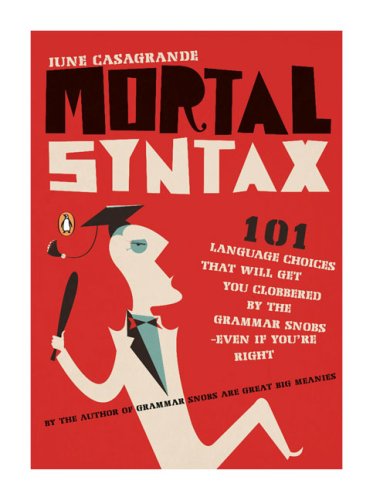
Second, how influential was/is the usage advice provided in these songs? And how often are they referenced in usage guides published in the last decades? I recently came across an entry which was relevant to these questions in the humorous usage guide Mortal Syntax, by June Casagrande. She includes an entire entry based on the song Lolly, Lolly, Lolly, Get Your Adverbs Here. The entry – on beginning a sentence with Therefore – is funny and informative. She also suggests at one point that the adverb song has led many Generation X-ers to discriminate in favor of “ly” adverbs, effectively leading the public to believe that “therefore,” “here,” “however,” “now,” “nevertheless,” and other members of the class are not adverbs (2008:46). In the same entry, Casagrande defends the usage advice provided in the adverb song as being inclusive. I concur. On the other hand, the nifty ‘-ly adverb attachment’ featured in the song is arguably more memorable than its actual lyrics.

Finally, I wonder whether these Schoolhouse Rock! songs were/are also popular with English-speaking children outside the U.S.? The Wikipedia entry for the program only mentions that it was broadcast nationally, but perhaps there are readers of this blog who have rocked out to these songs in other countries as well – or have children or grandchildren who have done so. If this is the case, I’d love to hear about it. Grammar Rock on!

Posted in cartoons, usage features | Tagged , , , , , | 2 Comments

Attitudes Survey: response so far

Many forms are being returned for my attitudes survey, so thanks to everyone filling them in, and helping with my research. Particularly the members of the University of the Third Age in the UK, who have been responding in great numbers since they received the call yesterday. Many thanks to Adrian Du Plessis, Fellow at Clare Hall (Cambridge, UK), for making this possible.

Here is a brief update on the material that has come in so far:

  • this morning the number of returned forms was 310: I’m hoping to get 2000, so please keep on sending them
  • the current age range is 21 to 84:  fantastic! I’d also be interested in hearing what younger people think. So please ask your children, grandchildren, younger siblings to fill in the forms for me: it would be great if I could have their views too


  • the majority of respondents so far are female. Thank you, girls! But men, where are you? Don’t let the factor gender skew my data
  • most people filled in the form for the could of sentence:  155 so far. Is it because they dislike this one most?
  • all the occupations pre-specified are represented in the data turn-out. Good! The “Other” category is extremely interesting for my purposes, too: it includes an accountant, an archealogist, a bursar, a chemistry technician, a communication secretary, a diplomat, an engineer, a retired geophysisict, a retired police officer, a policy adviser, a scientist and a trilingual secretary: all this produces great material for me to analyse
  • but where are the linguists? So far only 44 have responded: I need you too, so please fill in the forms
  • finally, most respondents at this point are British, or use British English as their linguistic model: 201 altogether. Americans lag behind: could anyone tell me if there is something similar to U3A in the US? Please advise …
  • btw: the “Other” category here is interesting too: we are currently only looking at two language varieties in this project, British and American. Our next step will be to expand and look at Canadian English, Australian English, New Zealand English, South African English …

Thanks once again for the turn out: things are going extremely well, so keep returning the forms!

Posted in news, usage features | Tagged , | 1 Comment

Better questions, better surveys…

In our usage polls we use the same criteria of acceptability as those of the survey from which they are taken, Mittins et al.’s Attitudes to English Usage. We ask you to rate usage items according to whether they are acceptable in different modes and situations: spoken formal and informal, written formal and informal and netspeak. But what are good questions to assess acceptability of certain usage items?

One of the problems with the methodology used by Mittins et al. in their survey is that they in some sense prompt those who take the polls by indicating what the problem is supposed to be. In this way they already presuppose that a particular usage item is saliently problematic. They also usually give the ‘incorrect’, ‘problematic’ or ‘unacceptable’ usage and asks those who take the polls how acceptable it is. These polls were designed maybe as long as 45 years ago, so it is not strange that they may seem somewhat simple. Updating our research to current methodological standards, we would for instance have to present the sentence and ask the following questions:

  1. “Is there anything wrong with this sentence?”
  2. “If the answer to 1. is yes, “What is it that’s wrong?”
  3. “What is the ‘correct’ form?”
  4. “Is the sentence acceptable in formal/informal speech/writing?”

Part of this has already been implemented in the survey carried out by Ingrid Tieken-Boon van Ostade, as mentioned earlier on this blog (https://bridgingtheunbridgeable.com/2012/05/07/attitudes-survey/).

What the survey by Mittins et al. also doesn’t take into account is how important a particular usage item is, or more accurate, how speakers rate the importance of its ‘proper’ use. This may make the survey more complex, but it would give a better picture of what is considered socially acceptable, as well as linguistically. To get this kind of information, we need to ask more questions about each item. So far, I have come up with the following questions, to be answered on a likert scale:

  1. “How important is the (correct) usage for you?”
  2. “How likely are you to correct someone else’s incorrect usage in private?”
  3. “How likely are you to correct someone else’s incorrect usage in public?”

What other questions would need to be asked to get a more comprehensive idea of how important people find usage & correctness?

Posted in usage features | Tagged , , , , , | Leave a comment

Ain’t, Fanny Burney and the OED

This gallery contains 3 photos.

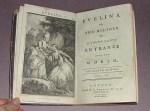
One of my most delightful discoveries when I was looking for first quotations from eighteenth-century authors in the OED was that Fanny Burney was cited as the first user of ain’t. The source was Evelina, her first novel published in … Continue reading

More Galleries | Tagged , , , | Leave a comment

Sounding the T or not?

This is a question Jimmie Fane, a character in Kingsley Amis’s novel The Biographer’s
Moustache 
(1996), asks his biographer Gordon Scott-Thomson. The question relates to the word often, and he asks:

How do you pronounce O, F, T, E, N? Sounding the T or not? (1996:68).

Language is often an issue in Amis’s novels, as in this one. Fane is decribed on the blurb as

an unashamed snob, has many pet hates, including younger men with moustaches and trendy pronunciation. Scott-Thomson, however, is extremely attached to his own moustache and not so particular about his use of language.

The biographer with the double-barrelled name is also made to use a split infinitive (“what was in your mind when you agreed to not merely let me write something about you”, 1996: 87), and other questions of pronunciation come up: “Gordon would have expected to be asked how he pronounced CONTROVERSY or IDEAL” (1996:87).

These features – the pronunciation of often, controversy and ideal – were evidently considered sociolinguistically salient at the time (though I’m not really sure what the problem is with ideal). Are they still so today? Do people still vary between OFTEN and OFFEN?

Posted in usage features | Tagged , , | Leave a comment

“Should of” in eighteenth-century English!

How old is could of, should of, would of, the controversial issue reported on elsewhere in this blog?

On reading the proofs for my chapter in the second edition of The Oxford History of English, edited by Lynda Mugglestone and first published in 2006, I was reminded of the fact that the writer Betsy Sheridan (1758-1837) had written in her diary on 16 September 1785: “I should not of known her” (ed. Lefanu 1986:69). As early as that!

Posted in usage features | Tagged , , , | 1 Comment

7th Usage Poll

This gallery contains 1 photo.

High time for a new usage poll:  items 31 – 35 from Mittins et al. (1970). Let us have your votes please! And should this poll really get you into the mood for more, there are six more polls to … Continue reading

More Galleries | Tagged | 1 Comment