
This gallery contains 1 photo.
High time for a new usage poll: items 31 – 35 from Mittins et al. (1970). Let us have your votes please! And should this poll really get you into the mood for more, there are six more polls to … Continue reading
This gallery contains 1 photo.
High time for a new usage poll: items 31 – 35 from Mittins et al. (1970). Let us have your votes please! And should this poll really get you into the mood for more, there are six more polls to … Continue reading
Elsewhere in this blog I reported on the first quotation from the OED for the term “flat adverb”:
1871 J. Earle Philol. Eng. Tongue vii. 361 The Flat Adverb is simply a substantive or an adjective placed in an adverbial position.
(This link, as well as the one below, actually works if you are on a university network for instance and if your library subscribes to the OED Online edition.)
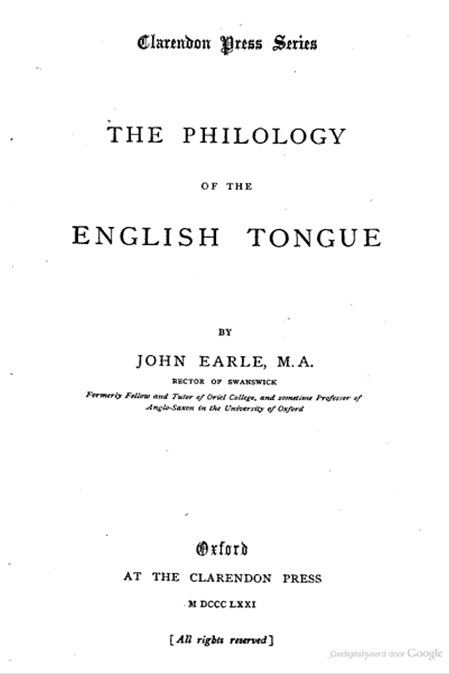 John Earle (1824-1903), the author of The Philology of the English Tongue (1871), has an entry in the Oxford Dictionary of National Biography. Earle’s book can be found through Google Books, and it has a fairly lengthy section on the flat adverb, called “Of the Flat Adverb” (1871:361-365). The section suggests that it was indeed Earle who coined the term himself:
The use of the unaltered adjective as an adverb has a peculiar effect, which I know not how to describe better than by the epithet Flat (1871:361).
He considers the use of flat adverbs “rustic and poetic … because it is archaic”, and he adds that it is “all but universal with the illiterate” (1871:364). He may not have used flat adverbs himself, which seems to account for the labels “rustic” and “illiterate”, but it is peculiar that he calls it “archaic”: the flat adverb has never gone out of use.
What is also worth commenting on is that Earle’s book was published by OUP (Clarendon Press): OUP published Fowler’s Modern English Usage as well as many other usage manuals, and we can now see that this interest in books on usage with OUP goes back a long time.

This gallery contains 1 photo.
For a paper I’m writing in the context of the Bridging the Unbridgeable project I’m doing a survey into attitudes to particular usage problems. For this pilot study, I’m collecting texts in which people express their opinions to such usage … Continue reading

This gallery contains 1 photo.
Next academic year, second semester, Ingrid Tieken will teach an MA course called “Prescription and Prescriptivism”. More details will be announced on the Leiden University website soon. Course description: Prescription and prescriptivism are perceived, particularly by linguists, as rather negative … Continue reading

This gallery contains 2 photos.
Kingsley Amis distinguishes two types of people in his amusing usage guide The King’s English based on their attitudes and usage: berks & wankers. These terms he quite obviously uses in absolutely nothing else but their most strictly technical sense as … Continue reading

This gallery contains 1 photo.
Reading Hoffman’s Honger (1990) by Leon de Winter, a Dutch writer (b. 1954) who divides his time between living in The Netherlands and Los Angeles, I was struck by the apostrophe in the title of this novel. Dutch usage of the apostrophe … Continue reading

This gallery contains 1 photo.
As a new feature on the blog, we are compiling a Language Calendar (see the bar under the banner). So far it contains only two dates: 4 March: National Grammar Day in the US 22 April: Modern English Usage Day … Continue reading
This gallery contains 3 photos.
Social media in teaching and research As a follow-up on the article Twitteren met een Twist in the final issue of Forum (19 April), the Bridging the Unbridgeable project is organising a session on the (potential) benefits social media can … Continue reading
 Today, 22 April 2012, is Modern English Usage day: according to Jenny McMorris, in her biography of H.W. Fowler called The Warden of English (OUP 2001), Modern English Usage was published on 22 April 1926. The Warden of English is a fantastic book to read, written in the style of the best English biographies. It comes very cheap, ten years after its original publication: Amazon sells new paperback copies at $1.59 only. Definitely worth buying.
And while you are planning to do so, I’d like to hear which of our readers regularly consult Modern English Usage: please let us know by filling in the poll below (multiple answers are allowed). But first watch this Youtube clip showing David Crystal on Fowler’s MEU.
This gallery contains 2 photos.
Thanks to Google for suggesting the right spelling if you happen – quite understandably – to search for “Bridging the Unbridgable”. No such help for typesetters or spelling correctors (quality newspaper NRC’s? or magazine L’Officiel’s?) missing the absence of the intermediate e … Continue reading


 Bridging the Unbridgeable