
John Honey’s Language is Power

This gallery contains 1 photo.

Honey’s book, published in 1997, is a controversial publication, to put it mildly. We are looking for reviews of the book in addition to the ones by Peter Trudgill, Roy Harris and Paul Bennett. A rejoinder to Trudgill’s review appeared … Continue reading

More Galleries | 3 Comments

Usage guides for our collection

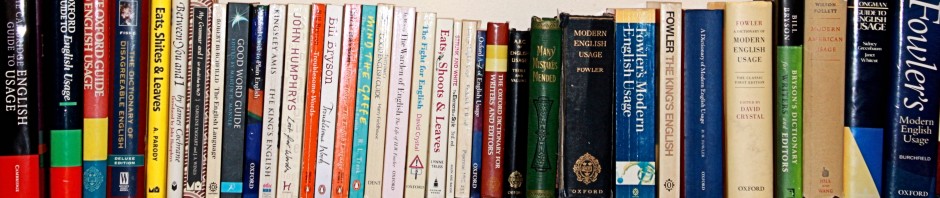
Kate Wild, one of our contributors, has kindly lent us two copies of her usage guides: anon., A Dictionary of Daily Blunders. London: Whittaker & Co (1880) anon. Many Mistakes Mended. New York: N. Tibbals & Sons (1886). The first of this … Continue reading

More Galleries | Tagged | Leave a comment

Apostrophe s

This gallery contains 3 photos.

In a park in Ealing, London (was it Ealing Common?) we came upon this notice: The arrival and that of their descendant’s have changed the face of Ealing and England forever. If you look carefully, someone tried to erase the … Continue reading

More Galleries | Tagged | 4 Comments

Images of prescriptivism

We are looking for images that will help to give a visual illustration of prescriptivism. There are of course pictures of Henry Watson Fowler, the author of Modern English Usage, but what else is there that we could use?


Posted in Uncategorized | Tagged | 5 Comments

Bridging the unbridgeable on Facebook

We have just launched the Facebook page of the project. Follow the link on the right to visit the page and feel free like us and join our new community of friends to help bridge the unbridgeable!

Posted in news | Tagged | Leave a comment

What are “usage guides” called in other languages?

The usage guide seems a typical English – British as well as American – phenomenon, though one of our commenters, Nadia Petrova, has already drawn our attention to the fact that they are also popular in Russia today. But what … Continue reading

More Galleries | Tagged , | 1 Comment

Your favourite usage guide?

“How can our listeners help you?” was a question Tom Holland asked  when he interviewed Ingrid Tieken on the BBC Radio 4 programme Making History (broadcast: Tuesday 18 October 2011). Listeners of Making History can help us by telling us … Continue reading

More Galleries | Tagged , , | 11 Comments

Snares in pairs: lie/lay and others

Paul Bennett, one of the commenters in this blog, offers language advice to the readers of his website. There is a wealth of information in his Quick Language Guide for Writers, and of particular interest there is his section called Snares in pairs.

Posted in usage features | 1 Comment

The French Academy goes interactive

Earlier this week, an article appeared in The Independent called “Language watchdog goes interactive to teach French to the French”. It reports on the fight against English influence on French by the Academie Française. Words criticised are stresser, as in “C’était stressant le week end de shopping avec ma meuf, quoi” and many others.

It is not clear how interactive the website of the Academie Française actually is: all it offers is to contact them and report (presumably) new anglicisms in the language: “Pour nous contacter: direnepasdire@academie-francaise.fr”. But isn’t contacter an anglicism as well? More seriously though: would this be the way to fight the influx of English in French? It seems like a lost battle, the more so, since president Sarkozy not so long ago advocated the teaching of English to French three-year olds.

Posted in news | Tagged | 1 Comment

Prescriptivism in the French-speaking world

The French-speaking world is a rather ‘monocentric’ linguistic community and prescriptivism has been an important part of the discourse on the French language for centuries. My contribution to this blog will be to share some information about purism in France and in other Francophone countries, especially in Canada and in Québec (since a lot of my research deals with linguistic representations among Quebeckers).

But today, I would like to begin with a question to the specialists of the English language : how do you see the Francophone world in sociolinguistic terms ? Do you see it as more puristic than other major linguistic communities (English or Spanish, e.g.) ?

Posted in Uncategorized | Tagged , , | 1 Comment