Smaug, the Stupendous

This semester, I teach an MA course called Testing Prescriptivism. Part of the requirements for the course, as for earlier courses I taught on the subject, is that students write two blogposts each. Here is the first, by Bram Steijn:

Truly, the tales and songs fall utterly short of your enormity, oh, Smaug, the stupendous. What are the odds that the protagonist of The Hobbit trilogy, Bilbo Baggins, was referring to Smaug’s “deviation from the norm” or his “extreme monstrous wickedness” instead of his “enormousness”?

The usage of the word enormity to denote “excess in magnitude” (see OED) has been condemned by quite a few individuals. For all that, people continue to use enormity in the sense of “vast”, just as they continue to use aggravate to denote “annoy” instead of “making something worse or more serious (Kamm 2015: 166) and decimate as synonymous to “wreaking havoc” in place of its historical meaning “to cull by one ” (Kamm 2015: 215). The meaning of words can shift over time, and halting this process or preventing it from happening is next to impossible. Perhaps the best we can hope for is to try to understand why the shift is occurring.

Searching for enormity in the British National Corpus (BNC), I discovered that the chief manner in which the word is used is in the “enormousness” sense of the word – out of the first fifty entries (displayed in random order), 26 showed enormity to denote enormousness, 12 as wickedness/evilness, and 12 were, in my opinion, ambiguous. Furthermore, enormity collocates most frequently with the words of, the, and task, as in “the enormity of the task”.

I believe that the possible explanation for enormity’s shift in meaning to also include enormousness lies in these ambiguous sentences, the sentences where enormity could potentially mean both enormousness and wickedness, or is simply a healthy conflation of the two different, and according to certain prescriptivists such as Simon Heffer, irreconcilable meanings of the word. For example, “[t]he enormity of this lie was so great that its ripples did in fact spread out one of the lower astral planes as far as…” (HA3 810) and “[s]he hung her head, weighed down by the enormity of it all” (JY5 2925) (examples from the BNC). Was the lie that wicked/evil or so enormous that it caused ripples? Did she feel despondent because she could not cope with the wickedness of the situation or because it was all too much? I would like to propose that in these instances enormity is a happy marriage of the two meanings, and that by stating that enormity should solely be used to denote ‘wickedness’ is to limit the word’s potential.

Smaug the stupendous

Moreover, was Bilbo Baggins referring to the fact that Smaug was a superb/cool dragon? After all, wicked is increasingly used in that sense. And how ‘cool’ was Smaug, a fictional, fire-breathing dragon, really? Certain words carry multiple meanings, often without causing any confusion as to the meaning of that given word when looked at it in context of the whole utterance. As Oliver Kamm remarks in Accidence Will Happen, enormity “is a useful and concise word that can do duty in several ways, expressing subtle distinctions, which are conveyed by the context” (Kamm 2015: 236). So, when examining Bilbo’s use of enormity in the context in which it was used (see image), I think it is safe to say he was referring to Smaug’s enormousness.

Reference:

Kamm, Oliver (2015). Accidence Will Happen. The Non-Pedantic Guide to English UsageLondon: Weidenfeld & Nicolson .


Posted in MA Leiden, usage features | 3 Comments

No Dutch complaint tradition?

In their book Authority in Language, Milroy and Milroy write that English has a well-established “complaint tradition” and that such a tradition is “typically found in communities that have highly developed standard languages” (2012: 39). But how about Dutch? In contrast to English newspapers, where letters-to-the-editor commonly deal with linguistic complaints (our very own Morana Lukač  recently published a paper on the topic), Dutch newspapers rarely publish such complaints. With, admittedly, rare exceptions like this one on modifying adjectives like unique (which btw is also an English usage problem).

It is hard to get information from editors about this. When I last wrote to NRC-Handelsblad about this (I was hoping to be able to arrange for an internship there as a means of infiltrating the editorial office and find out), I never received a reply, nor was my own letter-to-the-editor (which I wrote by way of a test) ever published. But now that I have a monthly feature on language in the weekly paper Den Haag Centraal, I spotted a good opportunity. Though when I asked the paper’s chief editor, Casper Postmaa, he told me that they never receive such letters, on language, that is. Undoubtedly to my disappointment, he added, but I’m sure not to his. Apparently their spelling has been tested as being rather good, much in contrast to the national NRC-Handelsblad. This indeed had been the subject of my complaint: three spelling errors in one short article.

DHC logo

So do The Netherlands not have a linguistic complaint tradition then? Perhaps it is because we complain about everything else: the weather, over-crowded trains, you name it. The weather is nice today, and I’m working from home, so no complaints from me at the moment. But what about the language?

DHC

Posted in letters to the editor | Tagged , , | 1 Comment

Continuing the usage game

On our blog, we often report on current developments in the usage debate, bits and pieces of our research findings and also new publications of usage guides. Being a true book addict, I would like to share two of the most recent additions not only to my own personal library but also to the stock of books dealing with the usage debate.

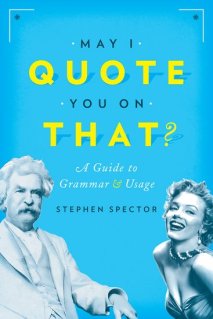
may i quoteThe first book is most probably the latest usage guide available at the moment. May I quote you on that? A Guide to Grammar and Usage was published in late 2015 and written by Stephen Spector, a member of the English Faculty of Stony Brook University. His take on English grammar and usage is quite refreshing as he takes a rather descriptive approach to the usage debate, but does not eschew providing his readers with rules of Standard English to follow. What makes this usage guide special are not only the numerous quotations of famous contemporaries, e.g. Lady Gaga, Hillary Clinton and George Clooney, but also short exercises at the end of usage entries to clarify Spector’s point of view. Furthermore, the distinction between different styles and degrees of formality is reflected in his usage advice and although he claims to be a traditionalist and “stuff English professor”, Spector seems pretty lenient and descriptive in his advice. Being an American usage guide, May I quote you on that? includes also information from different usage panels, such as the Harper Dictionary usage panel or the American Heritage Usage panel, and contrasts American with English usage.
gone completley
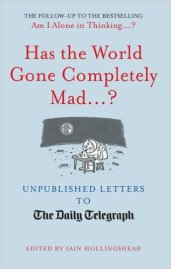
The second addition to my library is Has the World Gone Completely Mad…? Unpublished Letters to The Daily Telegraph edited by Iain Hollingshead and was also published in 2015. It does not come as a surprise that this book contains a chapter on the use and abuse of language. These short, but very amusing letters to the editor provide an interesting insight into how usage is perceived by the general public. To provide you with a taster, here’s a complaint about the Americanisation of British English:


“Sir – A true Brit would never use Americanisms. ‘Gonna’, the favourite word of George Osborne, is a no-no. Replacing the letter ‘t’ with the letter ‘d’ is a no-no-no-no. I am British. I am not Bridish. I am not going to sit here and accept the Americanisation of our language. Do you geddit or do you get it? It is insidious and needs to be stopped by the Broadcasting Watchdog.” (p. 129)


Posted in news, usage features, usage guide | Tagged , , , | 2 Comments

Splitting only

What do try and, only, split infinitives and dangling participles have in common? This is a question we asked a few weeks ago, and I promised to let you know as soon as we found out. Here, then, is a partial answer to what I found upon analysing the results of the attitudes survey I held in 2012. The data I analysed are the results to the survey question on the acceptability of only only (as in the Mittins sentence He only had one chapter to finish).

This is what one informant told us:

He only had to finish one chapter would be better and would eliminate the split infinitive but I find your sentence acceptable

Split infinitive??? And it wasn’t the only one:

Although there is a split infinitive I might use this sentence perhaps in conversation about someone and a book he was reading, I would not use it in a written piece as grammar is incorrect

Perhaps we may find the explanation in this informant’s reply:

I would say this.I suppose it may be considered by some to be technically incorrect to split the subject and verb with an adverb (as in French and German), but this is quite common in English and I like the nuancing flexibility of English being able to move the abverb; in French you can achieve this by moving the adverb to infront of the subjectandverb: seulement il avait ……

Yes, only does indeed split the subject and the verb in a way that many people still find unacceptable today (20 of 129 native speaker informants who filled in the survey). And I suppose the split infinitivs is such an iconic usage problem, that the notion of splitting is enough to suggest the split infinitive to some people. So here is one link between the four usage problems Carmen Ebner and I are writing a paper about, and who knows, there may be other equally unexpected ones to follow. We’ll let you know.

Posted in polls and surveys, usage features | Tagged , | Leave a comment

Of pedants, mavens, sticklers and …

only-snoopers! This is a term adopted by Sir Ernest Gowers in his discussion of the placement of only in Plain Words, another old chestnut in the usage guide tradition. The term reminds me of which-hunting, something pedants and other prescriptivists are renowned for. But only-snooping, which Gowers says “has become as popular a sport with some purists as split-infinitive-snooping was a generation ago” (he wrote this in 1948 by the way!), is new to me. (And you will find the meaning of snooping here.) But I don’t think it is very popular any more. Or is it?

(It is good to see that Rebecca Gowers, in her 4th edition of Plain Words, kept the term “only-snooping” in.)

(I’ve also just noticed that David Crystal, in Who Cares about English Usage, 1984, uses the term as well. Would he have consulted Plain Words on the topic?)

Posted in usage features, usage guide | Tagged , | 1 Comment

Blaming the media?

As part of our interactive feature series in English Today, the latest and ninth article has been published today in which I discuss attitudes towards the role of the media in language variation and change.

In my online questionnaire, I asked informants in Great Britain what they thought of the current state of English and obtained more than 170 answers to this rather general question. Clearly not all of them denounced that the end of English is nigh, but I decided to focus on answers containing a negative outlook on the development of English. I was particularly interested in the numerous answers by informants putting the blame for the alleged doom of the language on the media.

Since I would like to investigate this issue further, I launched a survey last December asking for your opinion on this matter. The survey was designed with UK media in mind, which is due to my focus on attitudes towards prescriptivism in British English. Do media institutions (still?) take on the role of the language guardian or do they boost language change? What do you think? The survey can be accessed by clicking here. Filling in the survey will take roughly 10 minutes and the majority of questions deals with language use in British national daily newspapers. I’d appreciate your help!

news-stock-photo1

Posted in announcement, polls and surveys | Tagged , , , , | Leave a comment

The descriptive backlash

Last month The Independent published a story featuring an email etiquette rule by Jonathan Tisch, a hotel magnate. According to Mr. Tisch, the one word you should never use to start emails is “I”. Referring to mentors, teachers and your own education is a common strategy when formulating prescriptive rules, and Mr. Tisch is no exception. He explains that this particular piece of advice was handed down to him by his former boss and mentor who claimed that “whenever you’re writing a letter — and now it applies to emails today — never start a paragraph with the word ‘I,’ because that immediately sends a message that you are more important than the person that you’re communicating with.” What was interesting about this piece is the commentary that followed under the article itself and in social media. The like-minded readers were among the minority and most commenters expressed their disagreement (“I don’t know about you but I know that I enjoy using a  nice perpendicular pronoun every now and again.”) or lack of interest (“Useless article”) in the prescriptive advice.

In the survey Ingrid Tieken and myself conducted in 2015, we asked our respondents (some of them, we presume, including our readers) about their experiences in publicly
voicing complaints about language. Most of the them replied that the complaints they voiced were not complaints on “wrong” usage, but on the pedants’ complaints themselves.

Although there is no doubt about continuing needs for usage advice, the tables are steadily turning with the backlash against prescriptive advice on the rise.

language bully

Posted in usage features | Tagged , , , | 6 Comments

The Age of Prescriptivism

Last week, at the symposium  The Effects of Prescriptivism in Language History organised at the University of Leiden Centre for Linguistics by Gijsbert Rutten and Marijke van der Wal, I presented a paper called The Age of Prescriptivism. For the paper I was able to draw on input from the readers of this blog, particularly on questions about irregular verbs which I put and on the discussion about drownded: I’m grateful to you all for your comments! If you are interested, you may find the presentation here: The Age of Prescriptivism; comments will be welcome. (There was also a handout, though with references only.)

Posted in announcement | Leave a comment

Try and, only, split infinitives, dangling participles

(If this is your first time on this blog: please fill in the acceptability survey below. Thank you!) What do these features have in common? That is something Carmen Ebner and I are going to figure out in the article we … Continue reading

More Galleries | Tagged , , , | 6 Comments

Please help us with our usage polls!

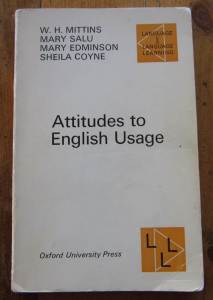
If you can spare us a little of your time, and if you haven’t done so already, please take our fifth usage poll. If you do so, we will be able to study the difference in acceptability compared between when Mittins et al. first did the survey in the late 1960s and today. We’ve had a reasonable amount of response for the other surveys, but not for this one. Even lower results were found for usage poll 7. And perhaps, though this would be asking a lot of you, we know, usage polls 8, 9 and 10 as well? Five sentences in each poll only! For the full list, look here in the banner. Thank you very much indeed.

Mittins


Posted in Uncategorized | 1 Comment