These are literally my favourite expressions

I think we all have our opinions about the use of the word literally as an intensifier in expressions where it doesn’t literally mean literally. Personally, it doesn’t usually bother me, so for me there is hardly an ‘incorrect’ use of literally. But there is a type of situation in which the use of literally may seem ‘incorrect’, but maybe isn’t.

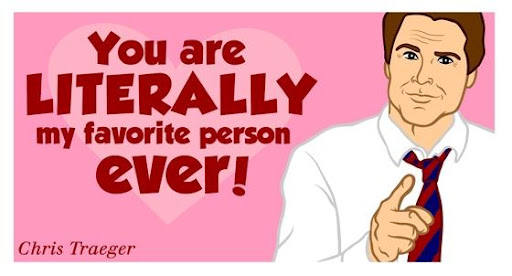
Those of you who have seen the show Parks and Recreation are familiar with the recurrent use of the word literally. Rob Lowe’s relentlessly optimistic character, Chris Traeger, is a notorious over-user of the word. It must literally be his favourite in the world.

source: MyWork

source: My Work

Indeed, many of his literallys are of the ‘incorrect’ actually-not-literally variety which many usage guides deplore, such as this one:

That literally went on forever. I thought you were never going to stop talking

Obviously, the writers of the show keep putting them in because it’s funny, but I suspect also because they know it annoys the language pedants. But the interesting thing is that many of Chris’s literallys seem justifiable to me, since he often uses them to modify his opinions or feelings, as in this one:

That is literally the best news I’ve heard all day

Here is a compilation of Chris’s literallys on YouTube you can watch. Which are justifiable and which are ‘incorrect’?

Posted in usage features | Tagged , , , | Leave a comment

More usage guides in 2014?

Penguin

The present year promises to be a good year for usage guides. Later this month, Rebecca Gowers’s new edition of her great-grandfather’s Plain Words will be published, an e-version of David Crystal’s Who Cares about English Usage will come out, and after the summer, a whole new usage guide will be published by Steven Pinker. But what is more, all three will be published by Penguin!

From the titles currently in the HUGE database, we can see that Oxford University Press has traditionally been the leading publisher of this text type, but now it looks as if Penguin has discovered the market too.

But these three publications are the only ones I’ve heard about as coming out this year. Does anyone know of any other forthcoming titles?

Posted in usage guide | Tagged , , , , , | Leave a comment

Cross-cultural Prescriptivism

For his paper at the Cambridge Usage (Guides) Symposium on 26 and 27 June, Robert Ilson would welcome input from the readers of this blog. Elsewhere, he published  what he called a “plaidoyer” for a cross-cultural study of prescriptivism, and in the article he makes a number of detailed suggestions for such a study.

thesis NadiaA little while ago, Nadia Petrova, one of the readers of this blog and a former student of English at the University of Leiden, carried out the kind of analysis that Robert Ilson is interested in for her MA thesis. The thesis is called: “A Comparative Analysis of Russian and English Usage Guides form the Twentieth and Twenty-first Centuries” (2010). (Readers may indicate their interest in the thesis by commenting on this blog; as a reader herself, Nadia will be able to respond to the comments.)

In her thesis, Nadia focussed on three usage problems that are similar between Russian and English:

  • subject-verb agreement with collective nouns
  • dangling participles
  • the degrees of comparison of adjectives.

So here are three cross-cultural items of the kind that Robert Ilson will be interested in. And another one was recently found by Annemarie Walop (who wrote a blog post last week on prestigeful): it has to do with the tendency in Dutch to start a sentence with maar (“but”). The article Annemarie located is called “Beter: de maar-ziekte”. I haven’t checked, but I imagine that just as with and, you are not supposed to start a sentence with but in English either.

So on behalf of Robert Ilson, and he has promised to acknowledge all help received: what more usage problems are there in other languages that have a parallel with English?

Posted in usage features | Tagged , , | 9 Comments

Who is A. Parody?

You don’t have to be very imaginative to see that Eats, Shites & Leaves (2004) parodies the title  of Lynne Truss’s phenomenally popular Eats, Shoots & Leaves (2003). And so does the name of the author: A. Parody. The back flap gives Mr Parody a first name, Antal, adding that he is “of Hungarian extraction” and that he “fled to Britain from either Buda or Pest – sources differ – in the late 1940s, following the collapse of the so-called ‘Mashed-Potato Revolution'”. Haha. But who was the author, or compiler, really? And more interestingly, would a parody of usage literature herald the end of the genre?

Posted in usage guide | 2 Comments

Is it Prestigious to use Prestigeful?

During the next few months, the students from my MA course Testing Prescriptivism will be writing posts for this blog. This first one is from Annemarie Walop.
Microsoft Word's comment

Microsoft Word’s comment

It might be very telling that as I am writing this, Microsoft Word puts a red line under the word prestigeful. Sadly, it gives no suggestions as to what I should use instead.

Robert Burchfield

Robert Burchfield

I came across this adjectival form of prestige in the article ‘Usage Problems in British and American English’, written by Robert F. Ilson (1985). In his article Ilson deals with all the words that were on Robert Burchfield’s list in a BBC booklet called The Spoken Word, published in 1981 – words that were considered usage problems in British English. In the section on vocabulary there were 47 items, one of them being prestigious. Ilson commented that “the less controversial alternative prestigeful does not seem to have caught on” (p. 174).

Is this the case or has the form prestigeful never been very popular to begin with?

To find the answer to this question, I made use of the Oxford English Dictionary (OED). The OED lists three quotations for the word prestigeful, the first from 1936 and the last from 1990. Prestigious on the other hand has eight quotations, with the first one being dated 1901 and the final one 1994. Thus prestigious has been used for a longer period of time than its counterpart. Interestingly, the OED mentions another form: prestiginous (use prestigious instead! says Word). Prestiginous is labelled ‘rare’ in the OED, and  is defined as follows: “viewed in terms of prestige; prestigious”. It has two quotations, one from 1896 and one from 1951.

The New Fowler’s Modern English Usage (1996), edited by Robert Burchfield, has an entry on prestigious, which includes a reference to prestigeful:

Prestigious is challenged by prestige used attrib., and to a minor extent by the less euphonious form prestigeful (first recorded in 1956)” (p. 621)

Robert Burchfield apparently thought that the form needed to be mentioned, even though he might have been the only one to consider it a usage problem. Another usage guide, namely the Longman Guide to English Usage (1988), does not mention prestigeful, nor does Webster’s New Twentieth Century Dictionary (1971). The Concise Oxford Dictionary (1976) only has prestigeful listed under prestige, without any further explanation.

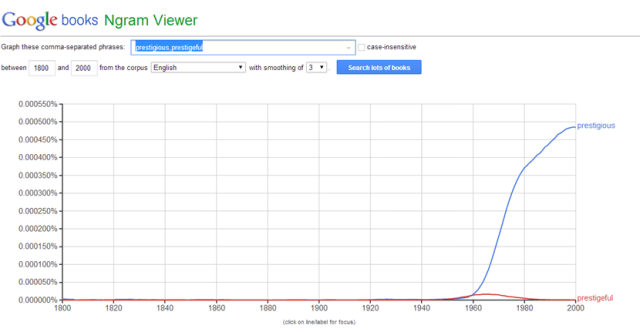
Google NGrams shows that during the 1960s and the 1970s, the form prestigeful was used sparingly, and that the form prestigious has always been preferred. In the 1980s, when Burchfield compiled his list for The Spoken Word, the form had all but disappeared, which makes it even more surprising to see that Burchfield still listed it in The New Fowler’s Modern English Usage in 1996.
Ngram prestigeful

This begs the question of whether the form prestigeful was ever used at all, or whether it was just Robert Burchfield who was obsessed by it?
Posted in MA Leiden, usage features | Tagged | 3 Comments

Was she American after all?

OUP

Last week, my book In Search of Jane Austen: The Language of the Letters (OUP, 2014) came out. I’ve already commented on this blog on the very interesting editorial process, which resulted in some changes that I wasn’t too happy about. I guess this happens all the time. I had been asked for my linguistic preferences, and I had specified British English, largely because I was worried about changes that might affect my whichs and thats.

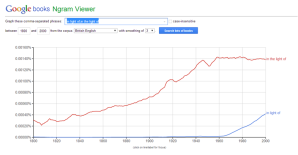
None of that happened, which was good, but there were other changes, and one of these led to my in the light of being changed into in light of. Though I’m not an English native speaker, I’m definitely an in-the-light-of user, so I changed them all back again. I tried to explain this to the editor by showing an Ngram of both constructions, which would have suggested that I’m probably considerably older than she is.

Ngram in (the) light of, British

Ngram in (the) light of, British

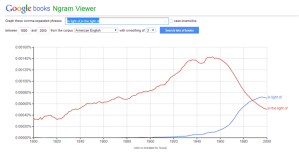
In the above Ngram the search parameter was set to British English. But look what happens if you change it to American:

Ngram in (the) light of American

Ngram in (the) light of, American

The different graph suggests that age may not have been an issue after all: could the editor have been American?

Posted in usage features | Tagged , , , | Leave a comment

Fixing English – soon to be published

Exciting news: we have just heard that a new book on prescriptivism is soon to be published (May): Anne Curzan’s Fixing English. Read its description on CUP’s website:

Over the past 300 years, attempts have been made to prescribe how we should and should not use the English language. The efforts have been institutionalized in places such as usage guides, dictionaries, and school curricula. Such authorities have aspired to ‘fix’ the language, sometimes by keeping English exactly where it is, but also by trying to improve the current state of the language. Anne Curzan demonstrates the important role prescriptivism plays in the history of the English language, as a sociolinguistic factor in language change and as a vital meta-discourse about language. Starting with a pioneering new definition of prescriptivism as a linguistic phenomenon, she highlights the significant role played by Microsoft’s grammar checker, debates about ‘real words’, non-sexist language reform, and efforts to reappropriate stigmatized terms. Essential reading for anyone interested in the regulation of language, the book is a fascinating re-examination of how we tell language history.

Anne Curzan

And this is how the book is recommended by Deborah Cameron, author of Verbal Hygiene (1995) and one of the speakers at our usage guides symposium in Cambridge, in June: “Anne Curzan takes prescriptivism seriously; this informative, engaging and readable book deserves serious attention from anyone with an interest in the history – or the future – of English”. So definitely a book to look forward to!

Posted in news | Leave a comment

Editing out singular they?

This was a question Klazien Tilstra, a BA student from the University of Leiden, asked the members of SENSE a few months ago. If you wish to find out the answer, read the summary of her BA thesis on this blog.

Attitudes to the use of singular they are changing: read this blogpost on The Econonist online if you want to know more (with thanks to Johan Rooryck for posting the link on the Leiden MA Linguistics facebook page).

And what do YOU think about singular they?

Posted in announcement | Tagged , | 2 Comments

The Alphabet of Errors: L, M & N

lay and lieHave you told people a 1000 times not to use lie for lay? Are those people, after all your well-meant though prescriptive advice, still lost as to when to use the one and when the other? Do they forget your advice?

Elizabeth Richardson, about whom I earlier wrote the post The Alphabet of Errors, thought of a long-lasting solution: rhymes. In an article she sent to The English Journal in 1921, she reports of a group of senior pupils on a girls’ high school in Boston, Massachusetts who composed verses that had to help them pay attention to their speech. Standing on an assembly platform, the girls recited:

L
L is for lie
Used often as lay
An easy mistake,
But cast it away.

M
M is for may,
Twin sister of can;
Using one for the other
Is under a ban

N
N is for no,
Which often we say
Together with not
Beware, it means yea.

designed by Alanna Cavanagh (alannacavanagh.blogspot.nl)

designed by Alanna Cavanagh (alannacavanagh.blogspot.nl)

The usage problems dealt with in these rhymes (lie/lay, may/can, double negation) happen to be in the HUGE database. Though I have read quite a few usage guides by now, I haven’t come across series of poems (yet).

As I mentioned in my other post, I wonder whether similar attempts have been made to correct pupils’ speech. Would you happen to know a rhyme about a usage problem similar to the ones quoted above? Do you think they are effective?

Reference:
Richardson, E. (Oct. 1921) “The Alphabet of Errors.” The English Journal, 10.8: 472-473

Posted in usage features | Tagged , , , , , , , , , , | 1 Comment

Appropriate Usage – You decide!

The moment of truth has come. It is time to find out what YOU think about the English language and its usage? Is it fit as a fiddle? Or is it going down the drain? What do you consider acceptable and appropriate usage? What is Proper English Usage?

Let’s find out by filling in the online questionnaire!

Proper?

Proper?

In case you live in the UK (Greater London Area) and are interested in participating in the next steps of the survey, please contact me for more information.

Posted in announcement, polls and surveys, usage features | Tagged , , , , , | 2 Comments