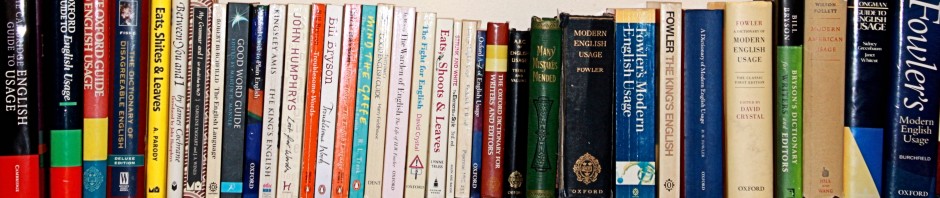
… has joined us in our interest in prescritpivism. Read all about it here.

And that isn’t all: here’s what they published two days later. Keep sending us more of this.
(Thanks, Joan!)
In February 2013, Inge Otto joined the project as an intern and in September she was hired as our new project assistent, replacing Cynthia Lange. Inge will primarily be working on the database of usage guides and usage problems that we are compiling.

Inge Otto and Robin Straaijer working on the H.U.G.E. database
When we were living in Cambridge, two years ago, I was struck by the pervasiveness of you guys as a plural pronoun. It is not as if it was new to me: in my history of the language lectures I tell the students about the grammatical gap in the English pronoun system, with you serving as an all-purpose second person pronoun. Speakers themselves feel uncomfortable with this, and have come up with you all, youse and you guys (as well as other forms: I often hear myself say “you people” when addressing my students as a group).

Sir Kingsley Amis (wikipedia)
You guys I always thought to be an Americanism, but what about you all? I now think it might be an Americanism too, or that is at least what Kingsley Amis suggests in his novel I want it now (1968). Amis published (or rather, his publishers did after his death) a usage guide. The King’s English, and his novels are filled with linguistic comments of all sorts. He doesn’t appear to have liked American English much (nor, as this novel shows, did he like Greek food, the Dutch language, or perhaps anything outlandish), but his comment on you all I think is hilarious.

I want it now (Panther)
A minor character in the novel, who is depicted as looking like someone “out of a Western”, is a frequent user of you all: “You-all got trouble there. Real bad trouble” (p. 128). So much so, that Ronnie Appleyard, the main character, “speaking without any conscious thought and very fast, … said, ‘He-all may have been [i.e. to the South] for all I know but I-all never have and neither of us-all have ever been to this bloody place and now you-all must excuse me.'” (p. 131).
English humour at its best, and another example of the type of Amis’s linguistic comment which you find in almost all his novels, and which very likely eventually led to his usage guide. But did you all indeed arise in American English? Or was Amis wrong here?
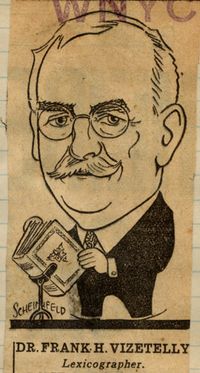
A Caricature of Vizetelly (source: WNYC)
Have you ever heard anybody say hain’t? Have you seen it written down somewhere for have not or has not? Until this morning I was totally unfamiliar with the expression. To be honest, I only knew of the existence of ain’t, and it is for this reason that I thought that Frank Vizetelly had made a mistake in his usage guide.
Because Frank Vizetelly’s A Desk-Book of Errors in English (1920) is to be included in the Hyper Usage Guide of English (the HUGE-database), I was searching Vizetelly’s guide this morning for usage problems. Although I had never heard of hain’t, Vizetelly makes it clear that the use of hain’t is an error people should avoid making:
hain’t: A common vulgarism for have not, haven’t, and made worse, if possible, by being used also for has not or hasn’t; as I hain’t, He hain’t, etc. I haven’t, He hasn’t are permissible, haven’t I? hasn’t he? are acceptable in conversation. But when the subject precedes in the first person singular and the plural, it is preferable to abbreviate the verb; as, I’v e not, you’ve not, etc. (page 102)
Because I still believed that Mr. Vizetelly could not but have made a slip of the pen when he was writing his guide, I decided to google hain’t.

A Desk-Book of Errors in English (1920), F. H. Vizetelly
Guess what? The online dictionaries actually do include hain’t. The Oxford English Dictionary Online shows a small, five-word entry (“vulgar contr. of have not“). Further, Wiktionary states that hain’t is a dialectal and archaic contraction of has/have not, and that it is a contraction of ain’t in some dialects. The Merriam Webster Dictionary, as well as some free online dictionaries (e.g. The Urban Dictionary and The Free Dictionary) also include hain’t.
After all it seems that Frank Vizetelly (or his editor) was not making a spelling error when he included hain’t in his usage guide. I wonder whether the expression occurs in other usage guides as well. Did you ever come across an entry with hain’t? Do you think that people these days would still consider hain’t a vulgarism – like Vizetelly did in the early twentieth century?
Whenever I listen to Bob Dylan’s song “Mr Tambourine Man”, I catch myself being surprised at the line:
I’m not sleepy and there is no place I’m going to.
Shouldn’t it be ain’t in this context? Googling for the line, I stumbled upon the same song but sung by The Byrds, so yes, it seems that my expectations when listening to Bob Dylan. are based on their version of the song. Ain’t of course does occur in another Dylan song, “It ain’t me babe”. So what happened? Which is the original version, why the difference? Any ideas?
Greatest hits
… when you use poor grammar” is the title of a picture book of grammatical and other linguistic bloopers. Viktorija brought it back with her as a present for our group when she returned from the States earlier this month. It is hilarious, so well worth a read.
Feel free to add your own pet bloopers here for more laughs! Sympathetic laughs to be sure, for as one reviewer says, we easily make such errors ourselves (I myself just had to correct pciture in the above text).

Thanks, Viktorija!
 During dinner at a conference last week, a British colleague raised the question of where the closing formula “kind regards” had suddenly come from. It is pervasive in emails nowadays, she said, but she waived my suggestion that it might be American influence. So to find out, I decided to search my email inbox for “kind regards” and classify the users according to whether they were native speakers of English (and whether British or American) or non-native speakers. This turned out to be a massive undertaking, as my mailbox is chronically full to overflowing, so I limited myself to the emails I received this year.
There were altogether 224 emails (out of how many I didn’t count) that ended with “kind regards”, ”best regards” and sometimes just “regards”. Of these, 109 were by non-native speakers (not only Dutch ones), 72 by Dutch students, 29 by Americans and 14 by British native speakers. (It should be said that many of these emails were by the same students and other people, which naturally skews the data. But the differences are striking all the same.)
I don’t want to mention names, but I was struck by the fact that three of my younger British colleagues tend to vary between “kind regards” and “best wishes”, but the Dutch students were remarkably consistent. So were the American students. What I also noticed is that faculty communications also consistently used “kind regards”, sometimes alongside the Dutch equivalent “met vriendelijke groet”. But though the two are clearly regarded as synonymous, I still wonder why “with best wishes” wasn’t chosen.
So do we have an example of American influence here? At first I thought of posting this small analysis on the Leiden English Department facebook page, but I didn’t because the last thing I want to achieve is to make students insecure about their English. Or should I raise the issue after all? I do think that people writing official Faculty communications should be aware of the fact that they might be using an Americanism when university policy is to use British English (though I’m not even sure that either of these things is the case). So let me have your views please! And tell me whether I should adapt my preferred British model in this respect to a new usage.
By way of a PS (since I reading Her Ladyship’s Guide to the Queen’s English): Caroline Taggart only mentions With best wishes (2010: 155), which probably means that kind regards is a usage she disapproves of.
One of the characteristics of English usage guides is that they often include tongue-in-cheek remarks, actual jokes or just plain witticisms. As the Fowler brothers wrote, when they were working on The King’s English, “we try to throw in a little elegant flippancy here & there” to alleviate the dryness of the topic (Jenny McMorris, 2001, The Warden of English, OUP, p. 59).
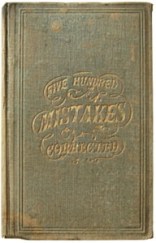 The anonymous author of one of the earliest American usage guides, Five Hundred Mistakes of Daily Occurrence in Speaking, Pronouncing, and Writing the English Language, Corrected (New York, 1856), clearly thought so too, and there are quite a few witticisms in the book, as well as jokes.
The author must have delighted in them, but do we still think them funny today? To find out, we’d like you to tell us by filling in the poll below, and to let us know which of the items you like best (one choice only!). Doing the poll requires a bit of reading, but may lead to a very pleasurable five minutes or so.
And if you wish to leave a reply, comments will be very welcome too.
The what-are-your-favourite-language-blogs poll posted in June is now closed. Surprisingly, a little more than half of the answers were given as write-ins in the option ‘other’. Here are the results.

First, a thank-you to those who voted for this blog, we’re very flattered! Congratulations to Lavengro, Peter Harvey’s blog, which got the most votes. The call to vote for his blog apparently worked! As you can see, the two other most often mentioned favourite blogs were Language Log and the Chronicle of Higher Education’s Lingua Franca. Links to both of these are in our blogroll. Note too, the mixture of blogs about language in a more general sense, and blogs that deal with language usage itself.
In the one instance in which this word occurs in Jane Austen’s letters it doesn’t mean what the spelling appears to suggest (innermost?):
he said the fleas were so starved when he came back from Chawton that they all flew upon him and eenermost eat him up (letter 93).
The quotation is from a part of the letter which was written by Jane Austen’s 13-year-old niece Elizabeth, and the word seems to mean “almost”. Unfortunately, I couldn’t verify this in the OED, as it doesn’t include the word as an entry.
Having a look at what we now believe is the first American English usage guide, Seth T. Hurd’s Grammatical Corrector or Vocabulary of the Common Errors of Speech (1847), I found an entry on eenamost:

And eenamost is in the OED. What is more, the first illustration of the word suggests that it is a Kentish dialect word: “1735–6 S. Pegge Alphabet of Kenticisms (1876) , E’en a’most, almost”. Elizabeth and her family lived in Godmersham, Kent, and in this letter to her aunt Cassandra, she mimicks the language of “Poor Will Amos”, a local 65-year-old Godmersham villager (see the index in Deirdre Le Faye’s edition of the letters).
The OED labels the word as “Eng. and U.S. dial.”. Hurd, however, labels it as “a gross corruption”. Perhaps there are more dialect words in his book which he labels like that. Searching for the word with Google’s Ngram Viewer (set to American English) suggests that the word was particularly frequent in the 1840s, and this is why it may have been adopted in his list of “common errors”:

Perhaps usage dropped as a result of Hurd’s book, but we need to know a lot more about its distribution and popularity. Has anyone ever come across references to it? Usage also dropped in British English after the 1840s, but it never surfaced again as much as it did in American English.


 Bridging the Unbridgeable