Punctuation matters

Nowadays, people seem to be more tolerant towards language. Punctuation errors, for instance, seem to be accepted more often, as understandability is believed to be more important than correctness.

Lynne Truss

Lynne Truss, the well-known author of Eats, Shoots & Leaves: The Zero Tolerance Approach to Punctuation, argues that  the deterioration of punctuation standards is due to  the Bolshevik printers of St. Petersburg who in historic times demanded to be paid the same rate for punctuation marks as for letters. This would have resulted in a letter such as the one below, that could both be interpreted as a love letter or as a break-up letter.

DEAR JOHN:

I WANT A MAN WHO KNOWS WHAT LOVE IS ALL ABOUT YOU ARE GENEROUS KIND THOUGHTFUL PEOPLE WHO ARE NOT LIKE YOU ADMIT TO BEING USELESS AND INFERIOR YOU HAVE RUINED ME FOR OTHER MEN I YEARN FOR YOU I HAVE NO FEELINGS WHATSOEVER WHEN WE’RE APART I CAN BE FOREVER HAPPY WILL YOU LET ME BE YOURS

JANE

This illustrates that understandability and punctuation are closely related. Jane, it seems, is punctuationally-challenged, as are more people nowadays. Truss’s goal is to remind readers of the importance of punctuation, as is the purpose of this blog post. She uses humor together with instruction to remind readers of the importance of punctuation.

Are you punctuationally challenged as well? Check out the solution here.
Posted in usage features | Tagged , | Leave a comment

Author Spotting

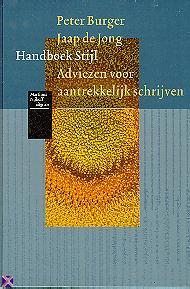
Het hanboek stijlI would like to share my excitement about my most recent book purchase. Perhaps unsurprisingly, it’s related to the HUGE database of usage guides and usage problems – albeit tangentially. The book is Het Handboek Stijl, which is the current standard style guide to written Dutch. The guide is co-authored by Peter Burger and Jaap de Jong – who both work here at Leiden University.

PinkerI always feel secretly cool about author spottings – even though they happen pretty much daily in the university setting. It still makes me happy. I even author spotted Steven Pinker a few weeks ago at the Niko Tinbergen lecture series. (And, judging by my mention of said spotting, I’m apparently still feeling secretly cool about it.)

But back to my neat new book:

Jaap de JongProfessor Jaap de Jong – in addition to being founder of the study Journalism and New Media here at Leiden – is also a co-editor of the popular Dutch language journal Genootschap Onze Taal and an expert on the theory of rhetoric among other things. During his oration a few years ago, De Jong also cited the great professor of the history of rhetoric Antoine Braet as an important influence. With this in mind, I was interested in the extent to which the style advice provided in Het Handboek Stijl would reflect these influences. Perhaps the pet peeves of Onze Taal readers have found their way into the advice? Or maybe the style tips tend toward the oratory? I’m still investigating these questions and others with my shiny new book – so perhaps I’ll write again with some answers at a later date.

Meanwhile, forays into the relationships between the lives and work of authors and the type of advice they provide on style and usage issues are fun and entertaining to undertake. They are also useful and relevant to studies such as the ones being conducted in the context of this project. So, to my list of covert hobbies, I think I can officially add ‘usage-advice tracing’ and ‘influence searching’. With hobbies like these on the loose, traditional pastimes better watch their backs.

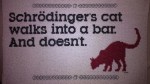
bar cat joke

I’m looking at you, cross stitching.

Posted in usage guide | Tagged , , , , | Leave a comment

Pulpitically?

500 mistakesI’m currently analysing the entries in Five Hundred Mistakes of Daily Occurrence (1856), one of the earliest Americn usage guides (though not the earliest one, as I thought before), for a paper I’m giving on the topic at the 5th Late Modern English Conference in Bergamo in August. The entris include some really amazing ones, such as the following:

“He talks pulpitically:” this word, which some who copy Chesterfield persist in using, has never by any good authority been admitted into the language (p. 50).

Checking the word in the OED shows that it is actually listed there, as a derivative of the adjective pulpitical (does that mean it was admitted into the language after all?). But it only has one example, from Chesterfield (1694-1773):

1751 Ld. Chesterfield Let. Mar. (1932) (modernized text) IV. 1690 To proceed then regularly and pulpitically; I will first show you, my beloved [etc.].

How frequent was the word to begin with, if the OED was only able to cite the one example that links the word to Chesterfield (and note that the word is labelled “Obs. rare”). And, more mysteriously still, how would Walton Burgess, the author of Five Hundred Mistakes, have learnt about its existence? The quotation from Chesterfield dates from an edition from 1932. So could he have used another usage guide for this?

Posted in usage guide | Tagged , , | Leave a comment

An Academy of English?

Even if Great Britain never had an Academy of English similar to the France’s Académie Française or the Spain’s Real Academia Española, authority is still assigned to different bodies. But to whom?

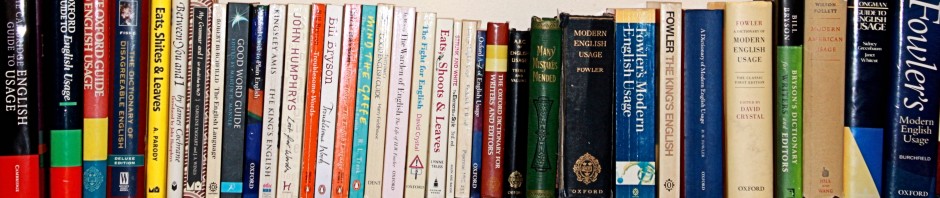
The desire for having a standard to hold onto and the search for a language guardian who is able to fulfill this desire have lingered on the minds of many. From Shakespeare and Dryden to dictionaries such as the Oxford English Dictionary (OED) – role models have always been found. Fowler’s A Dictionary to Modern English Usage is often considered the authority on English. You can even find comments such as J. Ezard’s saying that Fowler is “the closest Britain has to an Academy of English”. Others might consider her Majesty Queen Elizabeth II a language authority. So here is my question:

Who or what do you consider an English language authority? 

Posted in Uncategorized | Tagged , , , | 1 Comment

Latest conference news

Posted in announcement, events, news | Tagged , , , , | Leave a comment

Why learn to spell correctly? I have a spelling checker

Many people find spelling unimportant. And if they do find it important, they sometimes still believe there is no need to learn to spell correctly since we have a spelling checker. Therefore, let me illustrate the flaws of this useful spelling checker tool, as in the poem below:

Eye halve a spelling chequer

I have a spelling checker.
It came with my pea sea.
It plane lee marks four my revue
Miss steaks aye can knot sea.

Eye ran this poem threw it,
Your sure reel glad two no.
Its vary polished in it’s weigh.
My checker tolled me sew.

A checker is a bless sing,
It freeze yew lodes of thyme.
It helps me right awl stiles two reed,
And aides me when I rime.

Each frays come posed up on my screen
eye trussed too bee a joule.
The checker pours o’er every word
To cheque sum spelling rule.

Bee fore a veiling checker’s Hour
spelling mite decline,
And if we’re lacks oar have a laps,
We wood bee maid too wine.

Butt now bee cause my spelling
Is checked with such grate flair,
Their are no fault’s with in my cite,
Of nun eye am a ware.

Now spelling does knot phase me,
It does knot bring a tier.
My pay purrs awl due glad den
With wrapped word’s fare as hear.

To rite with care is quite a feet
Of witch won should be proud,
And wee mussed dew the best wee can,
Sew flaw’s are knot aloud.

Sow ewe can sea why aye dew prays,
Such soft wear four pea seas,
And why eye brake in two averse
Buy righting too pleas.

From: blog.darrencannell.com.

Spelling is indeed important. Firstly, to avoid confusion in meaning. Secondly, bad spelling may suggest that if the author does not seem to care enough about what he/she is saying, people should not be bothered to even read the article.

Until the time that spelling checkers will understand pragmatics fully, students need to be taught how to spell correctly, and, for example, learn the difference between their, they’re and there, to mention one of many pitfalls.

Posted in Uncategorized | Tagged , | Leave a comment

Fuck my grammar, Mary

And here is another one from Marilyn French’s Our Father. This time an old chestnut. Mary, the middle one (of the legitimate sisters) is discussing feminism with illegitimate and coloured Ronnie:

… As long as women have the babies they will need protection.

From who?

I beg your pardon?

Who do they need protection from?

Really, Ronny, your grammar …

Fuck my grammar, Mary. Why do women need … (p. 140)

Elsewhere is this blog there is a post on the disappearance of whom, and Marilyn French’s comment is in line with this development.

I’ll have to read on to see if there is any more of it in the novel.

Posted in usage features | Tagged , , | 2 Comments

The both of you

Penguin edition (1994)

Prescriptivism in literature or films: I’ve already noted a few examples in this blog. Here is another one. It is from Marilyn French‘s novel Our Father (1994). Alex, the first speaker, is one of the three (or four if you include illegitimate Ronnie) sisters who get together when their father suffered a stroke.

“You too! That’s what she does! The both of you so tough and hard but underneath you’re a couple of pussycats.”

“The two of you,”  Mary said sourly.

” Excuse me?”

Either ‘the two of you’  or ‘both of you.’  but never ‘the both of you'”.

Ignoring this Alex gushed to Ronnie … (p. 125).

Again, the purpose of the correction could have been to shut the speaker up (see Bertie vs. Mr Brown), but it didn’t.

I don’t know if this is a usage feature that is discussed in (American?) usage guides at all, and if it is, please let me know, but I’m collecting examples like these for the book I’m writing on prescriptivism. There must be a lot more, and I don’t know how to search for them systematically as I can only read one book or watch one film at a time. So if anyone could help here, I would be very grateful indeed.

Posted in usage features | Tagged , , | 1 Comment

New grammar tests in English schools

Marilyn Hedges, one of the readers of this blog, asked me to post the following:

From the Guardian article

Formal grammar teaching in English schools stopped in the 1960s, as Anya Luscombe mentioned in her recent talk in Leiden. It seems as if the grammar/no grammar policy may have come full circle, since 11-year-olds in England had to sit a grammar and spelling test this week for the first time according to an article in The Guardian earlier this week.

The Telegraph

The Telegraph reports that the reform is part of the Department for Education’s efforts to address concerns from universities and employers that too many pupils arrive without basic literacy and numeracy skills despite having passed national curriculum tests.

It will be interesting to see what the effect of this renewed attention to grammar will be in a few year’s time.

Posted in news | Tagged , , , | 1 Comment

Koffie’s or Koffies: apostrophe confusion in Dutch

Koffie's?

I came across an interesting use of an apostrophe with a plural in Dutch on my way to Leiden, and wondered what caused this misuse of the apostrophe in the image above. According to the Van Dale dictionary the correct plural of koffie is koffies, not koffie’s.

I came up with some possible theories to account for this misuse:

1. Generalising the Dutch apostrophe rule:

English loanwords that end in –y get an apostrophe plus –s in Dutch, unless there is a vowel before the –y, according to Genootschap Onze Taal. The coffee shop owner may have applied the same rule, adding -‘s although the Dutch word does not end in –y (cf. Dutch babybaby’s).

Another possible explanation could be that the apostrophe is used to avoid confusion in pronunciation. However, there is no need for an apostrophe since there is no such confusion while saying koffies out loud because there is just one way of pronouncing –ie.

2. English influence on Dutch:

English uses the apostrophe quite often before the –s, but never with plurals. The use of an apostrophe therefore has a clear purpose, since -‘s (or only the apostrophe in other cases) usually denotes possession. Sometimes the apostrophe is used to refer to something without a noun following, as in my father’s. This use leaves out the noun place. But this does not apply to koffie in the example above, since it is meant to indicate the plural.

To sum up, the misuse of the apostrophe in koffie’s can be accounted for in various ways. Could it indeed be influenced by English usage or is it due to generalising the Dutch apostrophe rules? I am curious to see what more the apostrophe future will bring us!

Posted in usage features | Tagged , , , | Leave a comment