On being a pedant

And I thought I was a pedant! Read more in the article In a Word from the New York Times Online (and tell us what you think).

Btw: searching for the author’s name, Philip Corbett, shows more interest on his part in language correctness. Here’s more: Bright Passages, Subjunctivitis!

(As ever: thanks, Bob.)

Posted in news | Tagged , | Leave a comment

Forecasted?

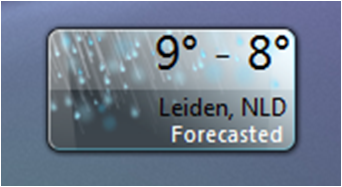
I have a little gadget on the desktop of my laptop that tells me the current state of weather. Sometimes, my laptop is not connected to the internet, and the gadget looks like this:

And each time I see it, I think: “Forecasted? Who would have written that?” After all, it is a strong verb: castcastcast is what I learnt in school, where does casted come from, all of a sudden? There is a blog elsewhere on the web that says that both cast (= past tense) and casted are found. Perhaps, but why not write forecast? It could be interpreted as a noun or a past tense verb at the same time: problem solved. Fortunately, though, there is a happy ending to this story:

Posted in usage features | Tagged , | 1 Comment

English Language Usage on Facebook – Survey

In the beginning of the last century, some notable linguists and scholars, George Philip Krapp, Sterling Leonard, and Fred Walcott, to name a few, expressed their cogent views on the relativity of linguistic correctness. Correct language is not something absolute, but rather something dependent on the context and the situation. I suppose we are all aware of how this translates into our everyday language usage. Talking to close friends is different from talking to someone we don’t know. The attention we give to our language correctness is certainly higher when we’re writing a formal letter, an essay, or when we’re preparing a speech or a presentation. I myself have noticed that I’m especially careful about my language when I’m writing to someone I don’t know. With my friends, I’m quite relaxed, and even if I make a mistake, I don’t feel like it’s a big deal. Such standards have become quite established, and we, more or less, intuitively know what kind of language is appropriate in which context.

Now, things become a bit (and that is an understatement!) complicated when it comes to language usage on the Internet. With the rise of social media, and particularly Social Network Sites (SNSs), human communication has been uniquely transformed. These changes have inevitably affected the way we use language. Language production on the Internet is so varied, that even in the cyberspace there are different rules for different contexts. Writing a blog post is very different from writing a comment on a friend’s Facebook wall. All this inspired me to take an in-depth look into the opinions of people regarding language usage on Facebook. I decided to restrict my current research only on Facebook language usage because, as David Crystal has already pointed out, language production on Facebook is a strange mixture of spoken and written language. I have also noticed in my years of experience as a Facebook user that people tend to have very different standards concerning spelling, punctuation and style when communicating via (on?) Facebook.

I put all my initial questions together and compiled a survey targeting Facebook users who are at the same time English speakers (both native and non-native). This is still a pilot survey at this stage, but I really hope it will provide some interesting initial insights. Since I launched the survey yesterday 90 people have already completed it, and I received some very good feedback! I am also hoping that most of the readers of this blog will be able to spare 10 minutes of their time to complete the survey and inform friends about it. All your help is appreciated! For those of you who are interested in the results, check our blog regularly for updates in the next few weeks.

Here is a link to the survey. Thank you!

 

Posted in polls and surveys, technology | Tagged , , , , , , | Leave a comment

Euro English

Dear all,

We will all become witnesses of the rise of a new English variety: Euro English. Those of you, who are not yet familiar with the term or the variety, do not panic. To cut a long story short, Euro English is a new English language variety spoken by citizens of the EuropeanUnion whose mother tongue is not English.

Language and politics can be a sensitive issue which often is connected to a national identity. Having decided against German as official language, the European Union issued a 5-year plan which aims at gradually introducing Euro English in Europe.

The European Commission has just announced an agreement whereby English will be the official language of the European Union rather than German, which was the other possibility. As part of the negotiations, the British Government conceded that English spelling had some room for improvement and has accepted a 5-year phase-in plan that would become known as “Euro-English”. In the first year, “s” will  replace the soft “c”. Sertainly, this will make the sivil servants jump with joy. The hard “c” will be dropped in favour of “k”. This should klear up konfusion, and keyboards kan have one less letter. There will be growing publik enthusiasm in the sekond year when the troublesome “ph” will be replaced with “f”. This will make words like fotograf 20% shorter. In the 3rd year, publik akseptanse of the new spelling kan be expekted to reach the stage where more komplikated changes are possible. Governments will enkourage the removal of double letters which have always ben a deterent to akurate speling. Also, al wil agre that the horibl mes of the silent “e” in the languag is disgrasful and it should go away. By the 4th yer people wil be reseptiv to steps such as replasing “th” with “z” and “w” with “v”. During ze fifz yer, ze unesesary “o” kan be dropd from vords kontaining “ou” and after ziz fifz yer, ve vil hav a reil sensibl riten styl. Zer vil be no mor trubl or difikultis and evrivun vil find it ezi tu understand ech oza. Ze drem of a united urop vil finali kum tru. Und efter ze fifz yer, ve vil al be speking German like zey vunted in ze forst plas. If zis mad you smil, pleas pas on to oza pepl…


In zis kas, gut lak evrivun.


Posted in Uncategorized | Tagged , | 2 Comments

Discussing correctness with Bryan A. Garner

Matthijs Smits sent us a link containing a discussion in the New York Times Online between American usage expert Bryan Garner and Economist journalist Robert Greene. The interview deals with the usual descriptivism/prescriptivism question, and by way of an illustration the question is raised and discussed as the the problem of when to use that or which. Matthijs, who wrote his MA thesis on Garner’s prescriptions in relation to actual usage, considers the discussion well worth reading, and notes that, with 473 comments (!), he is by no means the only one to enjoy the polemics.

Join the discussion on this blog!

(Thanks for the link, Matthijs!)
Posted in news | Tagged , , | 3 Comments

Webster’s ain’t

Just out, The Story of Ain’t by David Skinner, editor of Humanities magazine, is not about the verb form in the title but about “the controversy over Webster’s Third” when it was published “with much fanfare in 1961″. The book sets out to explain why the dictionary “was so jam-packed with fighting words” (ain’t was one of them), words that created a great deal of uproar among linguists and non-linguists alike. Read more about it in a review of the book by Janet Maslin in Wednesday’s issue of the online New York Times.

And while you’re at it, you might also like to read the article that inspired the book, “Ain’t that the Truth”, or listen to John J. Miller interviewing David Skinner. And guess what the first example David Skinner gave of a prescriptive comment is? Yes, it is the split infinitive. And he also raises the question of whether “we” should speak like the British. And finally, he makes a point for why we need usage guides (or rather, prescriptive dictionaries like the American Heritage Dictionary). All these issues are dealt with in this blog, too.

Thanks for the NYT link, Bob!

Posted in news | Tagged , , , | 1 Comment

Speaking correctly and French

This blog is primarily concerned with correctness and attitudes to usage in English, but English is not the only language in which correctness in language is an issue – has been an issue for centuries: French is well-known for having an Academy that addresses and decides on usage issues. One of the things the French Academy has been trying to stop is the influence of English, a losing battle it seems.

If you want to know more about this, and especially about the question of whether the French are more puristic or prescriptive than any other nation, you might like to listen to a lecture given by Professor Wendy Bennett from the University of Cambridge at the Cambridge Festival of Ideas two years ago. It is called “Speaking Correctly: Purism and Prescriptivism in France”.

Posted in Uncategorized | Tagged , , , , | Leave a comment

Settling the split infinitive differences

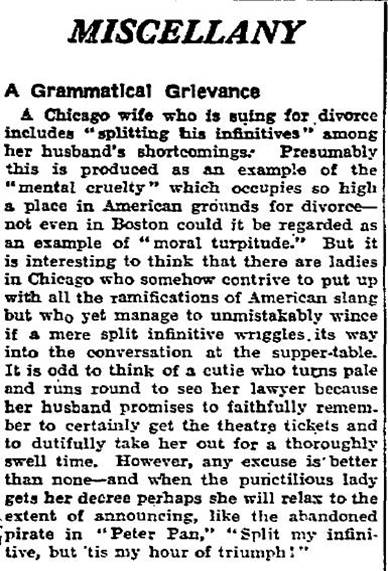
Letters to the editor (LTE) sections in historical newspaper databases are rich sources for investigating the language pedants’ pet peeves.  The split infinitive seems to be among the prominent causes for their perpetual discussions. A 1904 article in the Washington Post entitled “Shall the Infinitives do the Split?” reported on the debate on which the jury is still out, judging from the 21st-century LTE exchanges. Politicians, newspaper editors, and, famously, Star Trek screenwriters have been noted to boldly venture into the sphere of this disputed grammatical construction.

 The printed word has not been the only subject of criticism throughout the years. The 1931 Manchester Guardian article below reports on how the most meticulous language pedants keep their ears out for the matters of language even when it comes to pillow talk. Several decades ago, prior to the general legal acceptance of the no-fault divorce in the US, which today guards privacy behind the veil of “irreconcilable differences”, the petitioners relied on “cruelty” for assuring substantial grounds for their legal case. Apparently, split infinitives were reason enough for suing for divorce.

This humorous journalistic relic from the Prohibition Era might resonate well with some contemporary views on the split infinitive and the few (possibly a dying out species?) who, similarly to the British author, still hold the American slang to be primary evidence of the English language decline.


Posted in usage features | Tagged , , | Leave a comment

Strong verb questions

It seems we’re getting interested in strong verbs! Earlier on in this blog we reported on variation between snuck and sneaked, and on the use of went for gone, still quite common in eighteenth-century English but possibly on the increase in American usage today. And how about this one?

Page 152 of my copy of Frederick Forsyth’The Fourth Protocol (1984) reads

And then he had showed up in London.

Showed for shown? Is variation like this common in British English? Or is it a writer’s error, the famous author nodding? There are other strange usages, as on p. 261:

The garage was small and musty, but would serve his purpose admirable.

A flat adverb or a plain error? Perhaps nodding is not a bad epithet, for the book is dedicated Forsyth’s son,Shane Richard,

… age five, without whose living attentions this book would have been written in half the time.

Cute!

And here is another one (9 Feb 2014): Len Deighton’s Funeral Berlin has the following sentence on p. 266:

I had already began to fall back (1st edition, 3rd impression)

There was a typo a few pages further down: so is began a proof-reading error or a real variant?

Posted in usage features | Tagged , , | Leave a comment

Have went?

Several people in the attitudes survey I have been carrying out commented in their texts that they often hear have went and even see it written down sometimes. These people are all teachers, all in their late fifties, early sixties, but there was also one writer who said that she regularly used have went herself, and even at times preferred it to have gone because to her it means something different. This person, too, was a teacher, and one who is under thirty. All writers are American.

This is very interesting indeed: does it mean that have went is becoming more common, and is developing a different meaning from have gone? Could it be that this is a development taking place in American rather than British English?

If you google for have went, you get many hits to usage fora where the issue is discussed, such as one that is called englishforums.com. But what I’d like to know is if it is an issue that has been discussed in any printed usage guides already, or whether it is a new feature.

Read Viktorija’s comment on this post, and fill in the web poll on have went: Thanks!

.

Posted in usage features | Tagged , | 4 Comments