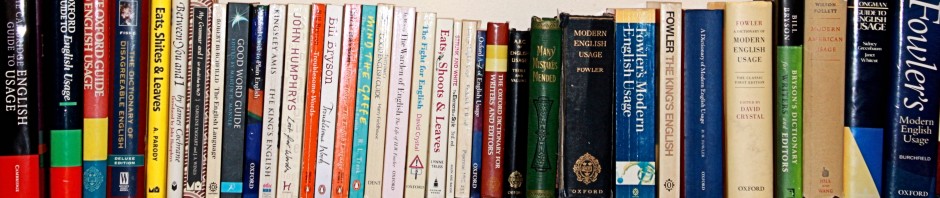
Linguists often debunk language prescriptions on the basis of their inaccuracy and their authors’ misunderstandings of linguistic concepts (see our comments on Heffer’s Strictly English). One of the most commonly confused and wrongly exemplified prescriptions is the one against passive constructions, the so-called passivophobia. Language Log’s Geoff Pullum, Mark Lieberman and Arnold Zwicky have diligently recorded and discussed many instances of the wrongly defined and exemplified passive constructions in the period between 2003 and 2013 in 72 blog entries (and counting). Pullum (2014) went on to publish a full-length article Fear and Loathing of the English Passive in the journal Language and Communication. Examples of passivophobia gone wrong include Michael Gove’s memo on letter writing:
Use the active, not the passive voice. Ministers have decided to increase spending on the poorest children. Poorer children are not having a harder time under this Government.
The BBC’s News Styleguide (2003):
There were riots in several towns in Northern England last night, in which police clashed with stone-throwing youths. Youths throwing stones clashed with police during riots in several towns in Northern England last night.
and the fourth edition of the Elements of Style (2000):
There were a great number of dead leaves lying on the ground. Dead leaves covered the ground.
None of the underlined sentences includes a passive construction. Existential clauses (There were riots…) in particular seem to be subject to wrong analyses.
Another type of an error found in prescriptive corrections runs even closer to the surface – the incorrection – a correction that includes a mistake itself. To explain how incorrections work John Bangsund (1992) of the Victorian Society of Editors in Australia introduced Muphry’s Law, the editorial application of the better-known Murphy’s law, which he defines in four points:
- if you write anything criticising editing or proofreading, there will be a fault of some kind in what you have written,
- if an author thanks you in a book for your editing or proofreading, there will be mistakes in the book,
- the stronger the sentiment expressed in (a) and (b), the greater the fault,
- any book devoted to editing or style will be internally inconsistent.
Here is an example taken from the recently published Style manual for amendments to bills of the UK’s Office of the Parliamentary Counsel and Cabinet Office spotted by a Twitter user:
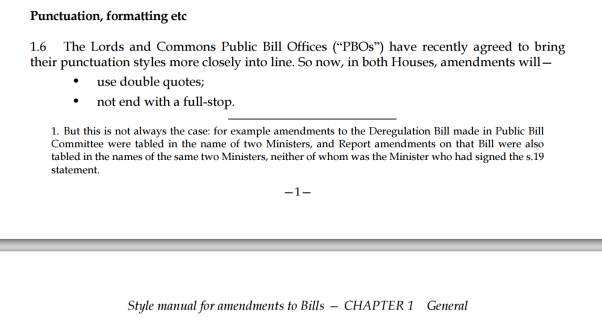
Many more examples are available if you look up #MuphrysLaw on Twitter.
 For more instances of prescriptive fallacies, you can tune into British Council’s YouTube channel and listen to the talk by Michael Rundell, editor-in-chief of the Macmillan Dictionary. He discusses the extreme prescriptivists’ lack of consideration for register variation, introduction of etymological and logical fallacies, and made up rules (including further discussion on passivophobia).
What are your favourite examples of prescriptive advice gone wrong?
Tell us in the comment section below!

 The former Education Secretary
 One important tool (or so I thought originally) to try and answer this question is the ten-page “Timeline of Books on Usage” in
  Bryan Garner’s Dictionary of Modern American Usage contains a lengthy list of works dealing with English usage, studies as well as usage guides. Very useful for our project! There is one item which I can’t quite classify offhand as belonging to either of these categories: English As She Is Taught, by Caroline LeRow (New York, 1887). There is a copy of the book for sale on eBay, but before I order it, I’d like to know if this is a usage guide or not.

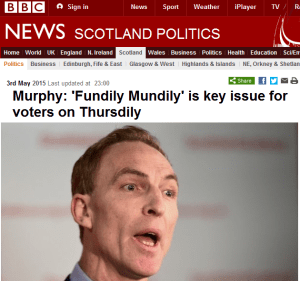 This election showed that politicians can also become linguistic innovators, sometimes inadvertently. The Scottish Labour MP Jim Murphy created the word fundilymundily while trying to pronounce fundamentally in a live BBC debate. Since then, an Up All Night caller claims, the word has entered common usage in Scotland. To check the life of this new word and the contexts in which it can be used, search for #fundilymundily on Twitter.


 Bridging the Unbridgeable