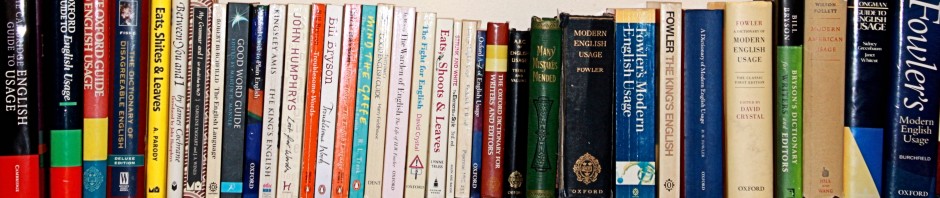
After Grammar Girl’s Top 10 Grammar Myths in 2010 and the Guardian’s 10 grammar rules you can forget three years later, linguist and author Arika Okrent joins the usage problem shortlisting club with her 4 Fake Grammar Rules You Don’t Need to Worry About.
Having read quite a substantial amount about usage problems and debunked grammar myths in the past three years, I have become somewhat used to seeing those so-called old-chestnuts pop up every now and again and being declared no longer problematic. Do not worry about the split infinitive! It’s okay to say to boldly go. This is the sort of English up with which you will not put. No wait. You will not put up with.
 While the split infinitive rule and the rule against preposition stranding can be found on all three lists, Okrent debunks two further, so far excluded myths on her list which attracted my attention. According to Okrent, there is nothing wrong about using they as a singular pronoun anymore. Read more on it on our blog here. The second “new” myth debunked by Okrent targets the use of hopefully as a sentence adverb. Ingrid Tieken wrote a blog post on the dying resistance of language pedants against its use, and included a poll which you are more than welcome to fill in.
Hopefully and singular they have been considered usage problems for quite some time now. A quick search in the HUGE database shows that singular they was first discussed in The Vulgarities of Speech Corrected published in 1826, while hopefully turns out to be a more recent usage problem which was first discussed in Wilma R. Ebbitt and David R. Ebbit’s Writer’s Guide and Index to English (1939). Nevertheless, it seems as if those two usage problems are gradually developing into old-chestnuts and joining the ranks of so-called shibboleths of language use such as the split infinitive and preposition stranding. Welcome to the club!
PS: My colleague is planning on reporting about this topic in more detail in our upcoming English Today feature.


 I’ve just finished going through the list of usage guide writers in
 I’m trying to find out who Kay Sayce is. I know she (he?) is the author of a usage guide called What not to write: A guide to the dos and dont’s of good English (2006). The book is included in the HUGE database. But I’d like to know more, such as what made her write the book? What else does she do besides writing a book this?
 And I have the same question for Ann Batko, who wrote When bad grammar happens to good people (2004). She appears to be an American writer, but I haven’t come across any other books by her or indeed any information at all. What I did find (in WorldCat) is that the book was translated into Chinese: yet another English usage guide! But this time a more modern one than Bryson’s. (See my post on
  WorldCat is a wonderful resource for our kind of work (though
 about the conversations about language’. In
  It is also peculiar that other situations in which such jokes are made mostly involve the same examples: literally and whom seem to be the favourites.
  I’m very proud to be able to announce the first substantial publication from the Bridging the Unbridgeable project: the papers from the workshop that preceded the Leiden Prescription conference, called


