Launched today, a new podcast by Linda Pillière, Morana Lukač and Ingrid Tieken-Boon van Ostade. Interested in prescriptivism and all it entails? Have a listen, and let us know what you think! There’ll be much more to come.

Launched today, a new podcast by Linda Pillière, Morana Lukač and Ingrid Tieken-Boon van Ostade. Interested in prescriptivism and all it entails? Have a listen, and let us know what you think! There’ll be much more to come.
The non-literal use of literally is a well-known usage problem in English, and has been discussed several times on this blog. A comparable discussion for Dutch once again hit the news, so it seems that the issue is ready to enter the arena of Dutch prescriptivism as well.

Those of you who are interested might like to watch our presentation during the ISLE Online Forum of 20 November, organised by Yoko Iyeiri – with great thanks to her for making it all happen. You will find the presentation here.
Hun and hen: these are third person plural pronouns in Dutch, but the distinction – hun for indirect object and hen for direct object – is hard to remember (for me it definitely is). And anyway, the distinction was only introduced by Dutch schoolmasters in the distant past who believed in the principle of one form – one function. The trick to remember is that hun comes before hen (in the paradigm: 3rd before 4th case) in the phrase hun hen “their duck”. There you go.
NRC, one of the more authorititave Dutch newspapers, has long been publishing so-called “Ikjes” on its back page: short, usually funny narratives written from a personal (i.e. Ik, “I”) perspective. I always read them first thing in the morning, so I can start the day with a smile. Last week, this one appeared (with apologies for non-Dutch speaking readers of this blog …):

Yesterday, Adrian Stenton obtained his PhD degree from the University of Leiden. His thesis is called These Kind of Words: Number agreement in the species noun phrase in International Academic English.
The thesis was published Open Access by LOT, and may now be freely obtained from their website, where you will also find a summary of its contents..
Well done, Adrian! This was also the last PhD thesis that was written in the context of the Bridging the Ubridgeable project. For all that, work on the subject will continue, so do keep following this blog.

August 1 is Yorkshire day and, right on cue, a link to a BBC news item about Yorkshire dialect arrived in a WhatsApp message from my daughter Alice, who lives in Sheffield: New signs drawn up after council apostrophe error.
The words ‘apostrophe error’ will be familiar to readers of this blog, but where this differs from most stories about punctuation prescriptivism is that the sign concerned was written in Yorkshire dialect. Next to a litter bin, North Yorkshire Council had placed a sign stating ‘gerrit in’t bin’, with a picture of litter discarded in the countryside and underneath, in standard English, ‘or take your litter home, ta’. The phrase ‘gerrit in’t bin’ includes two features of Yorkshire dialect: the spelling of what would be pronounced as a /t/ in RP as ‘r’ and the representation of ‘the’ as the letter ‘t’ with an apostrophe. Pronouncing ‘t’ as /r/ when a vowel follows is a feature of many varieties of English, but pronunciation of ‘the’, whilst not unique to Yorkshire, is perhaps the best known and most stereotypical feature of the dialect.
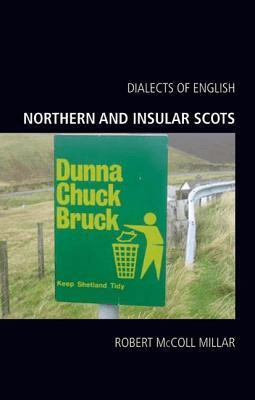
Why would North Yorkshire Council use a dialect phrase on its bins? Almost certainly to soften the authoritarian message about litter, invoke solidarity and raise a smile. A similar sign from Shetland stating ‘dunna chuck bruck’ appears on the cover of Robert McColl’s 2007 book on Northern and Insular Scots:
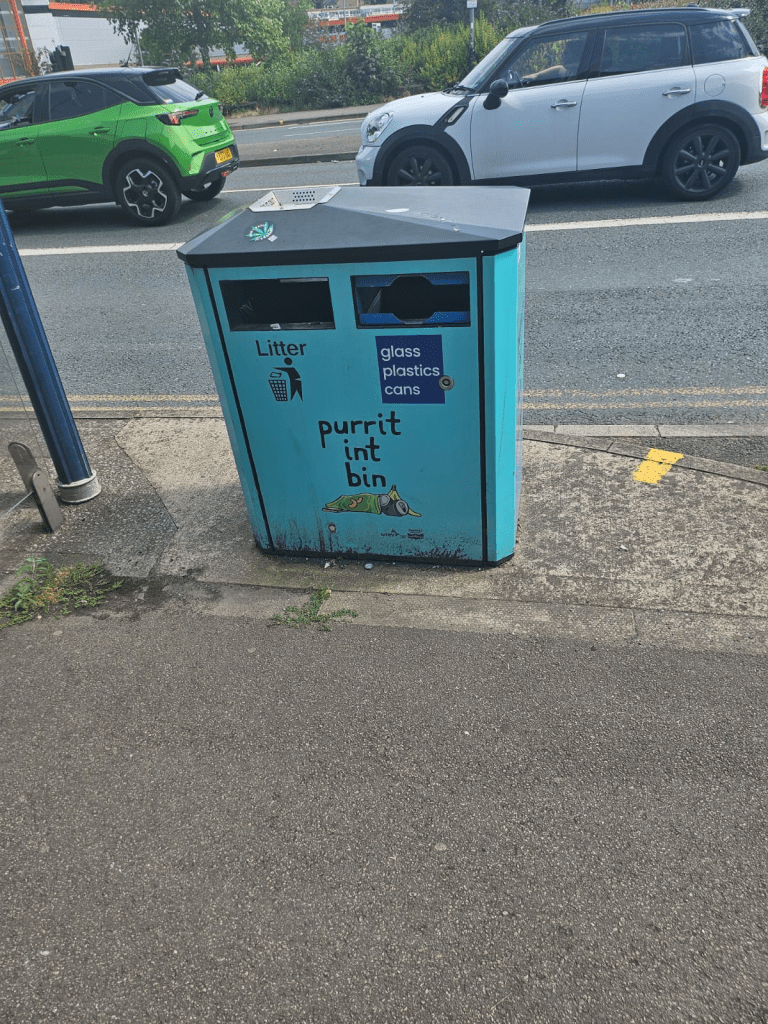
My daughter later sent me a photograph of a bin in Sheffield with a similar (though apostrophe-less) slogan ‘purrit int bin’. As the headline suggests, the furore in North Yorkshire was not about the use of dialect per se, but the supposed ‘apostrophe error’.
The BBC article, and a similar one the next day in The Guardian note that the ‘correct’ way to use the apostrophe in this instance would be to write ‘gerrit in t’bin’. But ‘correct’ according to who(m)? North Yorkshire Council’s spokesperson argued that they had seen spellings like ‘in’t bin’ in some dialect dictionaries, but that, on checking with the Yorkshire Dialect Society, they had been told that this was wrong and so had apologised and changed the downloadable versions of the sign. So they had consulted two authorities: dialect dictionaries and a dialect society, and had accepted the judgement of the latter.
The term ‘vernacular norms’ has been used in sociolinguistics since the 1980s, when Lesley Milroy argued that the close-knit networks of traditional working-class communities acted as mechanisms to enforce the norms of the local dialect. More recently, Barbara Johnstone has used the term to demonstrate how, in online forums focussing on local identity, some posters signal their authenticity by ‘feature dropping’, that is, including features of dialect in their posts. However, in these contexts, vernacular norms are enforced in a ‘bottom-up’ way, by the users of the dialect rather than the ‘top-down’ enforcement of norms by authorities.
In the case of the Yorkshire apostrophe, the problem arises because the dialect is written rather than spoken. In Yorkshire dialects (for there are several), the definite article is not pronounced as /t/ but as a glottal stop, or in some cases, not pronounced at all. As far as English grammar is concerned, the definite article goes before the noun, but in Yorkshire pronunciation, a glottal stop comes between ‘in’ and ‘bin’, so, in speech ‘in (glottal stop) bin’ would run together. In the Guardian article, Ian McMillan, aka the Bard of Barnsley, argues that apostrophes are unnecessary here: ‘If I was writing it I would miss the apostrophes out altogether. I would even write it as one word: gerritintbin’.
I’m writing this as several towns and cities in Yorkshire, as elsewhere in England, are clearing up after riots by far-right thugs who would question the right of certain groups to identify as ‘Yorkshire’. A row about apostrophes seems trivial in this context, yet it does raise some important questions about language, identity and authority.
Finally, another date for your diary. According to The Guardian, August 15 is International Apostrophe Day.
Filled with happy academic memories of the 7th Prescriptivism Conference organised by Linda Pillière and her team at the University of Aix Marseille towards the end of last month! The papers were all very interesting, the plenarists (Nuria Yañez-Bouza, Jane Hodson and Ian Cushing) very well chosen, and it was great to meet academic friends of long standing (in person once again) and to make new ones in the process. There are plans for publishing the proceedings (Multilingual Matters has already shown interest), and the next conference on the subject will be held in Brussels, to be organised by Rik Vosters and colleagues. Looking forward to it already!
One of the papers was particularly interesting from the perspective of the Bridging the Unbridgeable project. It only came on towards the end, so there was little time to exchange views and experiences, but it was fascinating to see how it drew on our HUGE database but dealt with styleguides rather than usage guides. These are text types which we took great care to distinguish in our project, not only because there are so many of them but also because they are expected to have exerted a different kind of influence on users and their language use. Style guides are used obligatorily, whereas usage guides are only consulted at the need of the individual user. There is nevertheless a great deal of overlap between them.
The style guide project is run by Holly Baker from Brigham Young University, and it owes a debt, she noted in her paper, to the HUGE database. It will also be freely accessible, she said and should already be available (if I remember correctly) by the end of next year. Her co-presenter at the conference was Liana Jankovich (not mentioned on the conference programme, but apparently a student from Brigham Young University as I found by googling her), who presented some preliminary results from an analysis of the use of metalangistic terms in the database. I expect considerable overlap with data on this subject from usage guides (see my book Describing Presciptivism, chapter 6) or from normative grammars from the eighteenth century, which is where the roots of prescriptivism can be found (see The Bishop’s Grammar, chapter 4). So I’ll be following this fascinating project with great interest!
Just out, I wrote earlier today, New Horizons in Prescriptivism Research, and in it there is an article I wrote on the exploitation of who/whom as a usage problem in popular culture: television series, films, popular novels. And here is another one, with as many as two references to the issue in Richard Osman’s novel The Thursday Murder Club (2020), once in the main text (“Who did what to who? Or is it, Whom did what to who? Either way …”, p. 237) and the second time in the Acknowledgements (a jab at the author’s copy-editor about correcting who/whom errors, p. 381). What is it with the who/whom issue? Is it a particular but within popular culture because people are insecure about what it should be? I’d have thought that nobody could be bothered about it any more, because our usage poll shows that who for whom is barely considered unacceptable any more. So what is going on here? (If you want to read more about the who/whom issue, have a look at my newly published paper.)
To be fair, there is one other usage problem in the book, on the use of me for I, which one of the characters, a sloppy police constable, is corrected for, five pages down from the who/whom comment (p. 242). Why only there? Or was the author havng it out with his copy-editor?


 Bridging the Unbridgeable
On Richard Osman and his editors
So I’ve finally read them all, all four of Richard Osman‘s The Thursday Murder Club crime novels. Not in the order in which they were published, due to their availability in our public library (so that in the end I actually bought three of them). I do recommend reading them in their order of publication though, so first The Thursday Murder Club (2020) itself, as it presents the main characters, followed by The Man who Died Twice (2021), The Bullet that Missed (2022) and The Last Devil Today (2023). They probably could be read independently, but there is a continuing line of storytelling, and the final novel neatly and sadly wraps the whole series up.
As I wrote elsewhere on this blog, I find it impossible to read without a pencil, especially when I come across metalinguistic comments relating to prescriptivism (and this blog). And yes, I found them in Osman’s novels, too. On the who/whom issue in the very first of them, for instance, or on I/me and got for have in the last one I read (The Man who Died Twice).
The comments all make sense, as making linguistic corrections is in line with the character of Elizabeth, former MI5 agent, but reading the Acknowledgements (as I always do) made me think that something else is going on. In all except for the closing novel Osman pays thanks to his editors, Trevor Horwood (twice, for the first two) and Natalie Wall (for the third) for pointing out particular linguistic strictures to him and (presumably) making him correct his language accordingly:
That last comment makes me wonder whether Natalie Wall is perhaps American, even though she appears to have been part of the UK publishing team? See p. 420 of novel number 4, which, surprisingly at this stage, contains no linguistic thanks to his editors (I looked three times).
What does all this mean? To me it suggests that Osman was playing a linguistic game with his editors, who may have pointed out particular linguistic infelicities (I find it striking, for instance, to find what looks like a deliberate split infinitive in the acknowledgement to Natalie). It may even be the case that he put in particular covert metalinguistic comments in his novels, just to make the point that in his eyes such criticism was trivial. And that by the fourth novel he had tired of the game, and chose not to comment on the linguistic editing process any more.
There won’t be any more Thursday Murder Club crime novels, it seems, but the good news is that the series is being adapted into a Netflix film, with Helen Mirren being cast as Elizabeth, Pierce Brosnan as Ron, Ben Kingsley as Ibrahim and Celia Imrie as Joyce. What a cast, and what a film to look forward to. Needless to say, I’ll watch with pencil and notebook at hand to see whether any of the metalinguistic comments made it into the script.
[Thank you Lyda, and Joan for confirming this, for commenting that “earlier this year Osman announced on FB that the series’ fifth book will be coming next year”. Will be hugely looking forward to it, and also to see if Richard Osman will continue to haggle with his editors over issues of prescriptivism.]
Share this: