Wikis and usage advice

You have surely concluded from our recent polls that we are interested in your favourite online sources on language use. After receiving a large number of different answers from you when asked about your go-to online sources, I noticed that some people rely on wikis when it comes to language advice.  Therefore, I decided to look into a few different formats of advice giving on these user-generated sites. WikiAnswers is the leading Q&A website in the world: it comes in really handy if you need to get quick answers to questions such as: Is it okay to end a sentence with a preposition? or Can you use ‘literally’ in a sentence? If there are several similar questions and answers, the alternatives are listed under the entry. Contributors are awarded ‘trust points’ or badges which makes participating on this wiki site a fun experience. WikiAnswers is an ad-supported website, which might distract you from your strictly linguistic interests which brought you here in the first place.

literally

da

Wikipedia, the most widely used and the best known wiki, provides users with a good overview of the discussion on a particular usage item in which they are interested. Aside from a definition as a quick way in, the readers are often presented with histories of disputes, famous examples from popular culture, linguistic analyses, examples from different languages, etc. If you are interested in the wider context and the origins of the respective dispute, Wikipedia makes a good starting point.

Finally, wikiHow is the visually most attractive of the three websites. This how-to website uses step-by-step explanations and guidance on how to use ‘who’and ‘whom’ correctly, improve your grammar, and choose between ‘I’ and ‘me’.

With the number of examples, tips, and external sources, wikiHow is a goldmine for teachers, students and learners of English. Remember, if you think that the answers, accounts or the advice are not up to date, you can always edit and join the growing wiki community.

Posted in technology, usage guide | Tagged , , , | Leave a comment

Attitudes to usage: a thought experiment

Imagine you’re sitting at a big table as part of a large group of people. It could be a cafe, it could be a restaurant, it could be a meeting at work. Some of the people at the table are your friends, some of them are acquaintances or colleagues, and there are some that you haven’t met until that day. Everybody is talking, various conversations are going on, and you can hear each of them with perfect clarity. Then someone makes a grammatical mistake.

table

What are your motives for choosing any of these three actions? Does it matter whether it was a friend, an acquaintance/colleague or a stranger who made the mistake? What about if it had been on a semi-public space on the internet such as a forum, chatroom or social media site?

Please send us your ideas in the comments!

Posted in polls and surveys | Tagged , | 7 Comments

Just out!

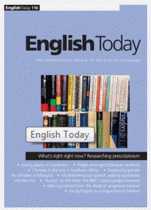
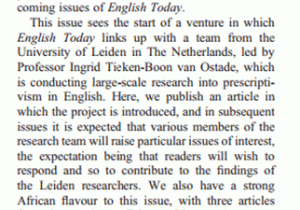
ET editorial Dec 2013This is how Clive Upton, editor of English Today, announces the start of our new regular feature in English Today. We are very happy with the opportunity offered to us by the editors of English Today, and hope to receive a lot of feedback from readers, also about what language topics you would like us to deal with in subsequent issues. We hope to make this into a truely interactive event.

Feel free to leave suggestions and comments by replying to this post. We will look forward to receiving them.

The issue’s cover is lovely, as usual.  Our regular readers will readily identify the image! The picture was made by Robin Straaijer.

Posted in news | 1 Comment

Soda, Pop, Coke – Ways of investigating language variation

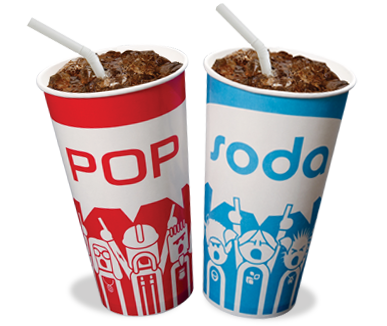
Soda, pop or coke?

As I am preparing for my fieldwork, which I will be conducting in early 2014 in and around London, I am looking into ways of investigating language variation and usage attitudes in general. Usage attitudes in particular are a very delicate issue which needs to be addressed  carefully. Whether you believe it or not, asking someone directly for his or her opinion, belief or attitude may not result in an honest answer. That is why, you have to be creative and find ways of how you can ‘deceive’ people and more or less trick them into giving you their true attitudes, without any ‘social-desireablity’ strings attached.

Folk linguistics, a field of sociolinguistics, has made use of dialect maps in order to identify dialect boundaries. Even though I am not going to investigate dialects, I think that this method allows you a glimpse into actual language use and beliefs about languages.

In 2003 professor Bert Vaux and Scott Golder conducted the Harvard Dialect Survey and investigated American dialects. The original questions and dialect maps can be found here. The survey proved to be popular and it now has been partially recreated by The Atlantic, which shows how linguistic research can easily be made availablet to and understandable for the general public.

Although the dialect survey was completed a decade ago, Vaux has now started to collect data for his new study on World Englishes, in which you can still participate.

Asking questions such as “What is your generic term for a sweetened carbonated beverage?” is most probably not getting your informants in the dilemma of giving an answer which they think is the socially acceptable or desired one.  Issues such as social desirability need to be borne in mind when conducting research. Yet, you will never know what people really think and use, if you don’t dare to ask.
Oh, and for me it would be a coke please!

Posted in Uncategorized | Tagged , , , , , , | Leave a comment

Jeremy Clarkson on car journalists and “generic he”

Jeremy Clarkson, Source: www.topgear.com

Jeremy Clarkson (Source: http://www.topgear.com)

Jeremy Clarkson, whom many of us might know from the British television show TopGear, in his column of October 2013 worries about things other than cars.

Right. What could that be? you might think.

Well, from the outside, most of his text indeed seems to be about “the Maserati Quattroporte” (which is the title of his column) and objects from similar categories (he also refers to Audi Q5s, Rolls-Royce Phantom Coupés, and to “Elton John’s piano” to modify his comment on the Rolls-Royce).

But in addition Clarkson interestingly also briefly refers to the topic of sexist language as he discusses the role of the car journalist back in 1932:

“So the job of the car journalist was valuable. He – I was going to say “or she” at this point, but I don’t think it’s necessary – would puff on his pipe, listen to the engineer explaining why he’d mounted the propshaft to the steering column, and then write a long review of whether or not the solution had worked. These were the days before oversteer became the be-all and end-all of motoring journalism.” (Topgear Magazine, October 2013)

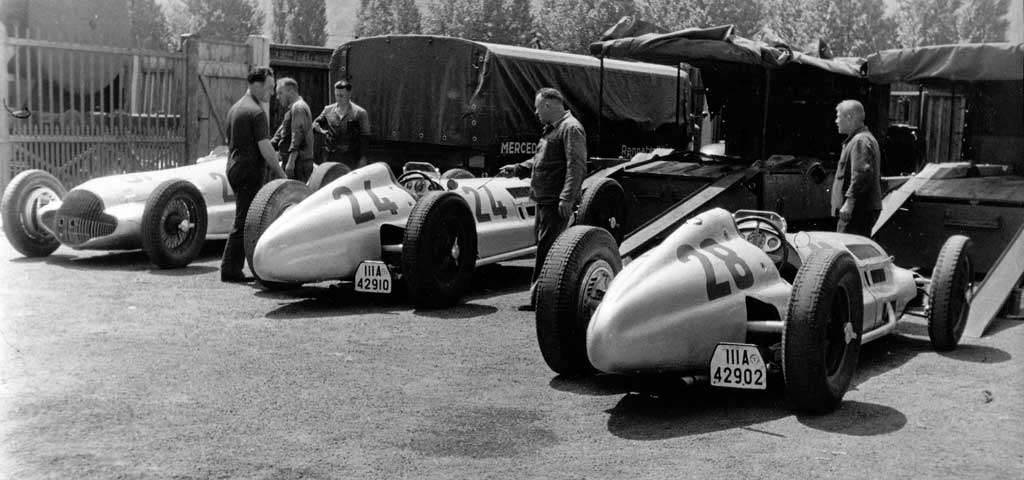
Mercedes-1930s-race-car-carrier-6

Mercedes racecars from the 1930s (Source: http://www.zercustoms.com)

Nowadays people think it is essential “to use language which implicitly or explicitly includes both men and women and makes no distinction between them” (Butterfield 2007: 67) when they refer to for instance a student, a client, a person; or, in the case of Clarkson, to a journalist. Saying “Each student should keep his fingers crossed” is currently regarded sexist language by many people.

Clarkson, in his column, jokingly tries to provide the reader with a sketch of a stereotypical car journalist from the 1930s, but as the dashes show he interrupted the process of writing. The TopGear presenter admits that he had to consider using the gender-neutral pronoun “he or she” rather than “generic he”. By explicitly writing down his hesitation, Clarkson shows that he is aware of the usage problem of sexist language. Still, he decides to go with “he” because using “he or she” would be problematical for the image he intends to create of this stereotypical 1932 car journalist.

After having read Clarkson’s column, I realise that I still know absolutely nothing about cars, but for some reason I would love to know more about car journalists that worked in the 1930s. Would you know whether there existed any female car journalists back in those days?

References:
Butterfield, Jeremy (ed.) (2007), Oxford A-Z of English Usage. Oxford: Oxford UP.

Posted in usage features, usage guide | Tagged , , , , , , , , | Leave a comment

Usage problems, usage questions?

In the under-water screen to this blog, we can see how (new) people got to our blog, what they are interested in, and also what they are seeking usage advice on. The most frequent usage questions that people have recently been consulting Google about – and were thus directed to us – were thusly, the question of whether it should be healthy or healthful and whether focussing should have one s or two. (I never know this myself either, but what I do know is that I’m not happy with Microsoft Outlook’s autocorrect function. We have written about this in the blog, too.). John Honey has been a popular topic in the past as well, so we know that there are many people who are interested in this controversial linguist,

We do not know though, what other questions people want to have usage advice on or what they are seeking information about, because if we haven’t written about it, they won’t find their way to the blog. But a lot of other people read the blog as well, so what I’d like to know is whether they are ever uncertain about features of usage and what these features are. We’d like to know because we’d like to study them and we’d like to be able to write about them, so please tell us!

Posted in usage features | Tagged | Leave a comment

Traditional and contemporary furniture

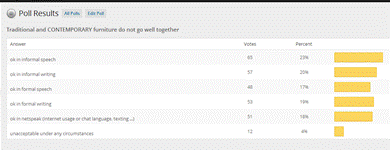
One of our readers asked about the collocation of traditional and contemporary, as in the example above. The question was item 4 in our first usage poll, which we carried out a while ago (but which is still open). It was based upon the survey presented by Mittins et al. in Attitudes to English Usage (1970).

Mittins et al. write that the perceived problem about the use of contemporary is that the word originally meant “at the same time, whenever that time might be”, and that the word was increasingly used in the sense of “present-day”: traditional and modern furniture is what the example sentence would be intended to mean (p. 29).

The Mittins survey showed that at the time, the new use had an acceptance rate of 70%, and this trend is confirmed by our own survey: our poll had 286 votes (multiple votes were possible), and only 12 people (bottom row) considered it “unacceptable under any circumstances”. So the linguistic collocation is probably as acceptable today as the stylistic one!

Usage poll view

Usage poll view

Posted in usage features | Leave a comment

Mini-exhibition on Sir Ernest Gowers

National Portrait Gallery

There have been various posts in this blog on Sir Ernest Gowers (1880-1966), one of our major usage guide writers, so high time for a mini-exhibition showing some of our finds, as well as illustrating his legacy as the writer of (ultimately) The Complete Plain Words (1954) and the editor of the second edition of Fowler’s Modern English Usage (1965).

Come and visit the exhibition on the second floor of the English department at Leiden, and read Carmen’s blog post on Gowers if you want to read more than just the wikipedia entry.

Posted in news, usage guide | 2 Comments

Between you and I in a 17th-century love story

Cusack (1998)

Reading a selection of journal entries in Bridget Cusack’s Everyday English 1500-1700 (EUP, 1998) I came across what we classify as between you and I in one of the texts, and not once but twice. The writer of the journal is Roger Lowe, a sympathetic young man from Lancashire who records his love for Emma Potter in the journal (and a lot of other things besides). Roger, according to Cusack, was a shopkeeper’s apprentice, and both numerate and literate. So much so that he was regularly called upon to write “wills, letters, accounts and presentments for his fellow-villagers” (p. 178).

Here are the instances:

  • and he enioind old William Hasleden and I to come to Rothwells which we did (ll. 15-16)
  • William Sixsmith would needs have John Moodij and I ride be hind hime which we did (ll. 61-62)

The story of his wooing of Emma doesn’t end in the three weeks that are recorded in Cusack’s selection of entries, but I do hope they lived happily ever after!

Posted in usage features | Tagged , , | Leave a comment

Thusly now a word?

One of the things that struck me is that many readers of this blog seem to have found their way to us as a result of searching the internet for the word thusly. The blog statistics for today, for instance, showed that the earlier blogpost by Cynthia Lange on thusly was the second most frequently read post (it has been up for eighteen months already). Googling for the word myself showed that our blog comes up fourth in the results list, which would be part of the explanation.

But what makes people want to look up the word to begin with? Is thusly perhaps developing into a new usage item? If so, I’d be very interested to hear what makes people want to use it rather than thus if its status is indeed disputed.

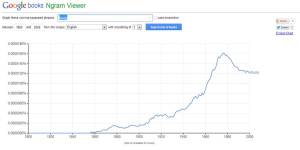
Checking its frequency of use with the help of Google Ngram viewer shows that the use of thusly has greatly increased since the 1960s, reaching a peak shortly before 1980. The drop that followed wasn’t very great, and it looks as if it is there to stay. Is this considered a problem? What do text writers and editors think?

a search with Google Ngram viewer

a search with Google Ngram viewer

Posted in usage features | Tagged , | 6 Comments