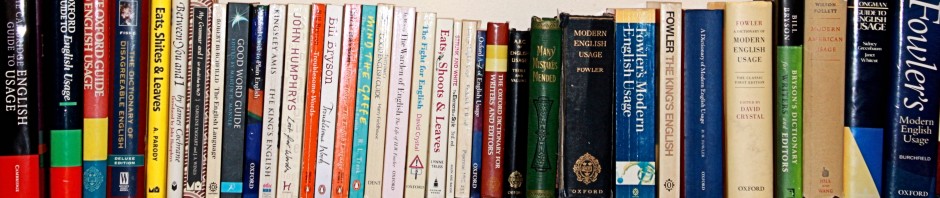
Back to school: buy Fowler

I was just forwarded an email from OUP USA which announces a Back to School 2013 offer of a 65% reduction on book prices.

back to school

The list of books on offer include Fowler’s Modern English Usage, at half-price, which is good, but in a section “Expand your Vocabulary” (??).  Never mind: an interest in Fowler is stimulated, which is interesting to see from the point of view what we are doing in this project. But the advertisement does raise the question, already put before in this blog, as to who uses Fowler, and what for. So tell us, teachers:

  • did you put Fowler on your students’ buying lists?
  • if so, why did you choose Fowler rather than another usage guide?
  • will you use Fowler in your teaching, and if so how?
  • do you expect to see any effect of students consulting Fowler in their writing skills? Have you found this already?
  • (does “school” mean secondary education, university education?)

And students:

  • will you buy Fowler? and how do you expect to profit from it?

We would really like to know!

Posted in news, usage guide | Tagged , , , | 2 Comments

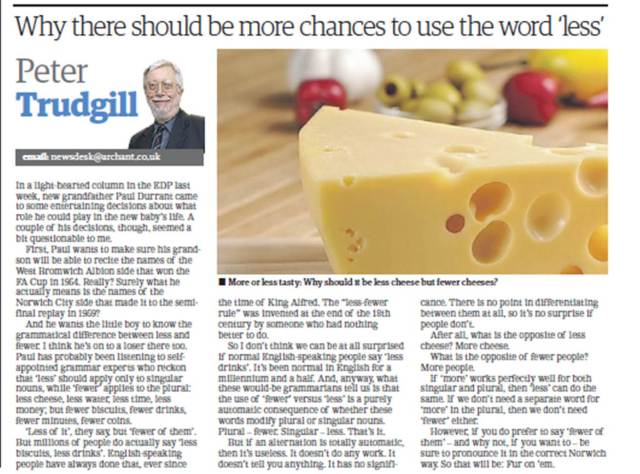
Peter Trudgill on less and fewer

Reading students’ papers this summer, I kept stumbling over their use of less for fewer. But it is not a typically Dutch error (as I have to see it in my role as their teacher), nor is it new. For a paper I’m writing for the 5th late Modern English Conference at Bergamo, later this month, I analysed a very early American usage guide, 500 Mistakes of Dayly Occurrence (1856), and the problem is already included there. I still have to check our HUGE database to see if earlier occurrences can be found, but I wouldn’t be surprised if they do.

Interestingly, Peter Tudgill, too, recently paid attention to the issue, in a column he wrote for the Eastern Daily Press (22 July 2013). It should be just readable in the image he allowed me to reproduce here. Comments welcome, as usual.

Peter Trudgill on less and fewer


Posted in news, usage features | Tagged , , , | 6 Comments

Edmund Weiner and English usage guides

Oxford guide to English usage

We probably all know Edmund Weiner  as one of the editors of the Oxford English Dictionary. But he is also the writer of a usage guide: The Oxford Guide to English Usage. The book first came out  in 1983, and a second edition came out ten years later, revised jointly with Andrew Delahunty.

What is perhaps less well known is that Weiner is also the author of an article on usage guides as a text type. It was published in a festschrift for Robert Burchfield (1988), who was also linked to the OED and who also published a usage guide, Fowler’s Modern English Usage (1996). Weiner’s article is one of the best I have read on the topic. It proceeds from his own experience as a writer of usage guides, but it provides an excellent classification of usage problems an also suggests reasons why particular usages become usage problems and thus gain admittance in usage guides. A very worthwhile study on the topic.

Reference:

Weiner, Edmund (1988), “On editing a usage guide”. In: E.G. Stanley and T.F. Hoad (eds), Words. For Robert Burchfield’s Sixty-fifth Birthday. Cambridge: D.S. Brewer. 171-183
.

Posted in usage guide | Tagged , , | 3 Comments

Class in British society

Mirror News

In relation to my research on John Honey, I’ve decided I need to read more on the British class system. Joan Beal already told me about the discussion on the subject in VariationList (thanks to which I read John Rickford’s article on class in sociolinguistics, from 1986). Joan also suggested Ivan Reid’s book Social Class Differences in Britain, which I now have open in front of me, but I’d like to know a more general, perhaps historical (?) work on class.

Any suggestions please?

Posted in Uncategorized | 2 Comments

The world’s worst written sentence

Consider the following sentence:

“Yet the nightmare cast its shroud in the guise of a contagion of  a deer-in-the-headlights paralysis.”  

According to columnist at The Economist, the above sentence would qualify to be nominated as “the world’s worst written sentence”, yet, believe it or not, there are worse. (Read the Economist column to find out more.) So what is wrong with the above sentence?

From a grammatical perspective the sentence is perfectly fine. What seems to bother people such as the columnist are stylistic issues. Without doubt, style can be a tricky subject. That is why, newspapers, TV networks and several magazines developed their own style guides. Nevertheless, one would still think that writing is, above all, a creative process. Conforming to rules regulating and restricting this creativity, thus, sounds a little odd.
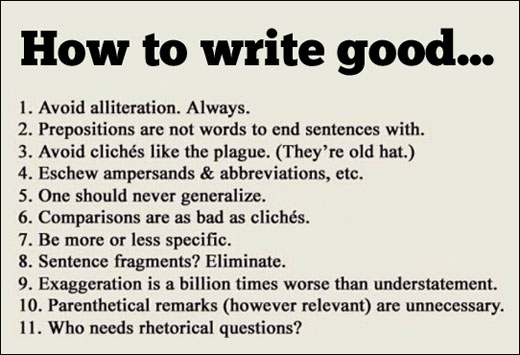
Fun with writing rules

What plays a crucial role in this matter is the genre. Certain expectations are triggered by knowing the genre of movies or books for example. A comedy would not be considered a comedy if laughter and humour were not involved. A crime novel would not be considered as such if no crime was committed. That is why, knowing that the so called “world’s worst written sentence” was penned by an author and academic of economics and can be found in a book on the economic crisis sheds a different light on the sentence.

The column seemed to have caused quite a stir as Mark Liberman, linguist and Language Log blogger, investigated the Economist’s own language use. Another column by the Economist on the issue of style followed. Reference was made to George Orwell‘s rules on writing which were first seen as the remedy for stylistic issues such as the “world’s worst written sentence”.

(i) Never use a metaphor, simile, or other figure of speech which you are used to seeing in print.

(ii) Never use a long word where a short one will do.

(iii) If it is possible to cut a word out, always cut it out.

(iv) Never use the passive where you can use the active.

(v) Never use a foreign phrase, a scientific word, or a jargon word if you can think of an everyday English equivalent.

(vi) Break any of these rules sooner than say anything outright barbarous.

Having been presented with the Economist’s own use of metaphors and stylistic “flaws”, the columnist revised Orwell’s six little rules. Eliminating all instances of never and always results not in language rules, but in valuable advice. Something worth bearing in mind is revised rule no. 6.:

(vi) Good writing is no place for the tyrant. Never say “never” and always avoid “always”, or at the least handle them with care. Overusing such words is an invitation for critics to hold you to your own impossible standard.

Another piece of advice: Keep creativity alive and carry on.

keep-creativity-alive-and-carry-on-1

Posted in Uncategorized | Tagged , , , , , , | 1 Comment

The history of txt spk and Queen Victoria

For years the language of instant messaging or text speak (txt spk) has been targeted in the popular media as hard evidence of the ongoing decline in literacy. In 2003, The Daily Telegraph published an article about a 13-year-old girl who allegedly wrote an English essay in txt spk shorthand, which baffled her teacher. The article stated that the girl’s essay began with the sentence:

“My smmr hols wr CWOT. B4, we usd 2go2 NY 2C my bro, his GF & thr 3 :- kds FTF. ILNY, it’s a gr8 plc.”

Translation: “My summer holidays were a complete waste of time. Before, we used to go to New York to see my brother, his girlfriend and their three screaming kids face to face. I love New York, it’s a great place.”

In a 2007 article for the Daily Mail, John Humphreys compared txt spk “vandals” with Genghis Khan, and accused them of “pillaging our punctuation; savaging our sentences; raping our vocabulary.” Other accounts of the ongoing moral panic caused by the vile instant messaging shorthand are numerous.

For years, scholars have been challenging such widespread txt spk misconceptions. One of the leading scholars in this field is David Crystal, who gave a number of talks and wrote a book “Txtng: the Gr8 Db8” in an attempt to dispute the myths of the new communication technologies.

Contrary to the popular beliefs, Crystal claims that the language of instant messaging does operate according to rules, many of which have existed for decades or even centuries. According to Crystal “Texting may be using a new technology, but its linguistic processes are centuries old.” This claim has recently acquired a new dimension, with the uncovering of 20 notes hand-written by Queen Victoria in the last four years of her life.

The letters addressed to Victoria’s Commissioner at Balmoral, James Forbes reveal the Queen’s fondness for using abbreviations such as “wh” for “which”, “shd” for “should”, “abt” for “about” and “wd.” for “would”. Spokesman Andrew Currie commented: “The writing is quite untidy and the abbreviations are interesting — a sort of early form of texting that suggest Queen Victoria was 100 years ahead of her time.”

This fascinating collection soon to be auctioned off is definite proof of Queen Victoria’s fondness of shorthand and rebuses alongside many of her contemporaries, among them the celebrated author Lewis Carol. Such historical finds again show what linguists have been claiming for years: instant messaging shorthand is hardly a novelty, it has existed for centuries, and it has always been limited to a specific context and/or medium.

2b or not 2b David Crystal

Posted in technology | Tagged , , , , | 1 Comment

Who was Sir Ernest Gowers?

While browsing in one of the many second hand bookshops in Scotland, I came across a familiar name: Sir Ernest Gowers.

Gowers, known for his revision of H.W. Fowler’s Modern English Usage, also published other reference works such as the gem which I can now proudly call mine: The Complete Plain Words, a combination of Gowers’s Plain Words and The ABC of Plain Words. Intrigued by my new acquisition, I wanted to know more about who Sir Ernest Arthur Gowers was and why he was entrusted with the revision of Modern English Usage.

Gowers working as public servant during war

Gowers (1880 -1966) worked and gained an excellent reputation as a public servant chairing numerous associations and commissions in England. His impressive career as a public servant, however, struck me as odd, yet fascinating, having known Gowers only for his revision of Fowler. So what was it then that made him qualified for taking on the revision of Fowler’s Modern English Usage (MEU)?

The Complete Plain Words

The Complete Plain Words

According to the Oxford Dictionary of National Biography (Gowers’s entry was written by none other than Robert W. Burchfield, author of the third revision of MEU), Gowers’s writing style of simple and unambiguous English procured him, first of all, with the task of writing Plain Words as an introduction for new members of the public service in 1948. The immediate and international success of Plain Words put Gowers finally on the map and a sequel The ABC of Plain Words was published in 1951. Since Gowers’s work showed great influence of Fowler, Oxford University Press entrusted Gowers with the revision of Fowler’s Modern English Usage, which he completed at the age of 85.

Gowers’s attempt to promote plain English and to eradicate “officialese” can be seen in the following extract from The Complete Plain Words.

     The basic fault of present-day writing is a tendency to say what one has to say in as complicated a way as possible. Instead of being simple, terse and direct, it is stilted, long-winded and circumlocutory; instead of choosing the simple word it prefers the unusual, instead of the plain phrase the cliché. (Gowers, 1954: 47)

The previous post on the blog discussed the 10 golden rules of Education Secretary Michael Gove, who aimed at doing the same. Whose advice is more useful is a verdict left for the readers to decide.

Posted in usage guide | Tagged , , , , , , | 1 Comment

Would your mum understand?

Michael Gove, Secretary of State for Education

In the past few months, Education Secretary Michael Gove, a former journalist, has hit the front page with his plans to introduce new grammar and spelling tests in UK schools. Now he is back in the headlines:

Would your mum understand it? Michael Gove bans jargon in education department“, “Gove’s golden rules for writing: can you do better?“.

These headlines announce Gove’s new venture of banning jargon from the department’s correspondence and giving advice on how to write properly by introducing 10 golden rules:

1.   If in doubt, cut it out.
2.   Read it out loud – if it sounds wrong, don’t send it.
3.   In letters, adjectives add little, adverbs even less.
4.   The more the letter reads like a political speech the less good it is as a letter.
5.   Would your mum understand that word, phrase or sentence? Would mine?
6.   Read the great writers to improve your own prose – George Orwell and Evelyn  Waugh, Jane Austen and George Eliot, Matthew Parris and Christopher Hitchens.
7.   Always use concrete words and phrases in preference to abstractions.
8.   Gwynne’s Grammar is a brief guide to the best writing style.
9.   Simon Heffer’s Strictly English is a more comprehensive – and very entertaining –     companion volume.
10. Our written work should be the clearest, most elegant, and most enjoyable to read of any Whitehall department’s because the Department for Education has the best civil servants in Whitehall.


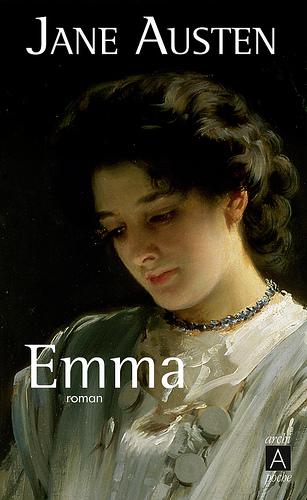
In my opinion some of the rules, in particular rule no. 6, sound a bit far-fetched. Reading Jane Austen and George Orwell will definitely have a positive influence on one’s literacy and education. Yet, Jane Austen’s Emma and a formal letter from the department of education are two completely different text types.
What do you think? Are Michael Gove’s 10 golden rules helpful?

Posted in Uncategorized | Tagged , , , , | 7 Comments

Does Only spelling Matter? A Word from the Creator of the Text of the Dutch Spelling Contest

Kees van Kooten

Kees van Kooten

Yesterday the Volkskrant introduced the composer of the text of the 24th edition of the Grand Dictation of the Dutch Language (het Groot Dictee der Nederlandse Taal), a Dutch spelling contest that is scheduled to be broadcast on 18 December 2013. Kees van Kooten, a 71-year-old Dutch comic and writer, will be in charge of writing the Dictation.

Van Kooten is planning to write something entirely different than his predecessors, because he believes that up until the present day contestants could get high scores by simply learning by heart the contents of the Green Booklet (het Groene Boekje) ­- a booklet with a green cover (hence its name) containing a list of words in the official spelling of the Dutch language.

According to the Volkskrant, Van Kooten is not particularly annoyed by incorrect spelling, however, but by language use that yields confusing results. Mistakes concerning reflexive verbs and prepositions can especially make the Dutch language ugly, in Van Kooten’s opinion.

A question that comes to mind is to what extent Van Kooten’s remarks are relevant in the context of the Dictation – for even though he might really believe that correct grammar is at least as important as correct spelling, the contestants in the Dictation will be dictated a grammatically correct text, which they will only need to write down. They will not be asked to produce grammatical constructions themselves.

Despite Van Kooten’s remarks, it seems that participants in the Dictation will not need to worry.  As usual, they can turn to the Green Booklet to learn that nepopenhaard (i.e. fake fireplace) is spelled in one go, whereas haute-couturewinkel (i.e. high couture shop) requires a dash, and Koningin Beatrixestafette (i.e. Queen Beatrix relay race) requires a space – so far, their grammar skills are nog yet tested.

Het Groene Boekje

Het Groene Boekje

In case you would like to test your Dutch spelling skills – to find out whether you need to practise for the contest – you could give this 2-minute test a try!

Posted in Uncategorized | Tagged , , , , , | Leave a comment

Punishing Princes Street

Edinburgh’s Princes Street is a true shopper’s delight. Its countless shops and stores make the hearts of shopaholics beat faster and credit cards moan even louder. Yet, it is not all sunshine and roses down Princes Street. Grammar – or to be more accurate – punctuation sticklers are unhappy about a simple “squiggle”: the missing apostrophe in Princes Street.

Apostrophe Vigilante

The Apostrophe Vigilante is on the beat to pinpoint missing or incorrect apostrophes and encourages the general public to report any evidence of crimes committed against proper punctuation. According to this article in the Independent, measures have been taken to demand correct punctuation by re-establishing the street’s old name: Princes’ Street.

Princess Street

Named after King George III’s two eldest sons, Prince George and Prince Frederick, Princes Street lost its apostrophe sometime in the 1830s much to the displeasure of those observing correct punctuation. This new punctuation watchdog is a fine example of how social media is increasingly used to advocate accurate punctuation and correct grammar. So in case you witness any crimes committed against punctuation while strolling down your favourite shopping street, you have the right to either send in a snap-shot to the Apostrophe Vigilante or to remain silent and keep on enjoying the latest trends and gadgets.

Note: Any crimes committed against punctuation in this post are done so unknowingly and the author is more than grateful to learn and eradicate mistakes.

Posted in usage features | Tagged , , , , | 1 Comment